

Why Your Campus Might Be Missing a Critical Piece of the Safety Puzzle
“How can we make our campus feel safer at night?”
“What’s the best way to improve emergency response time in open spaces?”
“Are blue light poles outdated, or are there smarter versions now?”
These are real questions being asked by security teams, IT directors, and facilities managers across the country. And with good reason.

Don’t Wait for the Next Outage
Tell us about your campus—we’ll match you with a solution architect.
The Problem: Public Spaces Are Vulnerable
Whether it’s a university, hospital, downtown district, or transportation hub—open spaces come with blind spots. You can have great surveillance inside buildings, but once people step outside, the ability to call for help or be seen can drop off fast.
And in moments of crisis—poor lighting, no cell service, or unclear wayfinding—those gaps can become liabilities.
Visible, connected technology like blue light poles can be part of a broader CPTED strategy—designing public space in ways that actively deter crime.
The Old Solution: Static Emergency Phones
According to the FBI’s campus safety data, crimes near dorms, garages, and walkways still pose a major concern for universities. For decades, blue light emergency phones offered a way to call 911 with a push of a button. But let’s be honest—they often fall short:
Many aren’t connected to a live network.
Maintenance is a nightmare.
They don’t integrate with modern systems like real-time video, alerts, or location tracking.
And worst of all, people don’t trust that they even work anymore.
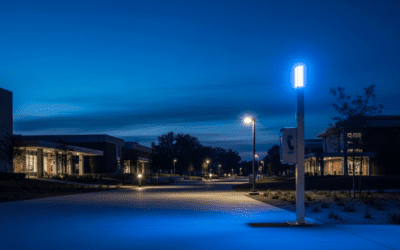
The New Approach: Connected Blue Light Poles
That’s where connected blue light poles come in.
Think of them as smart safety towers—not just phones, but fully integrated nodes that combine:
High-definition video surveillance
Instant voice connection to dispatch
Built-in LTE/5G connectivity (no trenching required)
Environmental sensors (gunshot detection, air quality, etc.)
Remote device management and power monitoring
They’re rugged, weatherproof, and online 24/7—even if the local Wi-Fi goes down.
Why Cities and Campuses Are Making the Shift
Connected poles aren’t just a nice-to-have anymore. They’re part of a layered safety strategy that helps:
Reduce emergency response time
Deter crime with visible, networked tech
Offer peace of mind to staff, students, and citizens
Future-proof your infrastructure with modular upgrades
If you’re exploring ways to modernize campus safety, eliminate dead zones, or deploy network-connected solutions without trenching, connected blue light poles may be worth a closer look.
Need help figuring out what’s right for your environment?
We’ll walk you through it.
Don’t Wait for the Next Outage
Tell us about your campus—we’ll match you with a solution architect.
You May Also Be Interested In…

AT&T FirstNet for Fire and EMS: A Command Network You Own
Speak with a Connectivity ExpertReady to deploy one-button connectivity for your mobile blood drives? Want to Learn More? Request a custom quote.
POTS Link vs. NAPCO StarLink Fire: Which Fire Panel POTS Replacement Is Right for You?
Blue Light Emergency Phone POTS Line Replacement: Extend Your Campus Emergency Call Infrastructure Without Replacing the Hardware
By: Reed Perryman, VP of Sales & Marketing, RCN Technologies Reed Perryman is VP of Sales & Marketing at RCN Technologies with 10 years of experience in POTS line replacement for government agencies, K–12 school districts, and critical infrastructure. He...