

Starlink-Ready PNK for Wildfire Response: Connectivity When Cell Towers Burn and the Fire Keeps Moving

Mark leads digital growth strategy and marketing analytics, helping organizations navigate the transition from legacy connectivity to modern wireless and 5G solutions.
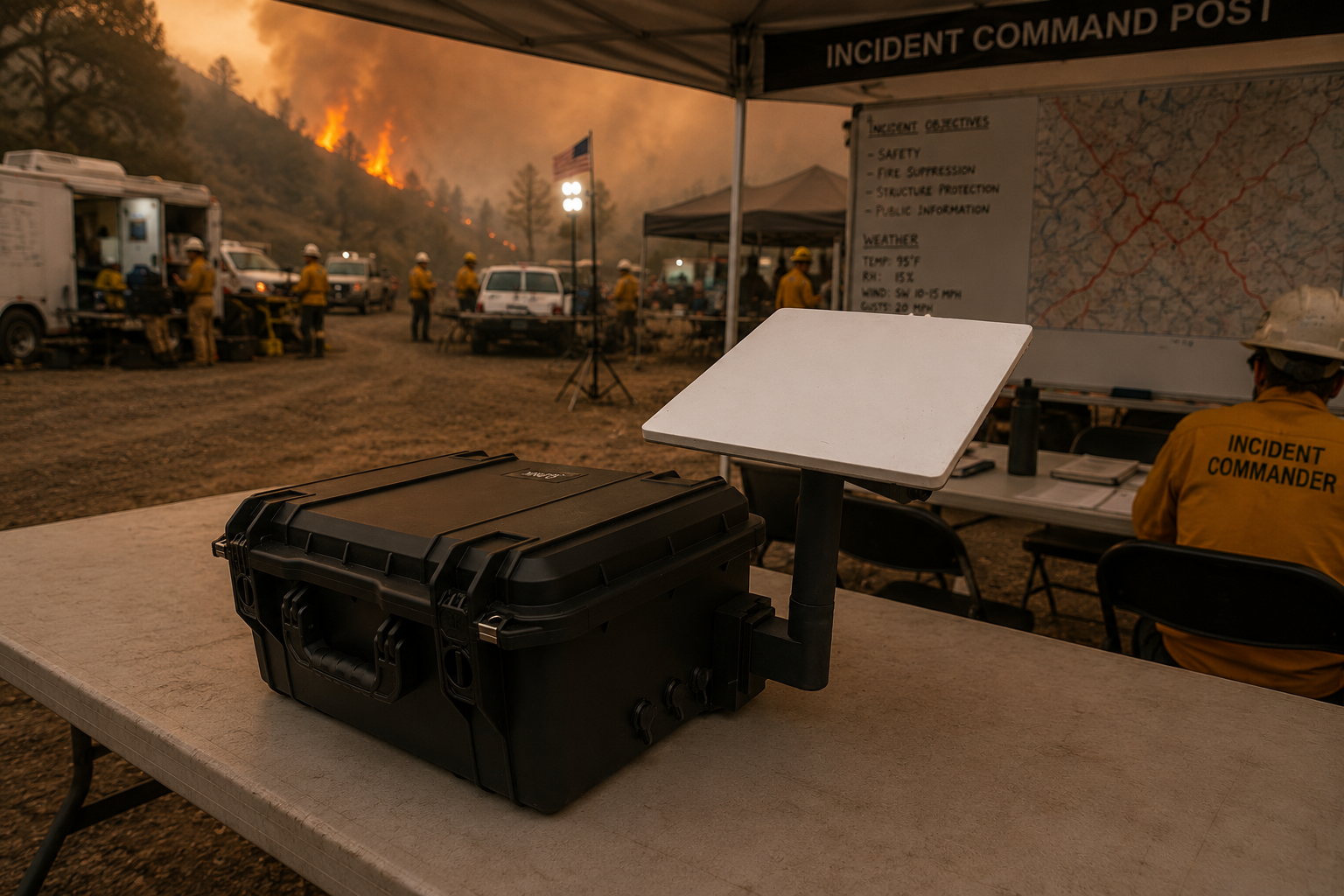
It is the third operational period of a fire that started at 14% containment yesterday morning. The base camp moved overnight when the wind shifted, the new ICP sits at a county fairgrounds twenty-one miles from where the IMT staged a day ago, and two of the three cell towers that covered the original camp burned last night. The third is on PSPS standby and the carrier cannot tell anyone in the IMT when it comes back up. The Division Alpha supervisor is staged at a drop point with no cellular bars at all. The state IMT planning chief needs to push tonight’s IAP, the medical unit needs to coordinate a patient transport with a critical access hospital ninety miles away, and the safety officer cannot reach the line crews on the east flank. This is the operational reality a deployable 5G network was designed for, and it is why state OES offices, federal land management agencies, and county emergency managers are buying the Starlink-Ready Pop-Up Network Kit ahead of fire season rather than improvising through it.
Why Wildfires Break Standard Connectivity
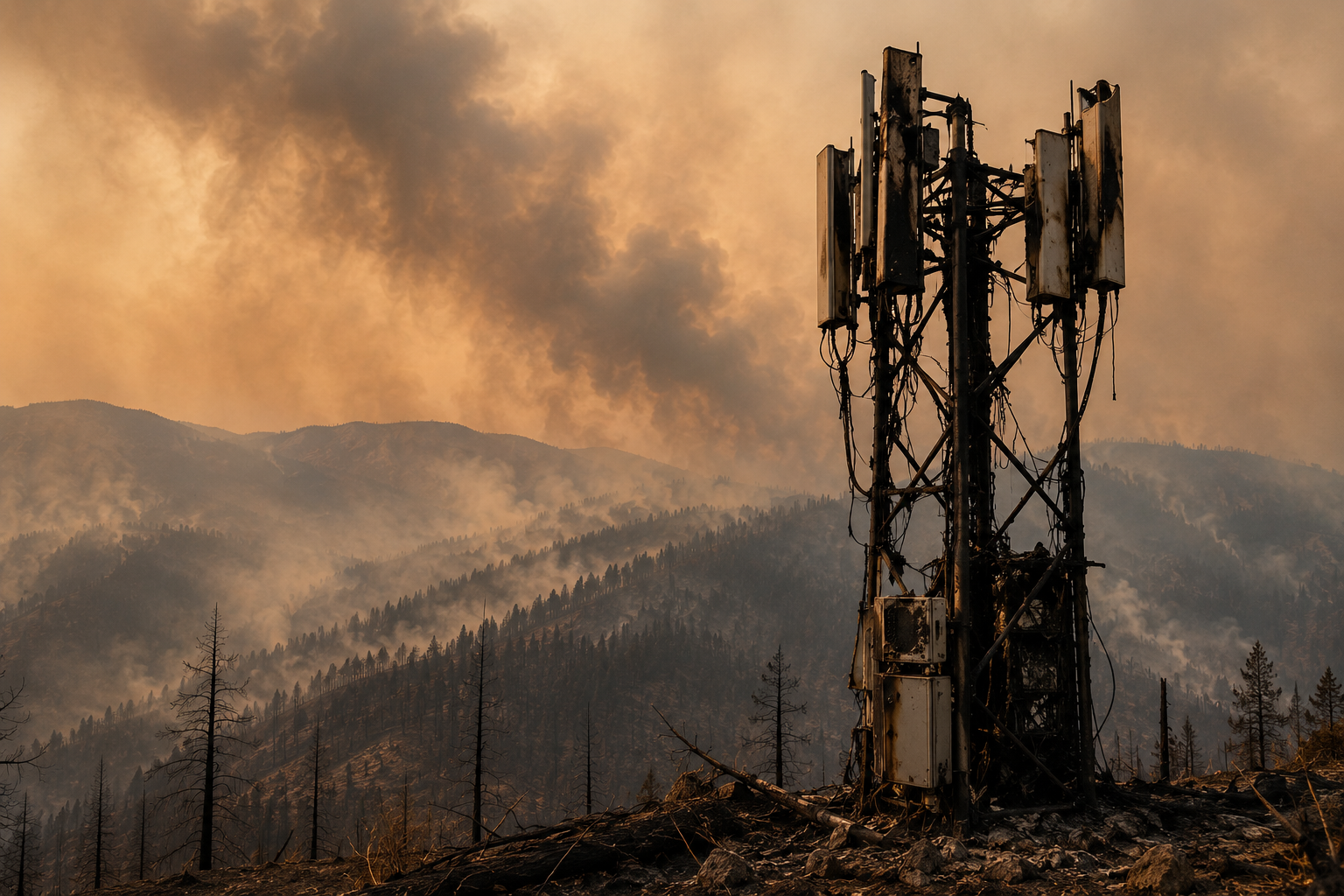
Wildfires break communications in three ways that storms and tornadoes generally don’t. The fire moves laterally for days or weeks across terrain that often had marginal cellular coverage to begin with. The fire burns the infrastructure itself, including cell sites, fiber runs, and the power feeding both. And the utility responsible for the power burning that infrastructure preemptively shuts the rest of the grid down across whole counties under a Public Safety Power Shutoff to keep new ignitions from starting. The result is a connectivity environment that gets worse for days at exactly the moment the response gets bigger.
A standard cellular kit, even a good one, depends on a carrier footprint that may not exist by hour seventy-two of a major incident. A satellite-only setup gives you a path but not a network. A consumer hotspot gives you neither. The wildfire connectivity problem is not a router problem. It is an integration problem, which is what the Starlink-Ready PNK was built to solve.
Building a Deployable 5G Network From the Cradlepoint R1900 and Starlink
The Ericsson Cradlepoint R1900 is a 5G-capable cellular router built for high-throughput, high-availability deployments where a single point of failure is not acceptable. It supports dual-modem operation with active-active failover across two carriers, gigabit-class cellular speeds where the network and the spectrum support it, and built-in enrollment in Ericsson Cradlepoint NetCloud Manager for remote visibility and configuration. In wildfire response, the R1900 is the model that shows up in IMT mobile command vehicles, ICP base camps, and division supervisor vehicles where the demand is real and the operating environment is hostile to lesser hardware.
The Starlink-Ready PNK pairs that router with a Starlink dish, the Panorama Mako high-gain cellular antenna, multi-carrier SIMs, a ruggedized case, internal battery, and DC conversion kit, all pre-configured into one piece of equipment the IMT can open and activate without an IT engineer on site. Starlink rides the WAN side of the router as a parallel path to cellular. When cellular is up, traffic can ride either. When the fire has burned through every cell site within range, Starlink carries the mission on its own. As Reed Perryman, RCN’s VP of Sales and Marketing, put it when the Starlink-Ready PNK launched: “If you can see the sky, you can have connectivity.”
A router is not a deployable 5G network. SIMs have to be provisioned, firmware staged, VPN tunnels built back to the agency network, VLANs mapped, antennas tuned, the dish configured, and the whole stack enrolled in NetCloud Manager before any of it is useful. The PNK handles all of that before the case ever ships, so the unit the planning chief pulls out of the cabinet is already a working network.
How Emergency Managers Use the Starlink-Ready PNK in a Wildfire
State and county emergency management offices sit on the strategic side of a wildfire. They run evacuation, shelter operations, ESF coordination, public information, and the long-tail recovery work that continues for months after the fire is contained. Their connectivity needs are constant, broad, and have to survive whatever the fire and the utility do to the grid.
In an active incident, the EM director’s kit is typically pre-staged at the EOC and a second kit travels to whatever forward staging area, evacuation center, or POD (point of distribution) opens up. When the fire forces a relocation, the kit relocates with it. The same VPN tunnel, the same SSID, the same network policy comes up at the new site, so the WebEOC instance, the shelter intake system, and the patient tracking tool reconnect without anyone reconfiguring anything. If the evacuation center is in a community college gym with no cellular signal and a fiber circuit that is currently melting, the dish goes up on the roof and the network operates on satellite alone for as long as the response needs it to.
The compliance posture matters here too. Evacuation centers handle protected health information when the medical team logs shelter intake or coordinates a transfer. Law enforcement integration carries CJIS data. The PNK supports the technical safeguards required under HIPAA and CJIS through IPsec encryption, VLAN segmentation, access controls on the SSID and management interfaces, and audit logging through NetCloud Manager. RCN can help configure the deployment to align with each framework. None of that is a certification stamp on the device, because no portable network product is “HIPAA certified” or “CJIS certified.” Compliance is a deployment-level outcome, and RCN configures for it.
How Incident Command Uses the Starlink-Ready PNK on the Fire
Type 1 and Type 2 IMTs run the fire itself. The Incident Commander, the Operations Section Chief, the Planning Section Chief, the Logistics Section Chief, and the Finance/Admin Section Chief operate out of an ICP that may move multiple times across a long-duration incident. Underneath that command structure are Division and Branch supervisors in the field, line crews working the perimeter, helibase staff, aerial coordinators, dozer operators, and a medical unit that has to evacuate the injured into a hospital system that may be hours away by ground.
The R1900 Starlink-Ready PNK is the transport-layer asset that makes that whole structure work as a network rather than a collection of radios. Specifically:
| Deployment point | Role of the kit |
|---|---|
| ICP / base camp | Network the planning section runs on. The IAP pushes to division supervisors. The 209 uploads to state and federal partners. WildCAD or the dispatch integration talks to its parent system. Crew time gets entered. Aviation and ground assets coordinate on the same secure network as the safety officer's reporting and the medical unit's HIPAA-bounded patient coordination. |
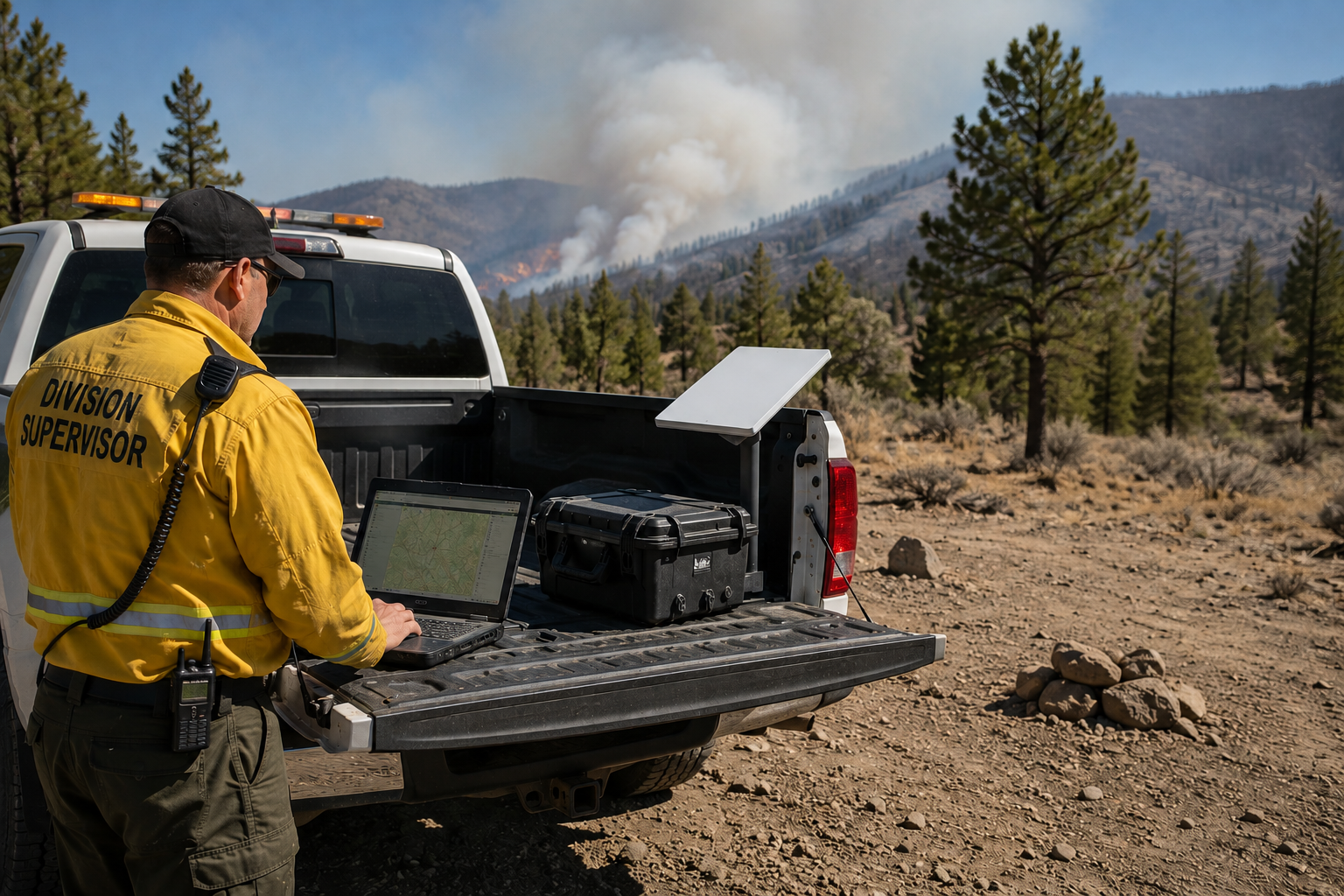
| Division supervisor vehicle | A second R1900 Starlink-Ready PNK keeps the DivSup in real-time contact with the ICP even when the line has no cellular footprint at all. The kit travels with the supervisor as the division geometry changes. |
| Spike camp / drop point | An R980 Starlink-Ready PNK keeps a smaller team online with a lighter form factor. Same network policy, same SSID, fewer devices, more portable. |
| Helibase | Supports aerial coordination, weather feeds for the air operations branch, and the FAA-required documentation that travels with the air assets. |
| Across the incident | Every PNK is visible in NetCloud Manager to the IMT's Communications Unit Leader (COML) and to RCN's 24/7 NOC. The NOC sees failovers, signal margin, dish status, and bandwidth utilization in real time and resolves most field issues remotely while the COML stays focused on the ICS-205. |
The kit is multi-carrier and FirstNet-compatible via AT&T SIMs, so public safety traffic continues to ride the appropriate cellular path where one exists. Where no cellular exists, Starlink carries everything. When cellular comes back, the unit balances or fails back based on the carrier policy RCN configured before shipping. None of those state transitions require a person on the fire to do anything.
The First Seventy-Two Hours
This is what the first three operational periods look like for a county whose EOC kit is pre-positioned, a state OES that pushes a second kit to the EOC when the incident scales, and an IMT that brings two more to the ICP and a fourth to the division running the most exposed flank.
Operational Period 1. Initial attack. Local fire is at the scene. The county EOC activates. The EOC kit comes online inside a minute, brings up the VPN tunnel back to the county network, and the shelter coordinator starts pre-staging an evacuation site. The EM director uploads the first sit-rep before the IC has named the fire.
Operational Period 2. Extended attack transitions to a Type 3 organization. The fire has crossed a ridge. The PSPS notice goes out for the affected feeders. Two cell sites in the impact area drop. The EOC kit fails over to Starlink without any manual action because the cellular policy detected the carrier degradation. The state OES pushes a second kit to the EOC. An evacuation center opens at a community center with no cellular and a fiber circuit that just lost power. The second kit goes there and the shelter intake system reconnects.
Operational Period 3. A Type 2 IMT takes the incident. The ICP stands up at the fairgrounds. Two R1900 Starlink-Ready PNKs come out of the IMT cache and online inside the same hour. A third PNK ships with the Division Alpha supervisor to the drop point twenty-one miles upcountry. The IAP gets pushed for tonight. Medical coordinates the first transport to a critical access hospital. NetCloud Manager has logged every authenticated session and every failover for the after-action file and for the FMAG documentation the Finance Section Chief will eventually compile.
What the kit does not give you is a guarantee that the incident will be easier than expected. What it gives you is a network that comes up when it is supposed to, fails over from cellular to satellite to cellular again as the fire and the grid do whatever they do, and produces the documentation a federal reviewer will eventually ask for during reimbursement closeout.
Procurement Paths for State, Federal, and Local Buyers
The Starlink-Ready PNK is available to state and county emergency management offices, federal land management agencies, and state forestry / fire agencies through the cooperative procurement vehicles those agencies already use. RCN supports public sector procurement through GSA Schedule, Sourcewell, OMNIA Partners, and NASPO ValuePoint, with additional federal IT coverage through Carahsoft and additional public sector reach through Equalis Group. State emergency management directors and federal incident contracting officers can buy the kit through the contract their agency is already set up against, which keeps the kit out of an open-bid cycle that fire season cannot wait for.
For federally declared incidents, the operational use of the kit during the response generally fits within FEMA Fire Management Assistance Grants (FMAG) and Public Assistance Category B documentation. RCN does not adjudicate eligibility, which is between the agency and the FEMA program officer assigned, but the NetCloud Manager audit trail and the deployment records support the documentation reviewers expect at closeout.
Configure Your Wildfire-Ready PNK Fleet
Whether you are pre-positioning kits before fire season opens, refreshing an existing IMT cache, or scaling an EOC posture to handle a multi-week extended attack, an RCN PNK specialist can scope the right configuration for your geography, your IMT structure, and your procurement vehicle.
Talk to a PNK SpecialistRCN Technologies is an Ericsson Cradlepoint Technical Excellence Partner and a Verizon Frontline Verified integrator serving state OES offices, federal land management agencies, county emergency managers, and incident management teams across all 50 states.
Frequently Asked Questions
What is a deployable 5G network for wildfire response?
A deployable 5G network is a self-contained, multi-carrier cellular and Wi-Fi system that gives an incident command post, evacuation center, or forward staging area secure, audit-trail-ready connectivity when the local cellular footprint is damaged, burned, or never existed. The Starlink-Ready Pop-Up Network Kit, built on the Cradlepoint R1900, adds Starlink satellite broadband to the standard PNK so the kit continues to work even when every cell tower in range is offline.
How fast does the Starlink-Ready PNK come online during an activation?
From the moment the case is opened and the external power button is pressed, the cellular WAN typically registers in under a minute. Starlink takes a few additional minutes to acquire the constellation and align, depending on dish placement. The pre-configured VPN tunnel, VLANs, and SSID come up on boot. Most ICPs and EOCs have the network broadcasting and devices online within five to ten minutes of activation.
What happens when the fire burns through every cell tower in range?
The R1900 routes traffic to the Starlink WAN path. The kit operates entirely independent of cellular infrastructure as long as the dish has sky view. When cellular comes back up, the router balances or fails back based on the carrier policy RCN configured before shipping. None of those transitions require an action from the IMT or the EOC staff.
Does it work with FirstNet and Verizon Frontline for public safety traffic?
Yes. The PNK is FirstNet-compatible via AT&T SIMs and Verizon Frontline Verified. Public safety traffic continues to ride the appropriate cellular path where one exists. Where cellular is unavailable, the same traffic rides Starlink under the same encryption and segmentation policy.
Can the kit support HIPAA-protected patient data at an evacuation center?
The PNK supports the technical safeguards required under HIPAA through end-to-end IPsec encryption, VLAN segmentation, SSID and management access controls, and audit logging through Ericsson Cradlepoint NetCloud Manager. RCN can help configure the deployment to align with HIPAA requirements. No portable network product is “HIPAA certified,” and any vendor claiming otherwise is misrepresenting the framework.
Is the Starlink-Ready PNK eligible for FMAG or FEMA Public Assistance?
For federally declared incidents where the kit supports an essential response function, the operational use of the Starlink-Ready PNK and FMAG or Public Assistance Category B documentation generally fit. RCN does not adjudicate eligibility, which is between the agency and the FEMA program officer, but the NetCloud audit trail and RCN’s deployment records support the documentation reviewers expect at closeout.
How does the kit fit into the ICS-205 communications plan?
The kit is a transport-layer asset that the Communications Unit Leader documents in the ICS-205 alongside the radio plan. It supports the COML’s operational picture rather than dictating it, and is visible in NetCloud Manager to the COML and to RCN’s NOC for the duration of the incident.
How is the kit managed and supported during a multi-week incident?
Every PNK is enrolled in NetCloud Manager, which gives the COML, the agency’s IT staff, and RCN’s 24/7 NOC real-time visibility into the unit. The NOC proactively flags signal degradation, certificate issues, dish status, and carrier policy questions, and resolves most field issues remotely. For long-duration fires the NOC stays in the loop without the IMT having to file a ticket each time something needs attention.
What is the difference between the R1900 and R980 Starlink-Ready PNK for wildfire use?
The R1900 is the heavier kit, supports up to 100 connected devices, and is the right choice for an ICP, an EOC, a mobile command vehicle, or a division supervisor running a high-traffic flank. The R980 is the lighter kit, supports up to 50 devices, and is the right choice for a spike camp, a drop point, a forward observation post, or a strike team where portability matters more than throughput.
You May Also Be Interested In…
Satellite vs. 5G: Which Wins for Remote and Temporary Sites?
Speak with a Connectivity ExpertReady to deploy one-button connectivity for your mobile blood drives? Want to Learn More? Request a custom quote.
Starlink for NPS Search and Rescue: A Command Network for the Trailhead
Mark Indelicato | Manager, Growth & Analytics at RCN TechnologiesMark leads digital growth strategy and marketing analytics, helping organizations navigate the transition from legacy connectivity to modern wireless and 5G solutions.The call comes in mid-afternoon....
Cradlepoint R980 for Mobile Libraries: Bookmobile and Outreach Wi-Fi
Mark Indelicato | Manager, Growth & Analytics at RCN TechnologiesMark leads digital growth strategy and marketing analytics, helping organizations navigate the transition from legacy connectivity to modern wireless and 5G solutions.The bookmobile pulls into a...
Speak with a Connectivity Expert
Ready to deploy one-button connectivity for your mobile blood drives?


Want to Learn More?
Request a custom quote.