

Starlink for NPS Search and Rescue: A Command Network for the Trailhead

Mark leads digital growth strategy and marketing analytics, helping organizations navigate the transition from legacy connectivity to modern wireless and 5G solutions.
The call comes in mid-afternoon. A hiker who left the south trailhead at 8 a.m. has not come back. Light fails at 7:42. The on-duty ranger drives to the trailhead, twenty-six road miles past the last cellular bar. The Incident Commander rolls in twenty minutes later with the SAR cache. Within an hour, the parking lot is a command post: a planning section setting up search segments in Caltopo, a logistics chief inventorying gear, a public information officer fielding the first phone call from the subject’s family, a dispatcher patching in the county SAR team, the local volunteer ground team, and the regional NPS aviation coordinator. Every one of those functions needs a network. The network does not exist at the trailhead. That is the problem a deployable 5G network was built to solve, and it is why NPS units, USFS ranger districts, and the volunteer SAR organizations that operate under federal unified command are buying Starlink-Ready Pop-Up Network Kits ahead of season rather than improvising through the next callout.
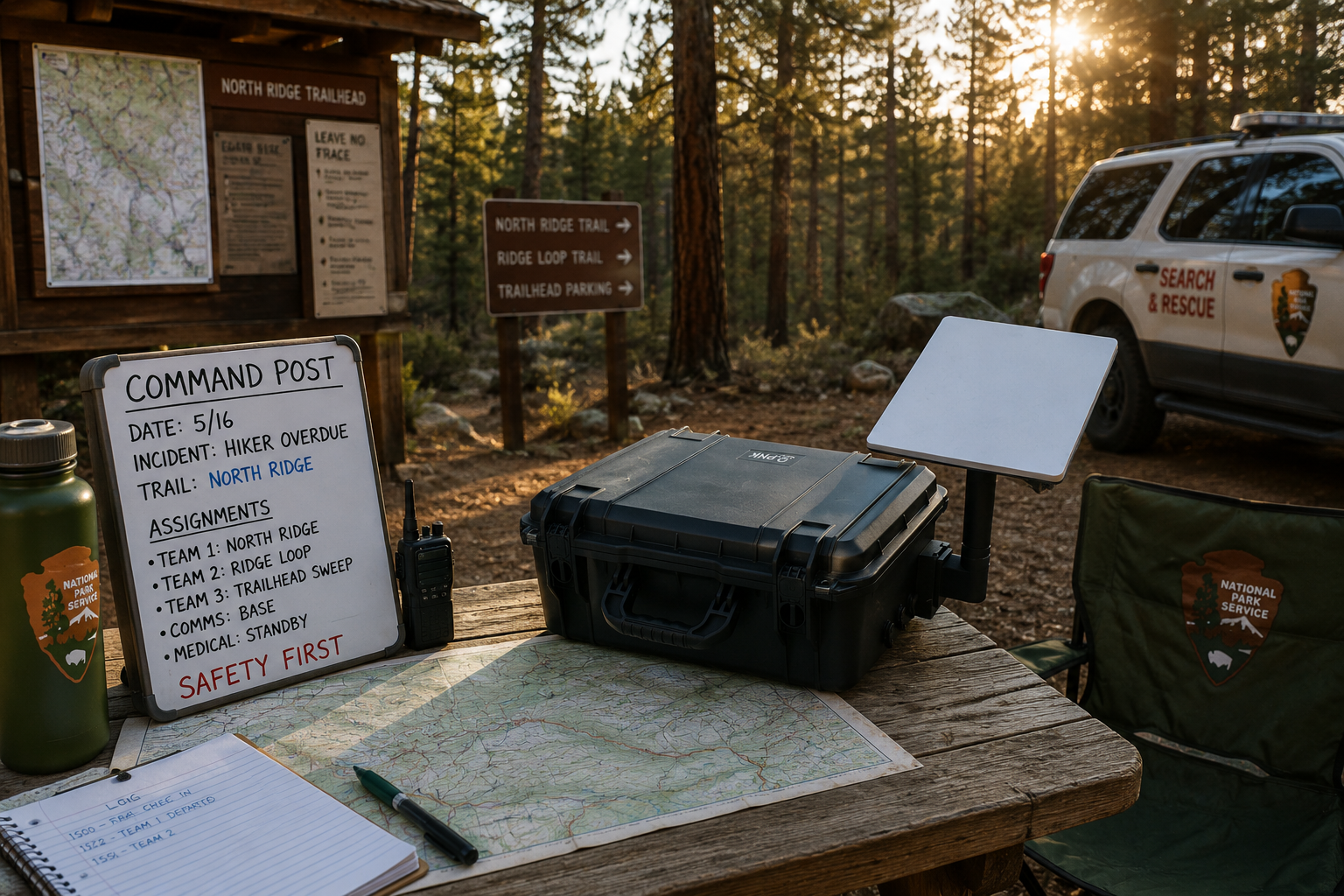
Starlink solves the satellite half of the problem. The low-earth-orbit constellation delivers high-throughput broadband to any location with line of sight to the sky. It does not depend on cellular footprint, does not depend on fiber, and does not depend on a carrier running a temporary site to a trailhead nine hours away from the nearest serviceable tower. For a search that may run twelve hours or twelve days, Starlink is the transport layer that makes the rest of the command network possible.
A Starlink terminal alone is not a command post network. The dish gives the search a WAN connection. What it does not give the search is the rest of the stack an SAR operation requires: secure Wi-Fi for the planning section’s laptops, segmentation so the field medical team’s HIPAA-bounded traffic does not share a broadcast domain with the press liaison’s social media, multi-carrier cellular as a parallel path for the moments when a single tower comes back into reach, antenna selection for vehicle-mount and pole-mount deployment at a trailhead with limited sky view, NOC-side management so the IC is not also the network engineer. That integration is what RCN’s Starlink-Ready Pop-Up Network Kit (PNK) provides, configured for the operational reality of NPS SAR.
What Is the Starlink-Ready PNK?
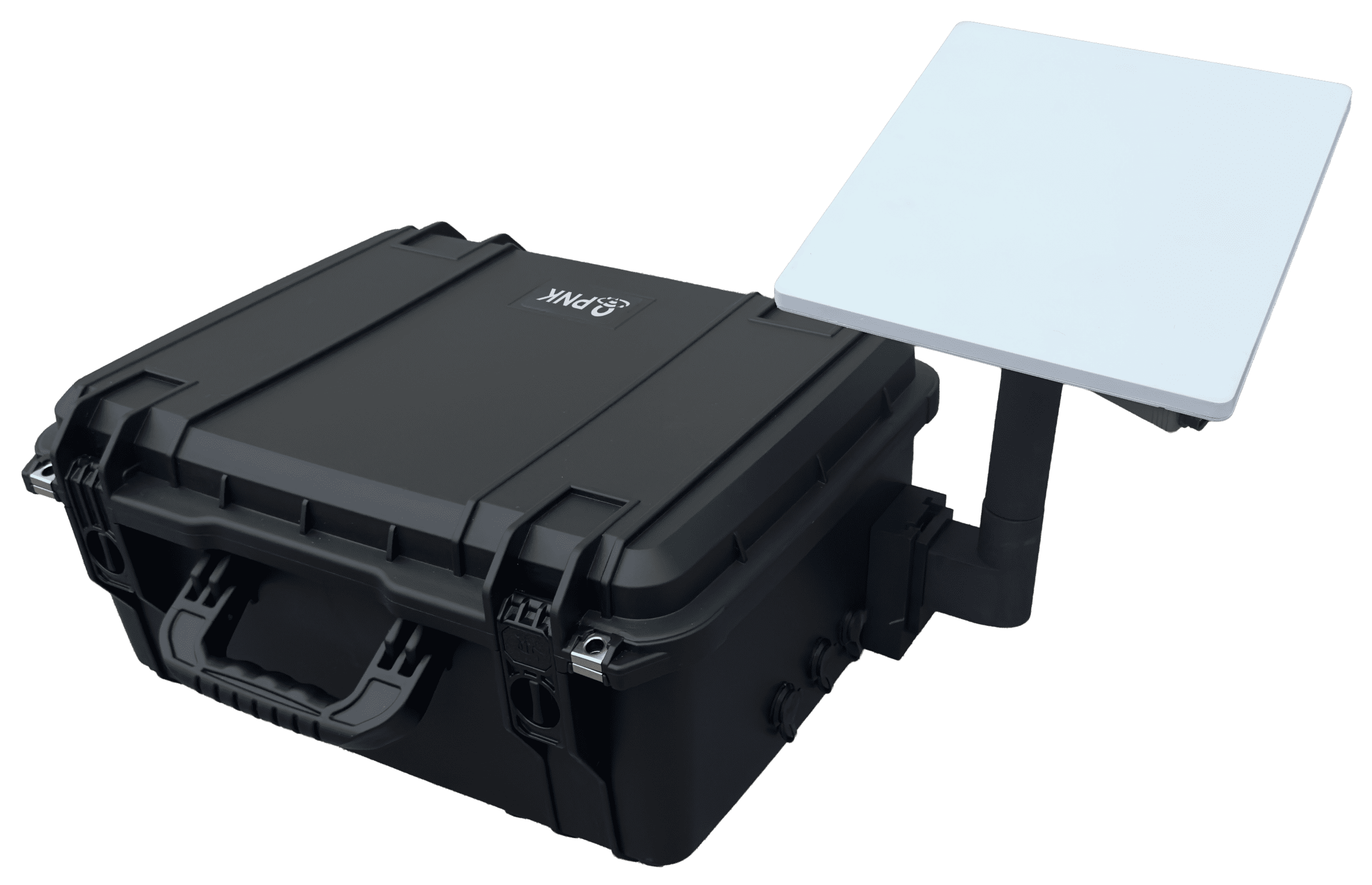
The Starlink-Ready PNK is RCN’s deployable network platform with a Starlink terminal pre-integrated as a managed WAN source. The Ericsson Cradlepoint router at the core of the kit treats the Starlink dish the same way it treats a cellular modem: as one transport path in a multi-WAN policy. When Starlink is the active path, traffic rides the dish. When cellular is available and configured as primary, the router uses cellular and holds Starlink as the standing alternative. The transition between paths is invisible to the laptop, the ICS form, the mapping software, or the dispatch console connected to the kit’s local Wi-Fi.
Every Starlink-Ready PNK arrives in a ruggedized case, pre-provisioned by RCN’s Knoxville integration team, enrolled in Ericsson Cradlepoint NetCloud Manager, and supported by RCN’s 24/7 U.S.-based Network Operations Center. The unit the IC pulls out of the SAR cache is a working network, not a parts list. The ranger who sets the kit up at the trailhead does not have to provision a SIM, configure a VLAN, or align the dish from a manual. The kit does the network. The IC runs the search.
Why a Deployable 5G Network Is the Trailhead’s Only Practical Option
Trailheads are where SAR commands set up. Trailheads are usually past the last cellular bar. That is the operating geometry, and a deployable 5G network is the only practical answer to it.
The closer alternatives all fail in predictable ways. A consumer hotspot at the trailhead picks up no signal because there is no signal to pick up. A satellite phone supports voice for the IC but cannot back a planning section’s Caltopo session or push a search assignment to a field team. A repeater that backhauls to a permanent agency network depends on infrastructure that does not reach into the backcountry. A drive-back-to-cellular workflow forces the IC to choose between being at the search and being on the network, which is no choice on a search where minutes matter. Cellular comes online at most trailheads only when a carrier deploys a Cell on Wheels, which is a process measured in hours and reserved for incidents large enough to justify a carrier request.
The Starlink-Ready PNK is the answer because it brings the network to the trailhead in the case the kit ships in. The dish sets up in line of sight of the sky, which a trailhead almost always offers. The router orchestrates whatever cellular is available alongside the satellite path. The IC opens the kit, presses the button, and the network is up by the time the planning chief has pulled out the laptop. Cellular as primary where it works. Satellite as the standing alternative where it does not. Both at once for the rare deployments where the IC wants active-active redundancy across paths.
How NPS Search and Rescue Operations Use the Starlink-Ready PNK
The use cases break into five operational patterns. A single search will typically touch two or three of them. A multi-day search may touch all five.
Trailhead command post
The IC sets up at the trailhead within an hour of the missing-person report. The Starlink-Ready PNK comes online inside the first ninety seconds. The planning section runs Caltopo for search segment assignment. The PIO fields family and media calls. Dispatch patches in county SAR, volunteers, and aviation.
Mobile command on extended searches
When the operational period rolls and the search area shifts, command relocates with it. The kit goes where command goes. The Caltopo session and assignment manifest come back up at the new location without anyone reconfiguring anything.
Subject location and medical coordination
When the subject is located, the search transitions to medical coordination. Field medical documentation, medical transport, the receiving hospital's emergency department. The kit's segmentation keeps HIPAA-bounded traffic separate from operational traffic.
Forward operating base for technical rescue
Rope, swiftwater, high-angle, or cave teams stage from a forward operating base near the technical site. A second R980 Starlink-Ready PNK at the FOB supports the technical team independent of the command kit's reach.
Aviation coordination
Helicopter operations routinely involve DOI aircraft, county aviation, and sometimes military rescue assets under formal agreement. Aviation coordination rides the same network the IC runs the search on, with the kit's segmentation keeping aviation traffic on its own VLAN.
Adjacent NPS and USFS deployments. NPS Blue Ridge operates RCN-deployed kits across its field operations. US Forest Service TICC, the inter-agency communications hub for federal wildland operations, operates RCN-deployed kits as part of its standing comms inventory.
Starlink-Ready PNK Configurations for SAR
RCN ships the Starlink-Ready PNK in configurations that match the search and the search team's mission profile.
| Configuration | Best for | Cellular | Satellite |
|---|---|---|---|
| PNK R980 Starlink-Ready | Trailhead command post for routine SAR callouts, forward operating base for technical teams | Single-modem 5G/LTE, multi-carrier capable | Integrated |
| PNK R1900 Starlink-Ready | Multi-day or multi-section search ICP, regional SAR coordinator vehicle, mobile command vehicle | Single-modem 5G/LTE, multi-carrier capable, higher throughput than R980 | Integrated |
| PNK R1900 Dual Starlink-Ready | Searches where any single-path outage is unacceptable, joint federal-state-volunteer command | Dual-modem, dual-carrier active-active failover | Integrated |
Federal Compliance: Supporting FISMA, CJIS, and DOI Cyber Baselines
Federal SAR operations run on networks subject to specific federal cyber requirements that civilian deployments do not have to navigate. The Starlink-Ready PNK supports the technical safeguards required under those frameworks, and RCN configures each deployment to align with the agency’s cyber posture.
FISMA and NIST 800-53. The Department of the Interior cyber baseline derives from FISMA and the NIST 800-53 control set. The Starlink-Ready PNK supports the technical safeguards required under that baseline through IPsec encryption on the WAN path, VLAN segmentation between operational sections, access controls on the management interface, audit logging through NetCloud Manager, and authenticated administrative access. RCN can configure each kit to align with the agency’s authorization boundary. No portable network product is “FISMA-certified,” because the framework governs the agency’s authorization process rather than a device.
FedRAMP for Starlink. Agencies considering Starlink as a transport for federal data should verify current FedRAMP authorization status with their CISO before relying on Starlink for systems requiring FedRAMP-authorized cloud services. Starlink has been working toward FedRAMP authorization, and the status updates over time. RCN does not represent that Starlink meets any specific FedRAMP threshold and can support the agency’s documentation requirements as the authorization process evolves.
CJIS for federal law enforcement on the SAR network. NPS LE rangers, USFWS officers, and any state or county law enforcement integrated into the SAR command structure may access CJIS data on the kit’s network. The Starlink-Ready PNK supports the technical safeguards required under the CJIS Security Policy through end-to-end IPsec encryption, VLAN segmentation that isolates CJIS-bounded traffic, dual-factor authentication on the management plane, and audit logging through NetCloud Manager. The kit does not make the agency CJIS compliant on its own; the agency’s policies and the kit’s configuration together support that posture.
HIPAA at the field-medical edge. When SAR transitions to medical evacuation, the field medical team’s documentation and patient handoff to the receiving hospital flow through the kit. The Starlink-Ready PNK supports the technical safeguards required under HIPAA through the same encryption and segmentation discipline applied to CJIS-bounded traffic, with the field medical VLAN separated from other operational sections. RCN configures the kit to align with the agency’s BAA structure where applicable.
Procurement Paths for Federal SAR Programs
Federal land management agencies procure deployable communications equipment through the federal contract vehicles those agencies already use. RCN supports federal procurement through:
- GSA Schedule for federal agencies including NPS, USFS, USFWS, and BLM
- Carahsoft for federal IT procurement contexts
- Sourcewell for state and local SAR partners
- NASPO ValuePoint for state-level SAR coordinator offices
Agency operating budgets and program-specific appropriations are the most common funding paths. The Great American Outdoors Act funds NPS deferred maintenance. Federal Lands Recreation Enhancement Act fee revenue can support visitor safety and field operations equipment at participating units. Federal land management bureaus also operate cross-agency cooperative agreements that allow SAR-relevant equipment acquisitions to flow through partner-agency contracts where the buying unit has a standing relationship.
RCN's PNK team can map a specific park unit, district, or regional office's preferred contract vehicle to a current quote and ship a fully provisioned kit on a standard purchase order.
Talk to a PNK specialist for NPS Search and Rescue
RCN's PNK team scopes deployments for federal land management agencies every week. RF assessment, SKU recommendation, antenna selection, carrier-mix planning, cyber baseline configuration, and procurement-vehicle matching are part of the standard engagement.
Configure your PNK →RCN Technologies is an Ericsson Cradlepoint Technical Excellence Partner, a Cradlepoint-certified integrator, and a Starlink-authorized integrator.
Frequently Asked Questions
What is a deployable 5G network for NPS Search and Rescue?
A deployable 5G network for NPS Search and Rescue is a self-contained, ruggedized wireless network that brings command-post connectivity to a trailhead, forward operating base, or aviation coordination point in under five minutes, even when the location is past the cellular footprint. RCN’s Starlink-Ready Pop-Up Network Kit combines an Ericsson Cradlepoint router, multi-carrier cellular SIMs, integrated antennas, and a Starlink satellite uplink in a single ruggedized case, managed remotely through NetCloud Manager and supported 24/7 by RCN’s U.S.-based NOC.
How does the Starlink-Ready PNK fail over between satellite and cellular at a trailhead?
The Cradlepoint router monitors every available WAN connection in real time. At a trailhead with no cellular, the kit runs on Starlink alone. When the search moves to a location where cellular returns, the router can prioritize cellular as primary based on the policy the SAR program sets, with Starlink standing by.
How fast does a Starlink-Ready PNK come online at the trailhead?
The kit powers on and brings up cellular and Wi-Fi in under 90 seconds. The Starlink terminal requires line-of-sight to the sky and a brief initial alignment, typically completing within several minutes of power-on. Total time from arrival at the trailhead to a working hybrid network is generally under five minutes.
Does the kit support CJIS-compliant traffic for federal LE on the SAR network?
The Starlink-Ready PNK supports the technical safeguards required under the CJIS Security Policy through IPsec encryption, VLAN segmentation that isolates CJIS-bounded traffic, dual-factor authentication on the management plane, and audit logging through NetCloud Manager. The kit does not make the agency CJIS compliant on its own.
Is Starlink FedRAMP authorized for federal SAR use?
FedRAMP authorization for Starlink Business has been an evolving question. Agencies should verify current FedRAMP authorization status with their CISO before relying on Starlink for systems requiring FedRAMP-authorized cloud services. For SAR command-post connectivity that does not flow regulated federal cloud data, the FedRAMP question is typically a lower-stakes determination.
Which federal contract vehicles can my unit use to buy a Starlink-Ready PNK?
RCN sells through GSA Schedule and Carahsoft for federal procurement. State and county SAR partners operating under federal unified command can use Sourcewell and NASPO ValuePoint as cooperative procurement paths. RCN’s PNK team matches the unit’s preferred contract vehicle to a current quote during scoping.
Who manages the network during a multi-day SAR operation?
Every PNK is enrolled in Ericsson Cradlepoint NetCloud Manager, which gives the unit’s communications coordinator and RCN’s 24/7 NOC real-time visibility into the deployed kit. The NOC proactively flags signal degradation, dish status, and carrier policy questions, and resolves most field issues remotely.
Can a single kit support multi-agency SAR command with federal, county, and volunteer organizations?
The Starlink-Ready PNK supports multi-agency unified command through VLAN segmentation that separates agency traffic on the same kit. Federal LE, county SAR, volunteer organizations, and aviation coordination can each operate on a dedicated VLAN with appropriate access controls, while a shared common-operating-picture VLAN gives the unified command its situational awareness.
You May Also Be Interested In…

Hurricane Season 2026: Emergency Connectivity Before the Storm Hits
Speak with a Connectivity ExpertReady to deploy one-button connectivity for your mobile blood drives? Want to Learn More? Request a custom quote.
Satellite vs. 5G: Which Wins for Remote and Temporary Sites?
Speak with a Connectivity ExpertReady to deploy one-button connectivity for your mobile blood drives? Want to Learn More? Request a custom quote.
Cradlepoint R980 for Mobile Libraries: Bookmobile and Outreach Wi-Fi
Mark Indelicato | Manager, Growth & Analytics at RCN TechnologiesMark leads digital growth strategy and marketing analytics, helping organizations navigate the transition from legacy connectivity to modern wireless and 5G solutions.The bookmobile pulls into a...
Speak with a Connectivity Expert
Ready to deploy one-button connectivity for your mobile blood drives?


Want to Learn More?
Request a custom quote.