

Cradlepoint R980 for Mobile Libraries: Bookmobile and Outreach Wi-Fi

Mark leads digital growth strategy and marketing analytics, helping organizations navigate the transition from legacy connectivity to modern wireless and 5G solutions.
The bookmobile pulls into a rural elementary school parking lot at 9:15 AM. The librarian unlocks the back door, plugs in the rooftop antenna’s power lead, and within minutes the self-checkout tablet boots, patron Wi-Fi comes up, the catalog (ILS) is reachable, the holds printer prints. The bookmobile does not return to the main branch until 4 PM, with four more stops in between. None of those stops have library Wi-Fi to borrow. This is a deployable 5G network at work, and increasingly it runs on a Cradlepoint R980 inside the vehicle.
The Cradlepoint R980 is the small-form-factor 5G router built for vehicle-mounted mobile deployments. Multi-carrier capable, fanless, IP-rated, designed for the antenna interface a bookmobile actually needs (rooftop mount, with a Panorama 7-in-1 puck pulling cellular, Wi-Fi, and GPS through a single penetration). It is the right router for the form factor.
But a router in a bookmobile is not the same thing as a working network across a full service day. What turns the R980 into a working mobile library network is everything that wraps it: the carrier-aggregating SIM strategy that switches when one carrier drops, the NetCloud configuration that holds across reboots, the content-filtering policies aligned with CIPA, and the RCN 24/7 NOC that watches every deployed unit. The Pop-Up Network Kit (PNK) is the integrated bundle that delivers all of that as one purchase, pre-provisioned and ready to plug in.
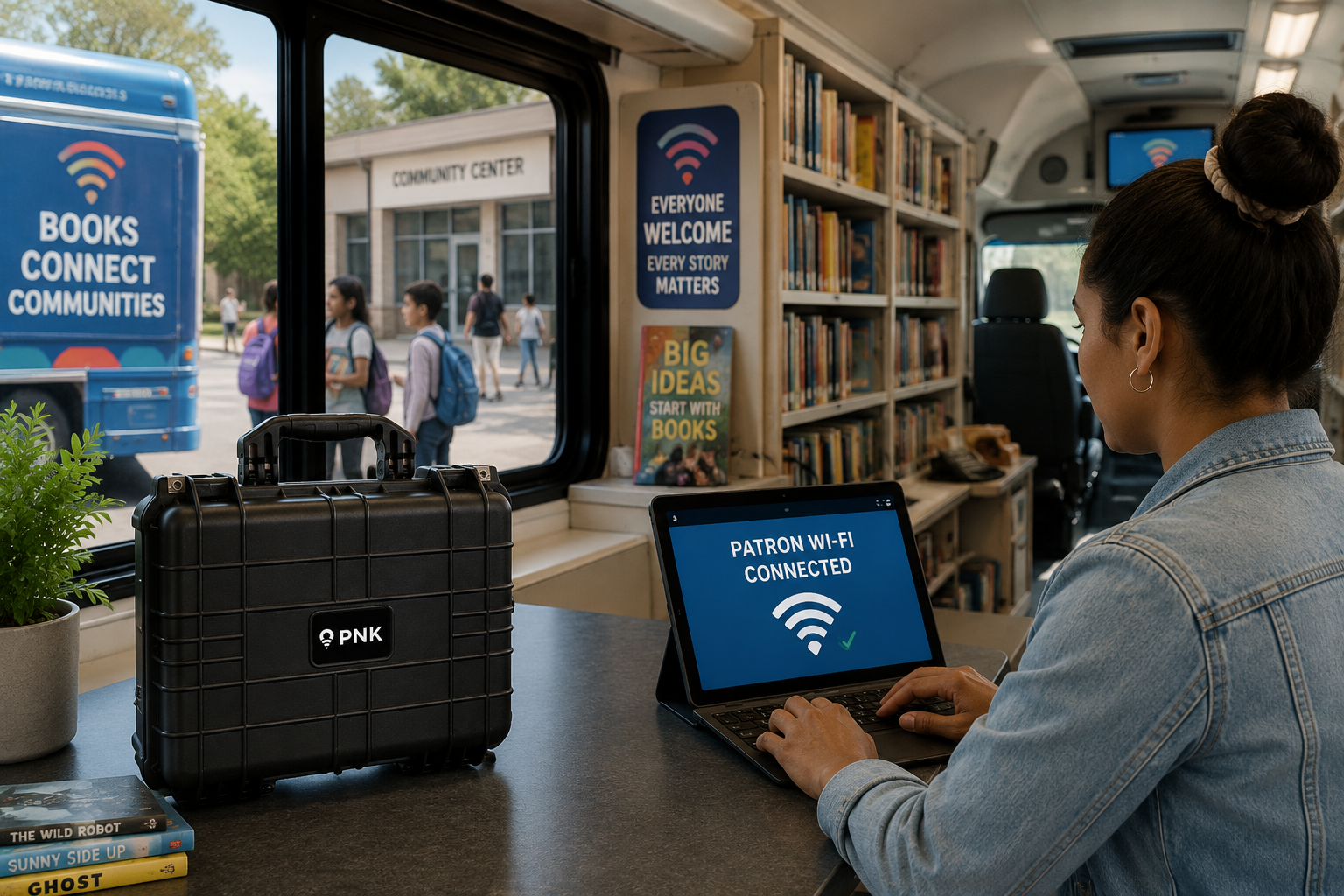
How mobile libraries use the Cradlepoint R980 PNK
Bookmobiles and outreach vehicles run the same workloads a fixed branch runs, just compressed into a vehicle and scheduled across multiple stops. On a typical service day the R980 PNK handles:
- Patron Wi-Fi at every stop, from children’s story hour at an elementary school to adult literacy at a community center to summer reading programming at a park.
- ILS catalog access to Polaris, Sierra, Koha, Symphony, or whichever integrated library system the branch runs, reachable from the bookmobile as if the vehicle were a wired branch.
- Self-checkout and RFID circulation at the same speed patrons get at the main building.
- Public access devices, including the loaner Chromebooks and tablets the library hands out for in-vehicle research time.
- Hotspot lending program check-in and check-out processing, including device registration steps that require cloud access.
- Staff connectivity for email, scheduling, ILS administration, and the internal apps the outreach librarian uses to track program attendance.
A deployable 5G network for the stops between branches
The Cradlepoint R980 PNK is the smaller, faster-to-redeploy configuration. The bookmobile or outreach van plugs in, the unit boots, the network comes up, and within five minutes the team is operational. There is no IT staff on the vehicle. There does not need to be.
This is the configuration that fits most mobile library deployments. Single-operator vehicles where IT support is not onboard. Scheduled stops where the peak device count lands around 10 to 15 (patrons, staff laptops, the self-checkout tablet, the holds printer, hotspot devices being returned). Multi-carrier coverage that needs to fail gracefully when a rural cell sector drops. Battery backup that holds through a shore-power disconnect or a vehicle restart mid-stop.
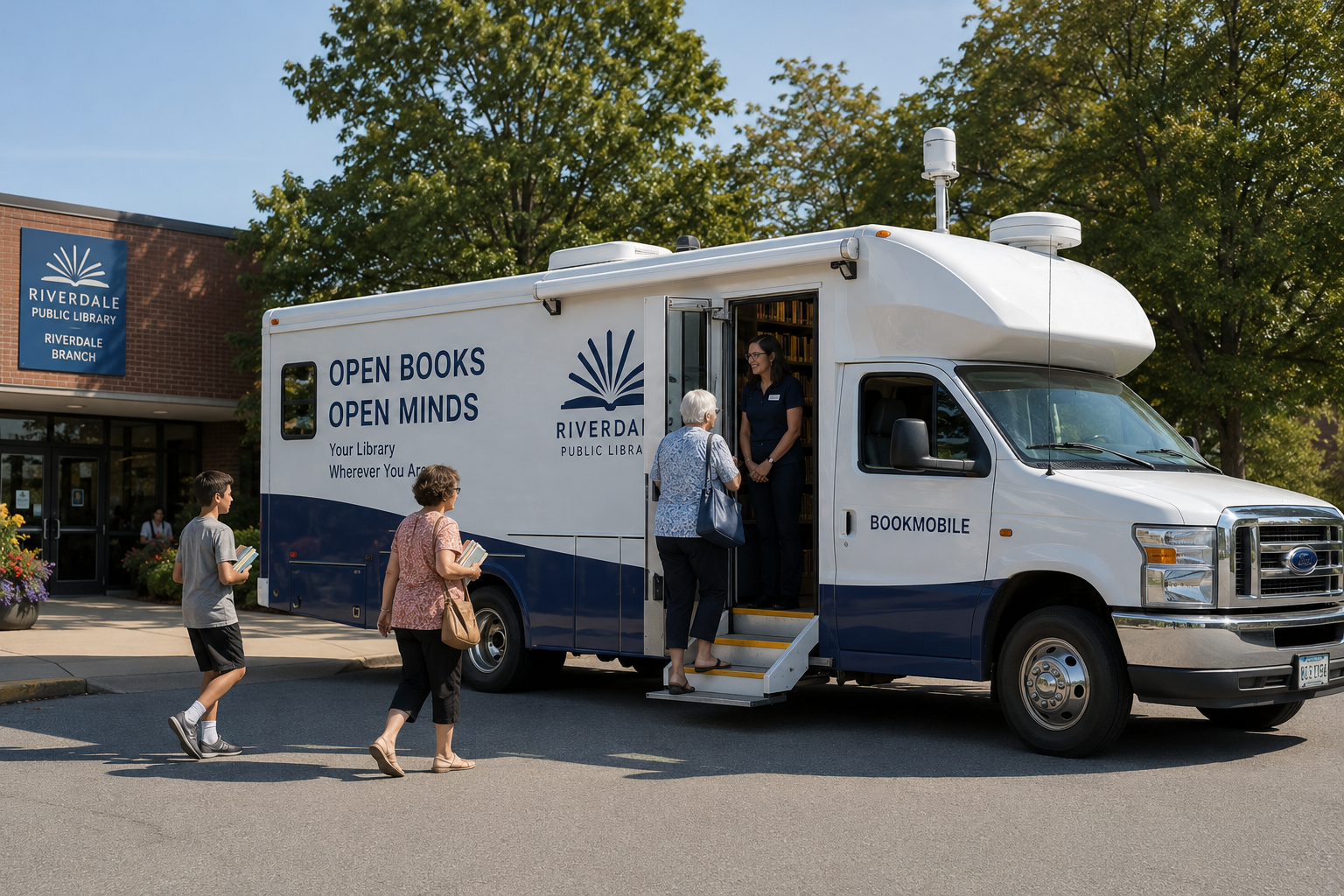
Bookmobiles that travel into known-marginal coverage (deeply rural routes, mountain communities, certain tribal land routes) may want the R1900 Dual Modem PNK instead, with active-active failover across two carriers. The R980 fits most library deployments. The R1900 Dual Modem fits the harder ones.
Carrier compatibility, content filtering, and CIPA
The PNK runs on AT&T, Verizon, and T-Mobile cellular, with multi-carrier SIM aggregation that selects the strongest signal at each stop on the route. Libraries with an existing E-Rate-funded carrier relationship can typically continue that relationship on the PNK; libraries selecting a carrier at deployment time can choose based on the coverage check across their actual stops.
The PNK supports the content-filtering technical requirements libraries need to align with the Children’s Internet Protection Act (CIPA) for E-Rate compliance. Filtering is configured at the NetCloud policy layer and applied across every SSID the PNK broadcasts (patron Wi-Fi, staff Wi-Fi, and any program-specific SSIDs). RCN can help configure the deployment to meet your specific CIPA program and any additional state-level filtering requirements.
Setup is five minutes once the kit arrives. Pre-provisioning means the SIMs are activated before shipment, the NetCloud configuration is loaded, the antennas are tuned to the vehicle, and the team plugs the unit into vehicle power and turns it on.
Where the R980 PNK fits across a library’s mobile operations
Most mobile library programs run more than one vehicle. The bookmobile is the most visible piece, but the same R980 PNK plays different roles across the rest of the fleet. The pattern below is how libraries with multiple deployment surfaces think about which kit goes where.
| Deployment point | Role of the kit |
|---|---|
| Bookmobile | The primary route vehicle. Patron Wi-Fi at every stop, ILS catalog access for circulation, self-checkout and RFID, the holds printer, and the public-access devices. Same NetCloud policy and same SSID structure as the main branch, so staff and patron authentication carry across stops. |
| Outreach van / programming vehicle | A second R980 PNK keeps the outreach librarian online at smaller stops the bookmobile does not serve. Senior centers, accessible-services visits, after-school programming sites, summer reading kickoffs at parks. Lighter device load, same five-minute setup. |
| Pop-up library at events | The PNK travels with the event tent. Library card sign-ups, on-the-spot ILS lookups, hotspot lending enrollments at festivals, fairs, and community days. Same setup workflow, same content-filtering policy applied to the public SSID. |
| Tech program / digital literacy vehicle | When the program is the network (digital literacy classes, STEM kit demos, e-resource workshops), the PNK is what makes the lesson possible. Loaner devices come up on the same filtered network the patron Wi-Fi uses. |
| Across the fleet | Every PNK is visible in NetCloud Manager to the library's IT lead and to RCN's 24/7 NOC. The NOC sees signal margin, carrier failovers, SIM status, and device counts in real time and resolves most field issues remotely before the driver knows there's an issue. |
The R980 fits all five deployment points in most library systems. For routes with stops that lack cellular entirely, the same kit ships Starlink-Ready as covered above. The coverage check identifies which stops on a route would need that layer before the kit ships.
Why a deployable 5G network is more than a router
A Cradlepoint router alone is not enough to run a bookmobile network. A router plus an antenna plus a SIM plus a Pelican case is not enough either. What turns those parts into a network the outreach team can actually use across a service day is the integration layer: the carrier-aggregating SIM strategy, the antenna selection tuned to the bookmobile, the NetCloud configuration that holds across reboots and SIM swaps, the content-filtering policies, the RCN 24/7 NOC monitoring every deployed unit, and the pre-provisioning that makes “plug it in, the network is up” the actual experience the driver gets.
The PNK is the product RCN built to deliver that whole stack as one purchase. Browse the full deployable 5G network catalog or move to a coverage check for your specific route.
Coverage check, the real next step
The CTA most PNK pages send you to is “request a custom quote.” That is the wrong ask for a bookmobile program. A quote without a coverage check across your actual route is a guess.
A coverage check is a 48-hour deliverable. Send the list of ZIP codes (or specific addresses) for your bookmobile route or outreach stop schedule. RCN engineering pulls real signal data across AT&T, Verizon, and T-Mobile for each stop, models the PNK configuration against the worst stop on the route, and returns a configuration recommendation. R980 PNK for clean coverage. R980 Starlink-Ready if a stop on the route lacks cellular entirely. No purchase obligation.
Talk to a PNK specialist about your bookmobile or outreach program
A short call with someone who has done this with other libraries. We'll walk through your fleet, your funding path, your route, and the configuration that fits. No purchase obligation.
Talk to a PNK SpecialistRCN Technologies is an Ericsson Technical Excellence Partner and a Cradlepoint-certified integrator. The PNK is supported by RCN's U.S.-based 24/7 NOC.
Frequently Asked Questions
What is a deployable 5G network for mobile libraries?
A deployable 5G network for mobile libraries is a self-contained cellular network the bookmobile or outreach vehicle carries with it, providing patron Wi-Fi, ILS catalog access, self-checkout, and staff connectivity at every stop on the route. RCN’s Pop-Up Network Kit (PNK) is RCN’s version of that product, purpose-built for this use case, with the Cradlepoint R980 as the standard configuration for most bookmobile deployments.
Will the R980 PNK handle our self-checkout, ILS access, and patron Wi-Fi at the same time?
Yes. The R980 PNK is sized for peak loads typical of bookmobile stops (10 to 15 active devices including staff laptops, self-checkout, the holds printer, and patron devices). Larger outreach vehicles or programs running heavier device loads can step up to the R1900 PNK.
Does the PNK support CIPA content filtering for E-Rate compliance?
Yes. The PNK supports the technical content-filtering requirements libraries need to align with the Children’s Internet Protection Act. Filtering is configured at the NetCloud policy layer and applied to every SSID the PNK broadcasts. RCN can help configure the deployment to meet your CIPA program and any additional state requirements.
What if a stop on the route has no usable cellular coverage at all?
This is what the R980 Starlink-Ready configuration solves. A Starlink Mini is integrated alongside the cellular modem, and when the kit reaches a stop with no usable cellular the Starlink path carries the workload. When cellular returns at the next stop, the kit fails back automatically. A PNK specialist will flag which stops on your route need the Starlink layer during the call.
How long does the PNK take to set up at each stop?
The PNK is operational within five minutes of arrival on site. Pre-provisioning at deployment time means the SIMs are activated, the NetCloud configuration is loaded, the antennas are tuned to the vehicle, and the only step the driver takes at each stop is connecting vehicle power and turning the unit on.
What carriers does the PNK run on?
The PNK runs on AT&T, Verizon, and T-Mobile cellular, with multi-carrier SIM aggregation that selects the strongest signal at each stop. Libraries with an existing E-Rate-funded carrier relationship can typically continue that relationship on the PNK.
What happens when I schedule a call with a PNK specialist?
A short conversation. The specialist asks about your fleet (one bookmobile, multiple outreach vehicles, pop-up programming), your funding path (E-Rate, LSTA grant, general fund), your route geography, and the workloads you need to support. You leave the call with a configuration recommendation in plain language and a sense of what it costs. No purchase obligation.
You May Also Be Interested In…

Hurricane Season 2026: Emergency Connectivity Before the Storm Hits
Speak with a Connectivity ExpertReady to deploy one-button connectivity for your mobile blood drives? Want to Learn More? Request a custom quote.
Satellite vs. 5G: Which Wins for Remote and Temporary Sites?
Speak with a Connectivity ExpertReady to deploy one-button connectivity for your mobile blood drives? Want to Learn More? Request a custom quote.
Starlink for NPS Search and Rescue: A Command Network for the Trailhead
Mark Indelicato | Manager, Growth & Analytics at RCN TechnologiesMark leads digital growth strategy and marketing analytics, helping organizations navigate the transition from legacy connectivity to modern wireless and 5G solutions.The call comes in mid-afternoon....
Speak with a Connectivity Expert
Ready to deploy one-button connectivity for your mobile blood drives?

Want to Learn More?
Request a custom quote.