

Wireless Insights
Hurricane Season 2026: Emergency Connectivity Before the Storm Hits
The Atlantic season is open. The agencies that scope a deployable network now are the ones that stay online when the first storm takes the towers down.
Talk to a PNK specialistThe 2026 Atlantic hurricane season opened June 1 and runs through November 30. NOAA’s outlook calls for a below-normal season: 8 to 14 named storms, of which 3 to 6 become hurricanes and 1 to 3 reach major strength, with 70 percent confidence in those ranges. A quiet forecast is not a safe forecast. It only takes one storm to cross your county, and the emergency managers who wait until a system has a name to think about connectivity are the ones improvising through landfall instead of operating through it. This is the window where a deployable 5G network moves from a line item to a plan.
The hardware at the center of that plan is the Ericsson Cradlepoint R1900, a 5G-capable cellular router built for high-availability deployments where a single point of failure is not acceptable. It supports dual-modem operation with active-active failover across two carriers, gigabit-class cellular speeds where the network and spectrum allow, and enrollment in Ericsson Cradlepoint NetCloud Manager for remote visibility.
A router by itself is not a network you can hand to an emergency manager. It needs SIMs provisioned, firmware staged, a VPN tunnel built back to the agency, VLANs mapped, antennas tuned, and the whole stack enrolled before it carries traffic. That is the gap the Pop-Up Network Kit (PNK) from RCN Technologies closes. The PNK is the integrated, operationally complete version of the hardware, and the Starlink-Ready PNK is the configuration built for the conditions a hurricane creates.
The short version: Stage Starlink-Ready PNK kits before landfall, not during the storm. They run on cellular when towers are up, fail over to Starlink when towers are gone, set up in about five minutes with no IT team on site, and buy on cooperative contracts so procurement is not racing a hurricane clock.
What Hurricane Season Does to Connectivity
A hurricane attacks communications from several directions at once, and understanding the failure modes is what separates a plan that holds from a plan that looks good on paper.
Cellular towers fail in three ways during a major storm. They lose backhaul when the fiber feeding them is cut. They lose grid power, and while most sites carry battery backup measured in hours and a smaller share carry generators, a multi-day outage outlasts the batteries and eventually outlasts the fuel resupply chain as roads stay closed. And they take direct physical damage from wind and water. The result is a coverage map that gets worse for days at exactly the moment the response gets larger.
Fixed circuits go down with the grid. The wired connection at the EOC, the shelter, and the forward command post is only as reliable as the utility feeding the building, and storm response routinely runs past the point where that utility is dependable. Satellite-only setups solve the transport problem but leave the agency without a real network. The connectivity problem in a hurricane is not a router problem or a dish problem. It is an integration problem, and it is the one the Starlink-Ready PNK was built to solve.
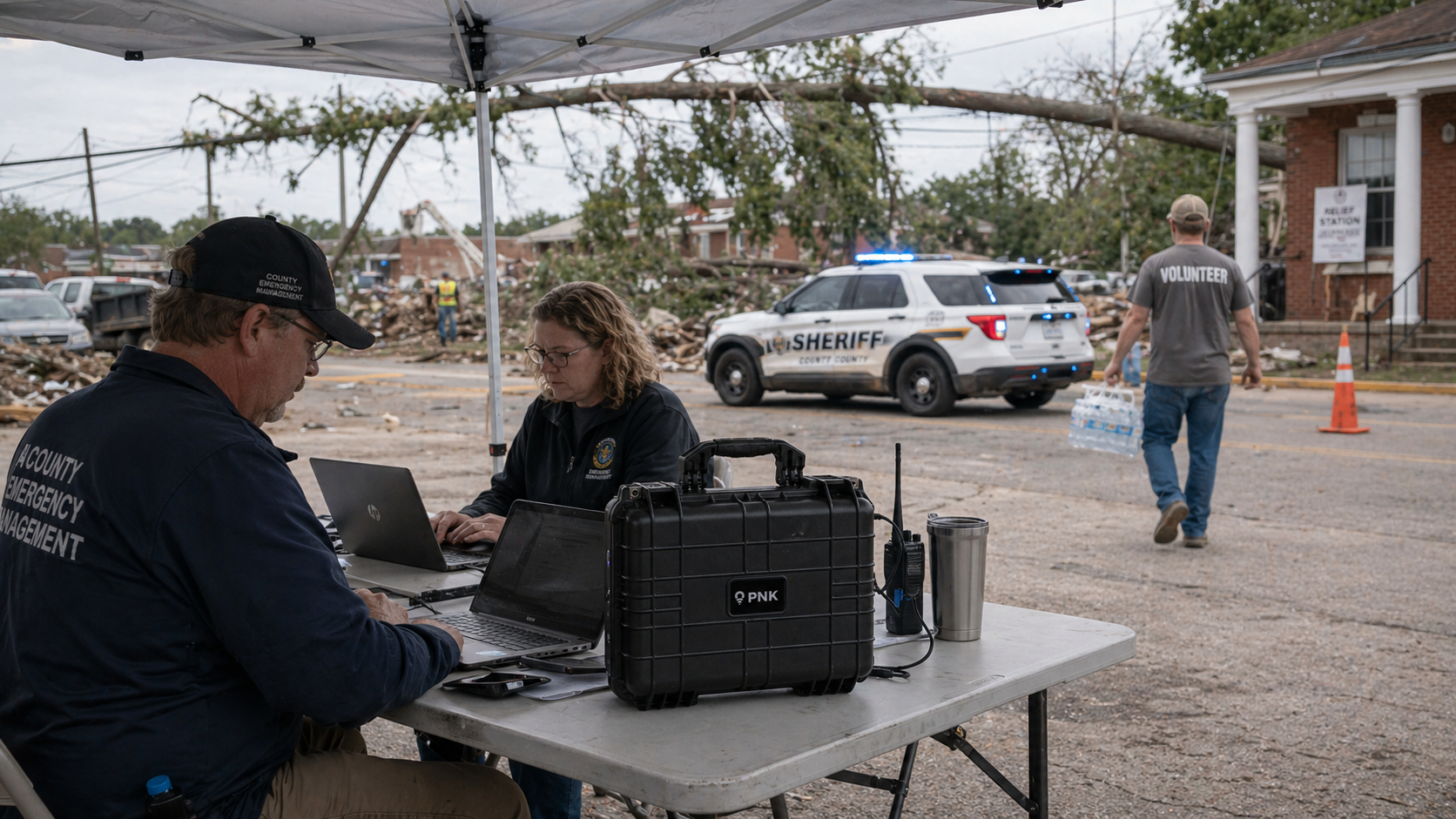
Why a Deployable 5G Network Belongs in Your Hurricane Plan Before the Storm
A deployable 5G network earns its place in the continuity of operations (COOP) plan because it removes the single assumption every other layer depends on: that some network will still be there when you need it. Pre-positioning is the whole point. An agency that stages kits ahead of a forecast landfall can put one at the EOC, one at a forward command post on higher ground, and one at a secondary site where cellular has historically failed, and run all three on a single supported platform rather than a drawer of consumer hotspots.
Buying ahead of the season also matches how public-sector procurement actually works. A kit scoped and ordered in June clears the approval, funding, and configuration steps with time to spare. A kit ordered the week a storm is named does not. The agencies that treat deployable connectivity as a pre-season capability, the same way they treat generators and sandbags, are the ones that open the case in the EOC and press a button instead of placing an order.
When the storm has already passed and the towers are down, the response playbook is a different document. For that side of the event, see our guide to the Cradlepoint R1900 for storm recovery. This piece is about the work that happens before the wind arrives.
How the Starlink-Ready PNK Keeps Emergency Operations Online
The Starlink-Ready PNK pairs the Cradlepoint R1900 with a Starlink terminal, multi-carrier SIMs, a Panorama Antennas high-gain antenna, a ruggedized case, internal battery, and a DC conversion kit, all configured into one unit the agency can open and activate without an engineer on site. Starlink rides the WAN side of the router as a parallel path to cellular. When cellular is available, the router uses it as primary. When the storm has taken every tower in range off the air, the router shifts traffic to Starlink without dropping the active sessions on the laptops, tablets, and ICS terminals connected to the local Wi-Fi. As Reed Perryman, RCN’s VP of Sales and Marketing, put it at the Starlink-Ready launch: “If you can see the sky, you can have connectivity.”
Multi-carrier within the cellular layer matters for the same reason. A PNK running two SIMs from two carriers keeps operating when one carrier’s regional network is impaired, and the dual-modem R1900 runs both active-active so an outage on one does not require anyone to intervene. Public safety priority works at the SIM layer: a kit running AT&T FirstNet SIMs is FirstNet-compatible and carries Band 14 priority, and a kit running Verizon Frontline gets dynamic priority on the Verizon network. The PNK does not lock the agency to one carrier.
Every kit is enrolled in NetCloud Manager and supported by RCN’s 24/7 U.S.-based Network Operations Center. The agency is not the network engineer during the response. RCN has supported government and emergency management agencies on deployments like this, and the NOC watches the unit before, during, and after the event so the people in the EOC can run the response.
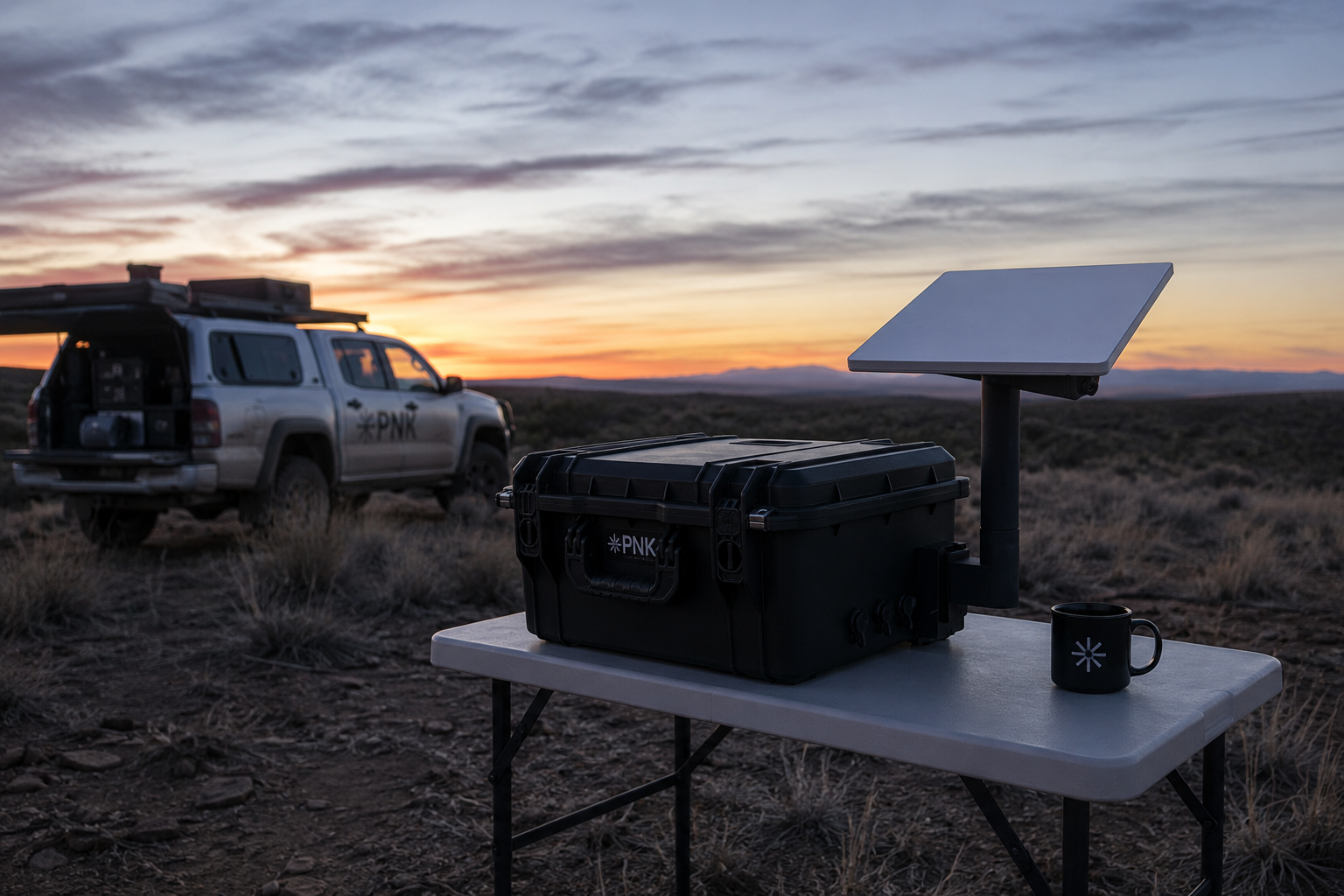
Choosing the Right PNK Configuration for Hurricane Season
The right kit depends on the role it plays in the plan. Smaller forward positions and single-team posts do not need the same capacity as a primary EOC failover stack.
| Configuration | Best fit in a hurricane plan | What it adds |
|---|---|---|
| R980 PNK | Single-team forward posts, shelters, smaller agencies | Compact, lighter, single-modem, fast to stage |
| R1900 PNK | Command posts and mid-size EOC roles | Higher capacity, single-modem, gigabit-class where supported |
| R1900 Dual PNK | Primary EOC failover, mission-critical positions | Dual-modem active-active across two carriers, no failover lag |
| Starlink-Ready PNK | Coastal and barrier sites, multi-day outages, off-grid | Adds Starlink as a managed WAN path for when terrestrial coverage is gone |
For coastal counties and barrier-island positions where cellular has failed in prior storms, the Starlink-Ready configuration is the default recommendation. For inland EOCs where the risk is a multi-day outage rather than total loss of coverage, the R1900 Dual carries the load and the Starlink-Ready kit becomes the standing backstop.
Setting Up Before the Season, Not During the Storm
Readiness is a checklist, and the time to run it is now. A PNK arrives pre-provisioned and is typically operational within five minutes of reaching the site: open the case, power it on, and the network comes up on the strongest available carrier. There is no SIM swapping, antenna alignment, or VPN setup for the field team. That simplicity is what makes pre-positioning work, because the person staging the kit ahead of landfall does not have to be the person who configured it.
Where connectivity costs are part of a declared-disaster response, agencies should confirm reimbursement eligibility under FEMA Public Assistance with their state coordinating officer rather than assuming coverage. Because emergency management is a government function, the buying path is a cooperative one:
- GSA Schedule for federal purchasing
- Sourcewell, NASPO ValuePoint, OMNIA Partners, and Equalis Group for state and local cooperative buying
- Carahsoft as the federal IT path
Configure your PNK for hurricane season
RCN’s PNK team will run an RF assessment, recommend the right configuration for each position in your plan, and scope the deployment so the kits are staged before the first storm forms.
Talk to a PNK specialistFrequently Asked Questions
What is a deployable 5G network for hurricane season?
A deployable 5G network is a self-contained cellular and Wi-Fi system that an emergency management agency can stage ahead of a storm and bring online in minutes. RCN's Starlink-Ready Pop-Up Network Kit, built on the Ericsson Cradlepoint R1900, runs on cellular when towers are up and fails over to Starlink satellite when they are gone.
When should an agency buy PNK kits for hurricane season?
Before the season, not during a storm. A kit scoped and ordered in June clears procurement, funding, and configuration with time to spare. A kit ordered the week a storm is named usually does not arrive in time to matter.
How does the Starlink-Ready PNK handle a tower going down mid-storm?
The Cradlepoint router treats Starlink as a parallel WAN path. When cellular drops, traffic shifts to Starlink without dropping the active sessions on connected devices. When a carrier restores a tower, the router can route back to cellular on configurable priority rules.
Does the PNK work on FirstNet?
Yes. The PNK is FirstNet-compatible through AT&T SIMs and carries Band 14 priority on the FirstNet network. It is also Verizon Frontline-compatible for agencies running Verizon priority service.
Is connectivity reimbursable under FEMA?
It can be, depending on the declaration and the use. Connectivity costs tied to a declared-disaster response may be eligible under FEMA Public Assistance. Agencies should confirm eligibility with their state coordinating officer rather than assuming coverage.
How fast does a PNK set up in the field?
A PNK arrives pre-provisioned and is typically operational within five minutes. Open the case, power it on, and the network comes up on the strongest available carrier. No IT staff required on site.
How is the kit supported during a response?
Every PNK is enrolled in Ericsson Cradlepoint NetCloud Manager and supported by RCN's 24/7 U.S.-based Network Operations Center, which monitors the unit before, during, and after the event.
How do government agencies buy the PNK?
Through cooperative contracts. The PNK is available on GSA Schedule, Sourcewell, NASPO ValuePoint, OMNIA Partners, and Equalis Group, with Carahsoft for federal IT, so agencies can procure on an existing vehicle.
Speak with a Connectivity Expert
Ready to deploy one-button connectivity for your mobile blood drives?


Want to Learn More?
Request a custom quote.