

Cradlepoint R1900 for Storm Recovery: Connectivity When Tornadoes and Hurricanes Take Towers Down

Mark leads digital growth strategy and marketing analytics, helping organizations navigate the transition from legacy connectivity to modern wireless and 5G solutions.
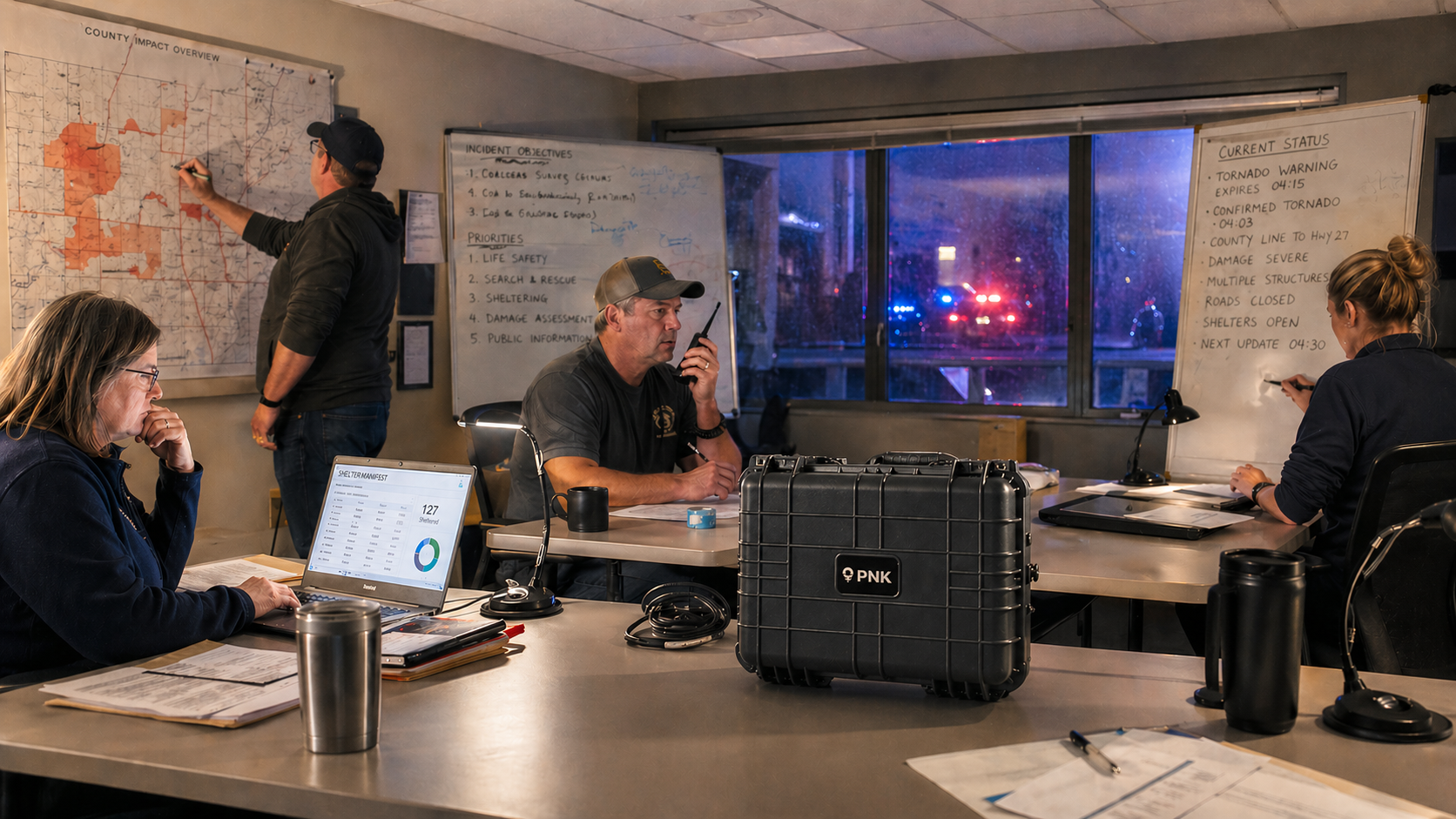
It is 3:42 AM and the tornado warning has lifted across a county in the storm belt. The emergency manager is at the EOC. The primary fiber circuit is severed under a downed pine south of the courthouse. Two cell sites in the impact zone are off the air. The WebEOC instance has not reconnected to state since the lights flickered. The first shelter is filling and the first patient transports are inbound. This is the moment a deployable 5G network earns its place in the COOP plan, and it is the reason county and state emergency managers are buying the Cradlepoint R1900 PNK before tornado season opens, not after the response is already underway.
Inside the Ericsson Cradlepoint R1900
The Ericsson Cradlepoint R1900 is a 5G-capable cellular router built for high-throughput, high-availability deployments where the operator cannot afford a single point of failure. It supports dual-modem operation with active-active failover across two carriers, gigabit-class cellular speeds where the network and the spectrum support it, and built-in enrollment in Ericsson Cradlepoint NetCloud Manager so the unit can be monitored and reconfigured remotely. The hardware is engineered for vehicles, trailers, command posts, and fixed sites that have to keep running when something else stops working.
In emergency management contexts, the R1900 is the model that shows up in mobile command vehicles, EOC failover stacks, and forward staging units for state and federal response teams. The dual-modem architecture is the architectural reason it shows up there: when one carrier loses a tower in a damaged area, the other carrier carries the traffic without dropping the session.
For the official R1900 specifications, see the Cradlepoint R1900 product page. The rest of this guide covers how to turn that hardware into a working storm recovery network when the people deploying it are also the people running the response.
A Router Is Not a Deployable 5G Network
An Ericsson Cradlepoint R1900 out of the box is still an IT project. It needs SIMs provisioned with the right carrier mix, firmware staged, a VPN tunnel configured back to the county network, VLAN segmentation mapped to the data classification policy, antenna tuning for the local RF environment, and enrollment in NetCloud Manager. Somebody has to do that work before the router is useful, and in a storm response that somebody is rarely available. The county IT director is troubleshooting the EOC’s primary circuit. The deputy is running a debris reconnaissance route. The volunteer who normally helps with networking lost cell service at home and cannot reach the courthouse.
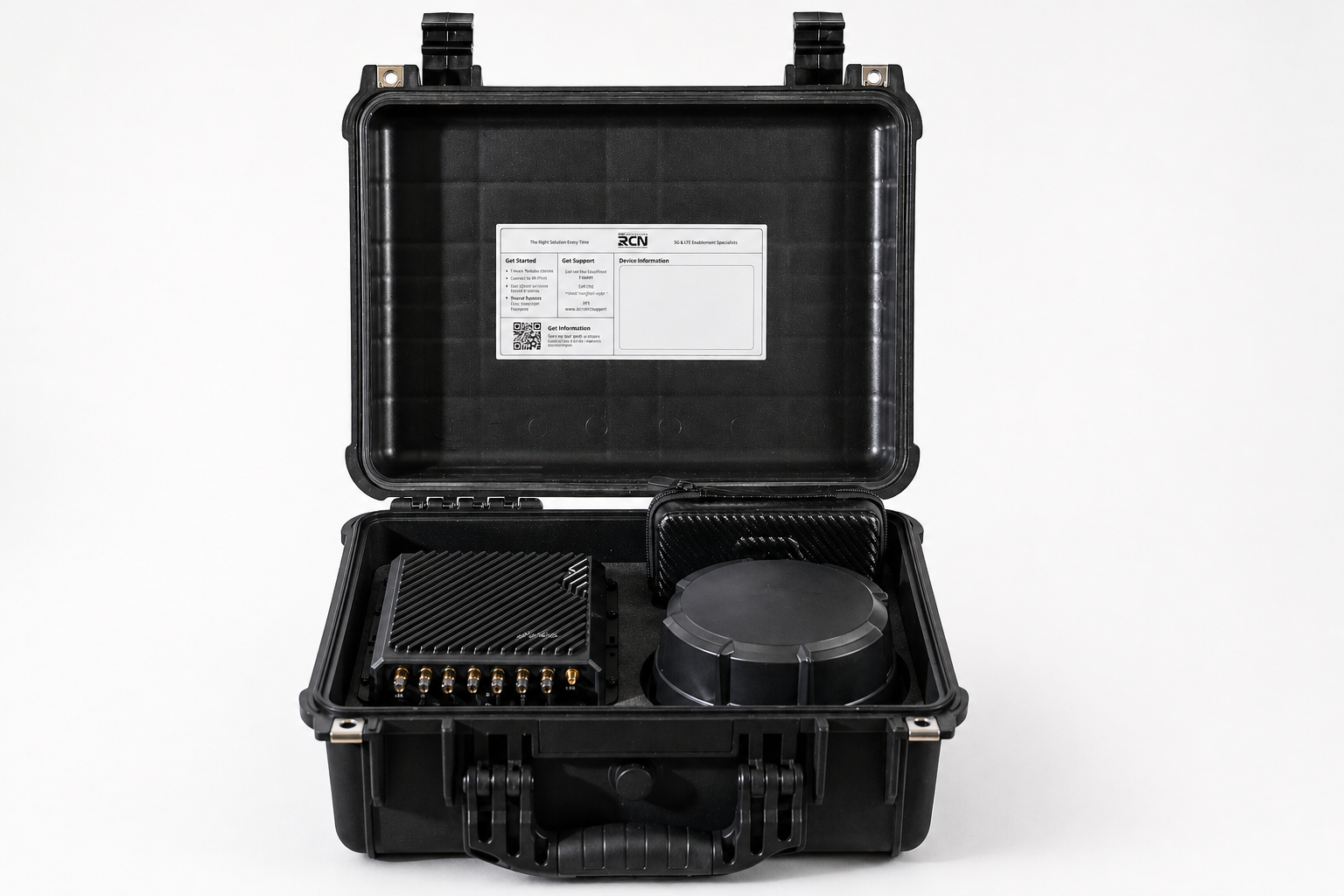
A true deployable 5G network, like the RCN Pop-Up Network Kit (PNK), handles all of it before the case ever ships:
- Cradlepoint R1900 or R980 pre-configured with the county’s network policy and routing
- Multi-carrier SIMs pre-provisioned with active-active failover across Verizon, AT&T (FirstNet-compatible via AT&T SIMs), T-Mobile, and US Cellular as the configuration calls for
- Site-to-site VPN tunnel back to the county network, established and tested before shipping
- VLANs mapped for shelter intake, accountability, and external coordination traffic
- Panorama Mako high-gain antenna tuned for vehicle, trailer, or fixed mount
- Starlink-ready configuration option for deployments where the local terrestrial network is gone
- NetCloud Manager enrollment, with RCN’s 24/7 NOC monitoring the unit before, during, and after deployment
- Ruggedized case, internal battery, chargers, and DC conversion kit included
The emergency manager never touches any of this. They open the case in the EOC, press the external power button, and the network comes up on the carrier with the strongest local signal. If that carrier loses a tower an hour later, the unit fails over to the second carrier without dropping a session. If the Starlink-ready configuration is in play, the kit can also bring satellite online when terrestrial coverage collapses entirely.
From the Cabinet to the EOC Floor
Emergency management staff have a job profile that does not include configuring routers. The EM director, the deputy, the planning chief, the logistics chief, and the communications officer manage the response, coordinate with the state, run the EOC, and answer to the elected officials watching it happen. Network configuration is something they outsource, and in most counties they outsource it to the same IT staff who are already overwhelmed when the kit is needed most.

The R1900 PNK is built for that reality. It lives in a cabinet, in a deputy’s vehicle, or at a state cache point. When the activation call goes out, somebody pulls the case, sets it on a table, and presses the external power button. The unit boots in under a minute, connects to the strongest available carrier, brings the VPN tunnel back to the county network, and broadcasts the pre-configured SSID. Tablets, laptops, and phones already provisioned with the network credentials connect on their own. The first time anybody in the EOC has to think about the kit is when they decide whether to send it out the door with the deputy team to a forward staging area.
If anything goes wrong, the team calls RCN’s NOC at a number printed on the case. A technician sees the unit in NetCloud Manager in real time. Most field issues, including failover that is not behaving the way it should, a SIM that needs to be cycled, or a VPN tunnel that has not re-established cleanly, get resolved remotely while the EM director stays focused on the shelter intake and the patient transport count.
Operationally, this means the EOC stays online without waiting for the IT shop to triage the primary circuit. The kit moves with the response when the response moves, including to a forward staging area or an alternate EOC if the primary site is hit. And the NetCloud audit trail captures exactly when the kit was activated, where it connected from, and how the traffic flowed during the response, which becomes part of the documentation the FEMA Public Assistance reviewer will eventually ask for during closeout.
Built for the COOP Plan, Documented for FEMA PA
County and state emergency managers operate under a Continuity of Operations (COOP) plan that defines how essential functions stay running when the primary site, primary circuit, or primary staff are unavailable. The R1900 PNK supports the technical safeguards COOP plans rely on: encryption in transit through the IPsec VPN, network segmentation through VLANs that separate sensitive shelter intake or patient tracking traffic from general operations, access controls on the SSID and management interfaces, and audit logging through NetCloud Manager. RCN can configure the unit to align with the data handling requirements your county has already documented, and provides a configuration summary for the COOP plan annex.
When the kit is deployed during a federally declared incident, the cost of the kit and its operational use generally fit within FEMA’s Public Assistance program, Category B, Emergency Protective Measures, assuming the agency follows standard PA documentation rules. The NetCloud audit trail and RCN’s deployment records support the documentation reviewers expect. RCN does not adjudicate eligibility, which is between the agency and the FEMA Public Assistance officer assigned to the incident. Agencies that have asked the question have generally found the kit fits cleanly into the framework when the deployment supports an essential response function during a tornado outbreak, hurricane landfall, ice storm, derecho, or other declared event.
A note on certification language. The R1900 PNK is not certified against any specific compliance framework, because no portable network product is. Compliance is a deployment-level outcome, achieved through correct configuration. RCN can configure the unit to align with HIPAA Security Rule technical safeguards if shelter manifests or patient data are in play, with CJIS technical safeguards if the kit will support law enforcement integration during the response, and with NIST 800-171 controls if federal data is handled. Each of those is a deployment-specific conversation, not a stamp on the box.
The First Twelve Hours with the PNK
This is what an activation looks like for a county that has the kit pre-positioned at the EOC and a second unit in a deputy’s response vehicle.
Hour 0. The tornado warning lifts, or the hurricane makes landfall, or the storm surge crests above the planned threshold. The activation call goes out. The EM director is at the EOC within thirty minutes, sometimes faster. The primary fiber circuit may already be down. If it is up, it is saturated by everyone in the county trying to reach a relative.
Hour 0 to 2. The kit comes out of the cabinet. Power button on. Within a minute, the unit registers on the carrier with the strongest local signal, brings up the VPN tunnel back to the county network, and broadcasts the SSID. The shelter manifest tool reaches back to state. The accountability board syncs. WebEOC reconnects. The EM director gets the first situation report uploaded before sunrise.
Hour 2 to 6. Shelters fill. Points of distribution stand up. Patient transports cycle through the staging hospital. The EOC is running the response on the kit’s network because the primary circuit is still being assessed. NetCloud audit logs capture every authenticated session. The RCN NOC is watching signal margin and flags a small carrier degradation in the impact zone, which the kit handles automatically by failing over to the second carrier. The EM director never sees it. The NOC sends a note to the county IT inbox for the after-action file.
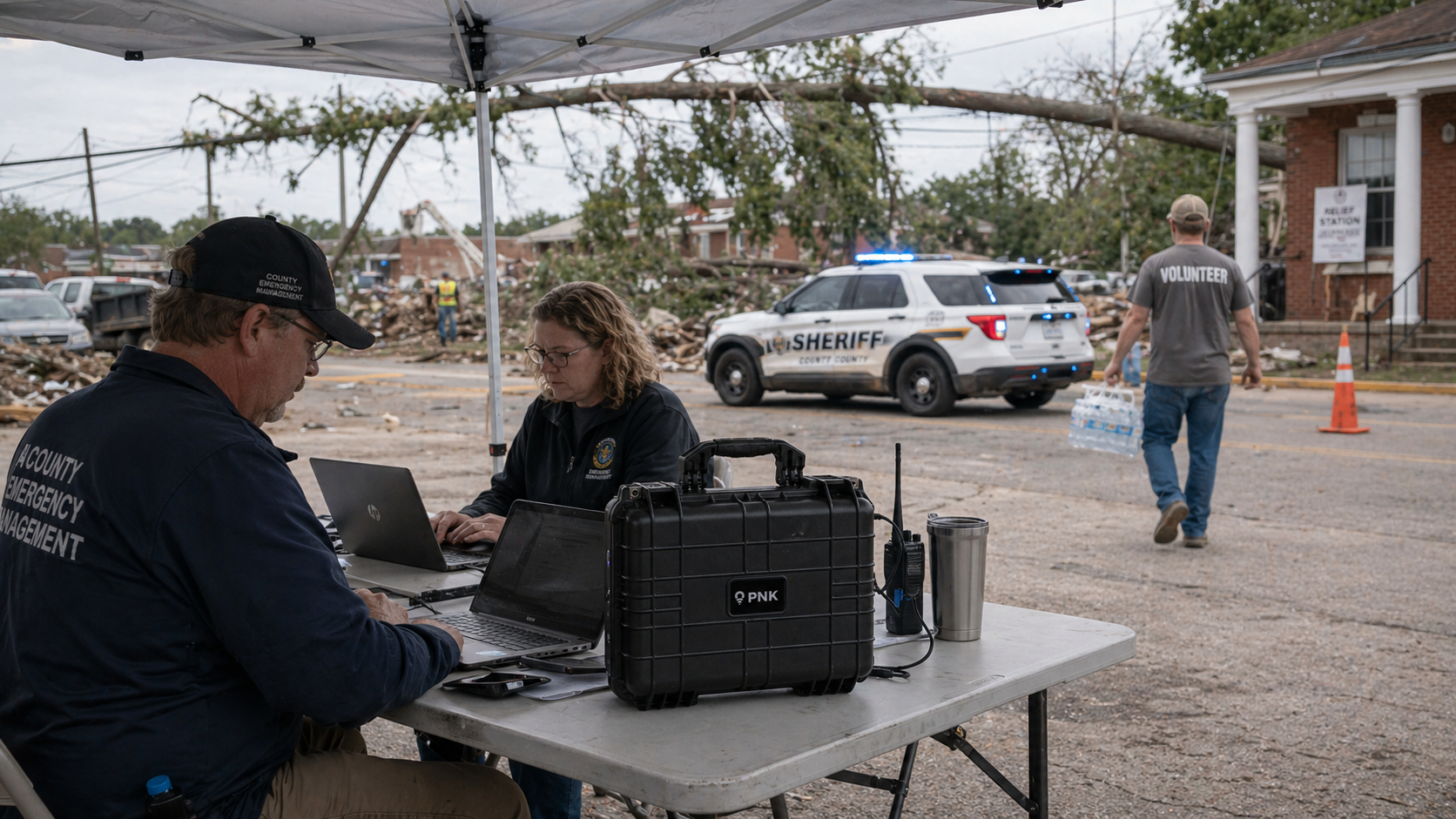
Hour 6 to 12. A forward staging area is set up at the impact zone. Either the deputy team brings the second kit, or the EOC kit relocates with the deputy EM director and the second cabinet kit comes online at the EOC. The relocation does not require a new configuration. The kit comes up on the same network policy at the new site. If the impact zone has lost every cellular tower in range, the Starlink-ready configuration adds the satellite uplink and the response continues. By hour twelve the EM director has a stable comms posture, a working audit trail, and a kit that can move again at hour eighteen if the situation calls for it.
What the kit does not give you is a guarantee that nothing will go wrong. Storm response is a contact sport. What it gives you is a network that comes up when it is supposed to, fails over when one carrier loses a tower, brings satellite into the picture when every tower is gone, and produces the documentation the FEMA officer will ask for during PA closeout. That is what a rapidly deployable cellular network is supposed to do for an emergency manager.
Frequently Asked Questions
What is a deployable 5G network for storm recovery?
A deployable 5G network is a self-contained, multi-carrier cellular and Wi-Fi system that provides secure, audit-trail-ready connectivity to an emergency operations center, forward staging area, or alternate site when primary circuits and local infrastructure are damaged. RCN’s Pop-Up Network Kit, built on the Cradlepoint R1900, is a deployable 5G network designed to be activated by emergency management staff without a network engineer on site.
How quickly can the R1900 PNK come online during an activation?
From the moment the case is opened and the external power button is pressed, the unit typically boots and registers on the strongest available carrier in under a minute. The pre-configured VPN tunnel and VLANs come up on boot. Devices already provisioned with the SSID and credentials connect on their own. Most EOCs have the network broadcasting and devices online within five minutes of the activation call.
What if every cell tower in the impact zone is down?
The R1900 PNK is multi-carrier by design and runs Verizon, AT&T (with FirstNet-compatible operation via AT&T SIMs), T-Mobile, and US Cellular as the configuration calls for. When one carrier loses a tower, the unit fails over without dropping the session. If every cellular tower in the impact zone is dark, the Starlink-ready configuration adds satellite uplink for the duration of the response. The Panorama Mako high-gain antenna also pulls workable signal in fringe coverage areas where a stock antenna would not.
Is the R1900 PNK eligible for FEMA Public Assistance?
For federally declared incidents where the kit supports an essential response function, the R1900 PNK and its operational use generally fit within FEMA Public Assistance Category B, Emergency Protective Measures. RCN does not adjudicate eligibility, which is between the agency and the FEMA Public Assistance officer, but the kit’s NetCloud audit trail and RCN’s deployment records support the documentation reviewers expect during PA closeout.
How does the kit handle multi-carrier failover?
The R1900 supports active-active dual-modem operation, meaning both carriers can be in service at the same time and the unit can fail over without re-establishing the session. RCN configures the carrier policy before shipping based on the agency’s coverage profile in the area where the kit will deploy. NetCloud Manager logs every failover event for the after-action file.
How is the kit managed and supported during a long incident?
Every R1900 PNK is enrolled in Ericsson Cradlepoint NetCloud Manager, which lets county IT or RCN’s 24/7 NOC monitor the unit in real time. The NOC proactively flags signal degradation, certificate issues, or carrier policy questions and resolves most field issues remotely. For multi-day or multi-week incidents, the NOC stays in the loop without the agency having to file a ticket every time something needs attention.
How does the R1900 PNK fit into ICS or unified command?
The kit is a transport-layer asset. It provides the network the response runs on rather than dictating how the response is structured. In ICS terms, the kit supports the Communications Unit Leader’s plan and is documented in the ICS-205 communications plan when needed. The PNK can move between the EOC, forward staging, an alternate EOC, and the joint information center as the unified command structure evolves through the incident.
You May Also Be Interested In…

Hurricane Season 2026: Emergency Connectivity Before the Storm Hits
Speak with a Connectivity ExpertReady to deploy one-button connectivity for your mobile blood drives? Want to Learn More? Request a custom quote.
Satellite vs. 5G: Which Wins for Remote and Temporary Sites?
Speak with a Connectivity ExpertReady to deploy one-button connectivity for your mobile blood drives? Want to Learn More? Request a custom quote.
Starlink for NPS Search and Rescue: A Command Network for the Trailhead
Mark Indelicato | Manager, Growth & Analytics at RCN TechnologiesMark leads digital growth strategy and marketing analytics, helping organizations navigate the transition from legacy connectivity to modern wireless and 5G solutions.The call comes in mid-afternoon....
Speak with a Connectivity Expert
Ready to deploy one-button connectivity for your mobile blood drives?


Want to Learn More?
Request a custom quote.