

Deployable 5G Networks for Construction Sites: Connecting LOTO Stations Before Permanent ISP Arrives

Mark leads digital growth strategy and marketing analytics, helping organizations navigate the transition from legacy connectivity to modern wireless and 5G solutions.
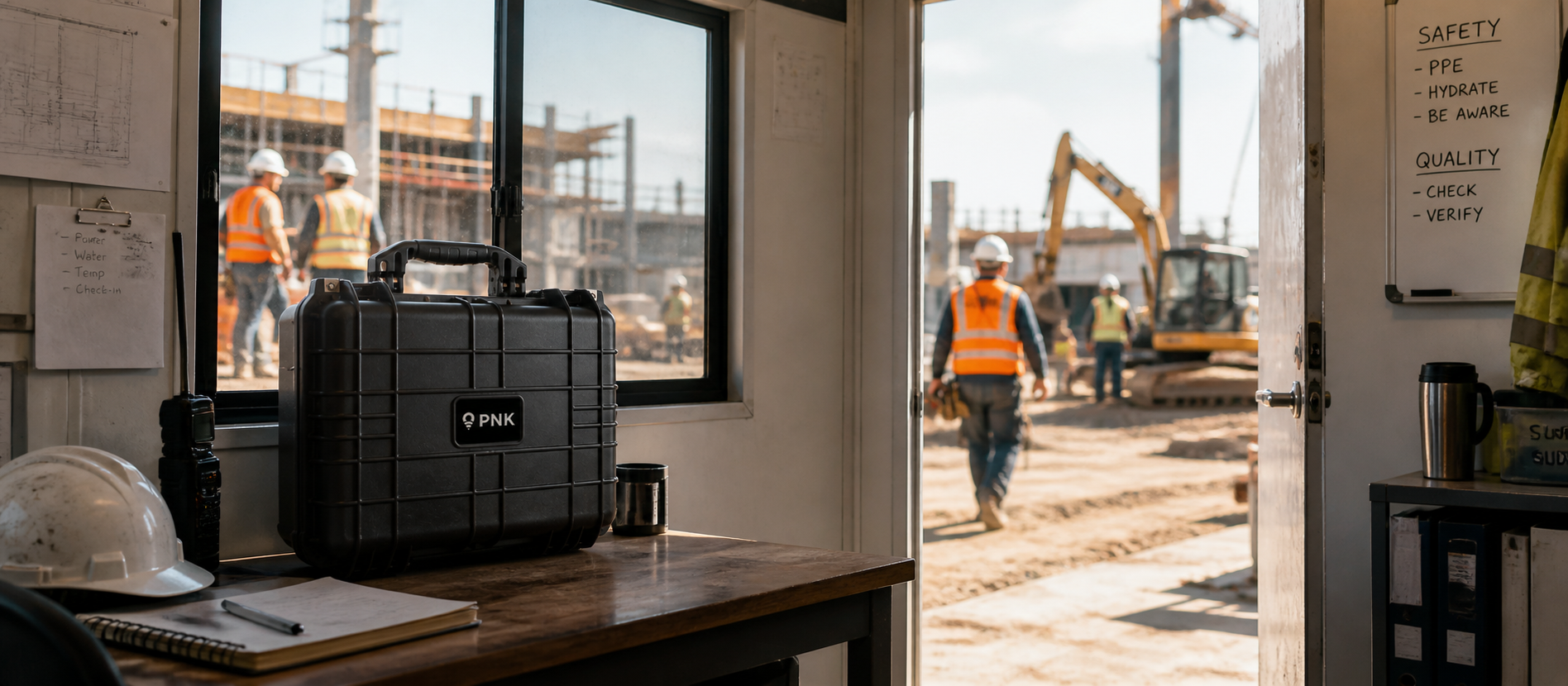
A construction superintendent walks into the jobsite trailer at 6 AM. The day’s first concrete pour starts in ninety minutes. Before any worker can apply a lock or a tag to the energy-isolation point on the pump, the digital lockout/tagout (LOTO) platform needs to authenticate the request, log the lock-holder, and post the energy-control plan to every device on site. The trailer’s “internet” is the super’s phone hotspot. It dropped four times during yesterday’s pour. Permanent ISP is not scheduled to land for another nine weeks. This is the gap a deployable 5G network is built to close.
What “Network-Dependent LOTO” Actually Means
For decades, lockout/tagout was a paper procedure. A worker pulled a lock and a tag from a board, applied them to the energy-isolation point, and signed a clipboard. OSHA 29 CFR 1910.147 governed the process; compliance was tracked on paper.
That is changing fast. Cloud-based LOTO platforms now drive the workflow on most large industrial and commercial jobsites: digital authentication of the authorized employee, real-time visibility into who has locks on which equipment, automated energy-control plan distribution, electronic permit-to-work integration, and audit-grade logging that lives in a cloud database rather than a binder in the trailer.
Every one of those capabilities depends on connectivity. When the network drops, the platform either falls back to a degraded offline mode (which most safety teams will not accept on energized work) or stops the work entirely until connectivity returns. The LOTO platform does not care that the site is pre-ISP. It expects an internet connection.
Phone hotspots and mobile MiFi devices are what most general contractors default to during the pre-ISP window. They were never built for it. A consumer hotspot tops out at ten to fifteen connected devices, runs on a single carrier with no failover, and treats a dropped session as a normal occurrence. A jobsite with LOTO stations, security cameras, project-management tablets, surveying gear, and crew Wi-Fi will saturate that hotspot in the first hour of work.
Why a Deployable 5G Network Beats
Job-Trailer Wi-Fi or Phone Hotspots
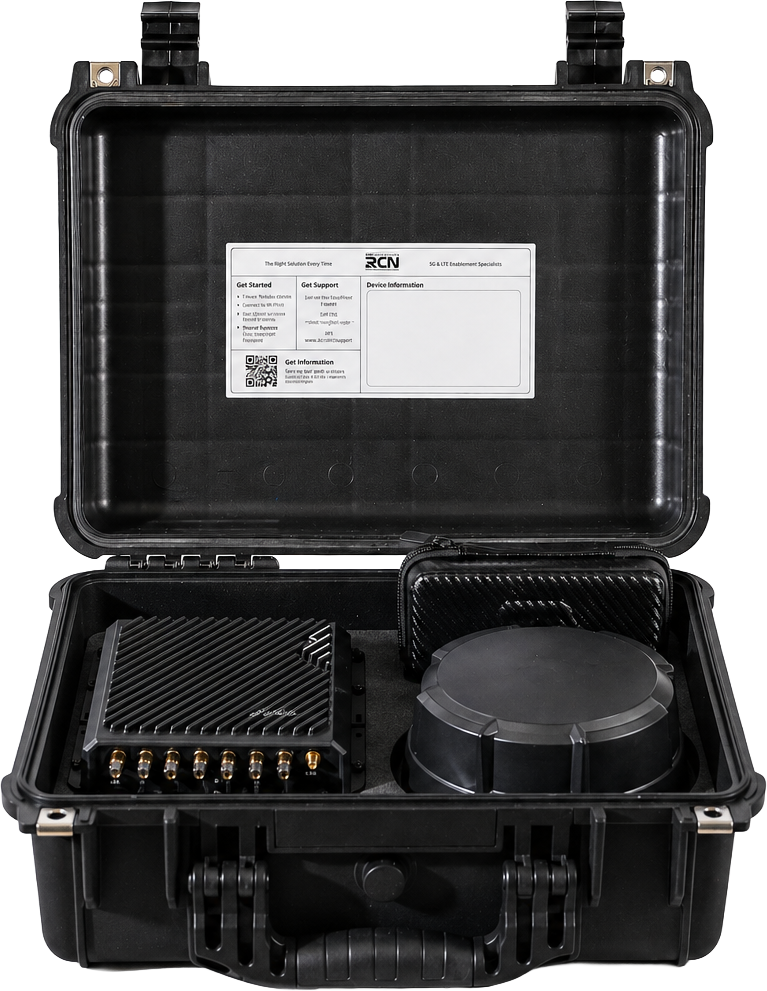
A deployable 5G network, like RCN’s Pop-Up Network Kit (PNK), is purpose-built for exactly this gap. The PNK arrives in a sealed, ruggedized case with the network pre-provisioned. The site team opens the case, presses the power button, and the network is live in under a minute. From that point forward, the trailer, the LOTO stations, the security cameras, and the crews are on the same managed, segmented, multi-carrier network the GC’s permanent infrastructure will eventually become.
The differences from a phone hotspot are not subtle:
- Up to 100 connected devices on a standard PNK, versus ten to fifteen on a consumer hotspot.
- Multi-carrier cellular with automatic failover between Verizon, AT&T (FirstNet-compatible via AT&T SIMs), and T-Mobile, instead of a single carrier with no fallback.
- End-to-end encryption on the cellular link plus WPA3 on the local wireless, instead of the open or weakly-secured Wi-Fi most hotspots ship with.
- VLAN segmentation so safety-critical traffic (LOTO authentications, alarm signaling, security cameras) lives on its own segment, separate from crew browsing or guest devices.
- Up to 10 site-to-site VPN tunnels, so the jobsite can reach the GC’s home-office systems, the LOTO platform’s cloud, the project-management environment, and any subcontractor’s required network paths simultaneously.
- 24/7 NOC support, so when something fails at 4 AM the morning before a pour, a U.S.-based technician sees the unit in NetCloud Manager and resolves it remotely.
The single point of comparison that matters most: the PNK is what the site uses in production, not a stopgap. When permanent ISP eventually lands, the PNK becomes the LTE/5G failover layer for the wired connection, or rolls to the next pre-ISP project on the GC’s calendar.
Choosing the Right PNK Configuration for Your Jobsite
RCN ships three primary PNK configurations and a Starlink-ready variant. Configuration depends on site size, device density, criticality of the connected work, and cellular coverage at the jobsite.
Cradlepoint R980 PNK
Single trailer, small to mid-sized crew, LOTO plus crew Wi-Fi plus a few cameras. Up to 100 devices, 10+ hours on internal battery, 14 lbs.
Cradlepoint R1900 PNK
Larger sites, multiple trailers, more cameras and IoT, vehicle-mounted use in foreman trucks. Built for higher device density and linear projects (highway, pipeline, transmission).
R1900 Dual Modem PNK
Active-active redundancy on two carriers simultaneously. No switchover gap. For high-voltage utility work, refinery turnarounds, hospital and data-center construction with critical environment integration.
Starlink-ready PNK
Remote infrastructure work where cellular coverage is marginal or absent. Rural transmission, pipeline, off-grid renewable installation, road and bridge work in low-population corridors.
Learn more about StarlinkFor most jobsites in metro and suburban coverage, the R980 or R1900 will do the job. For remote work, the Starlink-ready configuration is the answer. RCN’s engineering team will spec the right configuration based on a quick coverage check and a device count for the site.
OSHA, Insurance, and Project-Schedule Considerations
Network-dependent LOTO is not the only stake on the line during the pre-ISP window. Three other costs compound when the jobsite network is unreliable.
OSHA exposure on lockout/tagout
OSHA 29 CFR 1910.147 violations were among the top ten most-cited standards in fiscal 2024. Where a digital LOTO platform is the system of record, an unreliable network creates documentation gaps the platform cannot fill in after the fact. A connectivity drop during a lockout event is not just an operational nuisance; it is a hole in the audit trail.
Insurance and contractual obligations
A growing number of project owners and insurers are writing connected-jobsite requirements into contracts: 24/7 site-camera monitoring, real-time access logging, integrated safety-platform reporting. None of those requirements pause for permanent ISP installation. The GC is on the hook from the day the trailer rolls in.
Per-day delay cost
The all-in cost of a single delayed work day on a mid-sized commercial project runs into five and six figures. A LOTO platform stoppage that idles a crew for half a shift will, on most projects, exceed the entire monthly cost of the PNK within a single incident. The math is rarely close.
These three pressures together explain why GCs that have run pre-ISP windows on phone hotspots are increasingly walking away from that approach. The downside risk is asymmetric.
Where the PNK Platform Shows Up Beyond Construction
The PNK platform has been deployed across verticals where the operational pattern looks similar to a pre-ISP construction site: rapid stand-up, no permanent infrastructure, mission-critical applications, non-IT operators in the field. RCN’s PNK fleet is in active use with emergency management agencies running mobile incident command, public-safety teams establishing field connectivity in the wake of severe weather, mobile blood-collection operations running secure clinical workflows from a parking lot, and county election offices powering electronic poll books from rented buildings on Election Day.
The construction jobsite is the same pattern with a different uniform. The hardware, the management plane, the carrier resilience model, the NOC, and the deployment ergonomics are the same.
Spec the right PNK for your next pre-ISP jobsite.
RCN's engineering team runs a coverage check, a device-count review, and a configuration recommendation in a single 20-minute scoping call. No hardware decisions until the site profile is on the table.
Talk to a PNK SpecialistRCN Technologies is an Ericsson Cradlepoint Technical Excellence Partner serving construction, industrial, and adjacent verticals across all 50 states.
Frequently Asked Questions
What is a deployable 5G network for a construction site?
A deployable 5G network is a self-contained, rapidly deployable cellular and Wi-Fi system that delivers managed, segmented, multi-carrier connectivity to a jobsite from the day the trailer arrives. RCN’s Pop-Up Network Kit, built on Ericsson Cradlepoint hardware, is purpose-built to bridge the connectivity gap between project mobilization and permanent ISP turn-up.
How does a PNK support network-dependent LOTO platforms?
The PNK provides the always-on, segmented, multi-carrier connectivity that cloud-based lockout/tagout platforms require. LOTO traffic can run on its own VLAN, separated from crew Wi-Fi and guest traffic, with end-to-end encryption on the cellular link. Multi-carrier failover means a single tower outage does not stop a lockout authentication.
How long does setup take?
A standard PNK is shipped pre-provisioned. The site team opens the case, presses the power button, and the network broadcasts its pre-configured SSID inside one minute. No SIM swapping, no firmware flashing, no IT staff on site.
What if cellular coverage is weak at the jobsite?
The standard PNK ships with a Panorama Mako high-gain 5G antenna that pulls usable signal in locations where consumer hotspots fail. For sites with no reliable cellular coverage, RCN offers a Starlink-ready PNK that adds satellite as either a primary or backup link.
What happens when permanent ISP arrives?
The PNK does not get retired. It becomes the LTE/5G failover layer for the wired connection, or rolls to the next pre-ISP project on the GC’s calendar. Many of RCN’s construction-adjacent customers maintain a PNK on every active site as always-on failover insurance against ISP outages.
Does the PNK support security cameras and other jobsite IoT?
Yes. The PNK supports up to 100 connected devices and full VLAN segmentation, so security cameras, environmental sensors, asset trackers, and other jobsite IoT can run on isolated network segments separate from crew and operational traffic.
You May Also Be Interested In…

AT&T FirstNet for Fire and EMS: A Command Network You Own
Speak with a Connectivity ExpertReady to deploy one-button connectivity for your mobile blood drives? Want to Learn More? Request a custom quote.

Hurricane Season 2026: Emergency Connectivity Before the Storm Hits
Speak with a Connectivity ExpertReady to deploy one-button connectivity for your mobile blood drives? Want to Learn More? Request a custom quote.
Satellite vs. 5G: Which Wins for Remote and Temporary Sites?
Speak with a Connectivity ExpertReady to deploy one-button connectivity for your mobile blood drives? Want to Learn More? Request a custom quote.
Speak with a Connectivity Expert
Ready to deploy one-button connectivity for your mobile blood drives?

Want to Learn More?
Request a custom quote.