

What to Do With School Bus Wi-Fi Routers After E-Rate Funding Ends

Mark leads digital growth strategy and marketing analytics, helping organizations navigate the transition from legacy connectivity to modern wireless and 5G solutions.
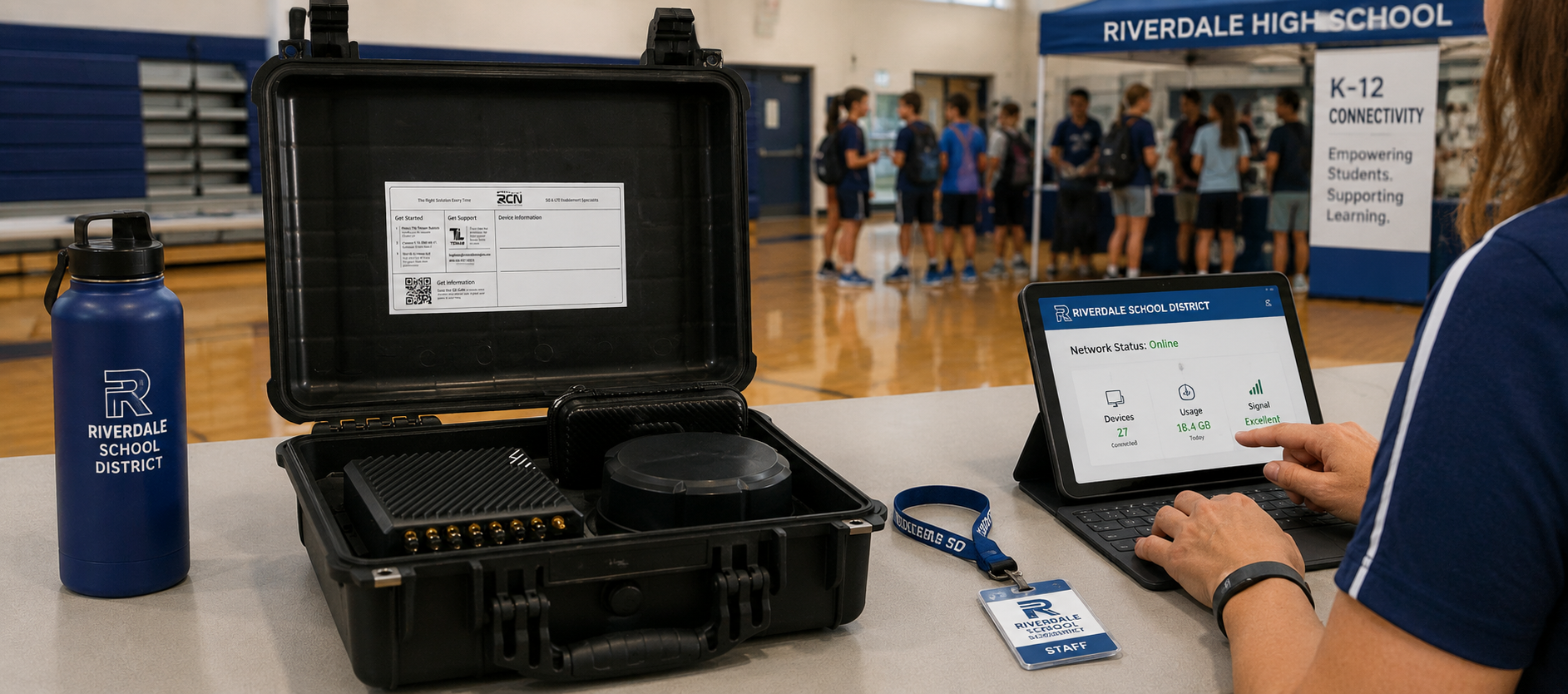
The FCC voted on September 30, 2025 to remove school bus Wi-Fi from E-Rate eligibility. Thousands of school districts are now sitting on enterprise-grade cellular routers they can no longer afford to operate on buses. Cradlepoints. Peplinks. Semtech XRs. Hardware that cost districts real capital, now pulling SIM cards and gathering dust in IT closets. A mid-sized school district in Indiana and Fox C-6 School District in Missouri found a better answer than storage. Their Directors of IT sent those routers to RCN Technologies, which repurposed them into a deployable 5G network the district can take anywhere: athletic events, field trips, administrative operations off-site, emergency response, or any situation where the district needs high-bandwidth connectivity outside its buildings.
What Hardware Qualifies?
This is not a Cradlepoint-only story. The districts getting the most out of their stranded routers come in with a range of hardware, and the RCN Pop-Up Network Kit (PNK) platform supports all of it. Qualifying devices include the full Ericsson Cradlepoint line: R920, R980, and R1900 series, as well as IBR1700 and IBR900 units that were commonly deployed under E-Rate bus Wi-Fi programs. On the Peplink side, the Max Transit series and BR1/BR2 Pro devices qualify. Semtech (formerly Sierra Wireless) XR and MG series routers are also supported.
| OEM / family | Models supported for PNK conversion |
|---|---|
| Ericsson Cradlepoint | R920, R980, R1900 series, IBR1700, IBR900 |
| Peplink | Max Transit series, BR1 Pro, BR2 Pro |
| Semtech (formerly Sierra Wireless) | XR series, MG series |
| Other compatible platforms | Teltonika, Digi, InHand Networks (contact RCN for evaluation) |
If your district ran a bus Wi-Fi program and decommissioned that hardware when the E-Rate funding was pulled, there is a strong chance those devices have years of service life remaining. The router is not the problem. The problem was the ongoing operational cost of carrier data plans, licensing fees, and management overhead that E-Rate dollars used to offset. The PNK model restructures that cost equation entirely.
For device-specific specifications, the Cradlepoint R980 product page is the authoritative reference for that device family. The rest of this guide covers how RCN converts that hardware, regardless of brand, into a working district-owned deployable network. If your district’s hardware is not listed here, contact RCN for a compatibility evaluation before writing off the asset.
Why a Deployable 5G Network Requires More Than a Router
A decommissioned bus router is not a deployable network. It is a box. Getting it to the point where a coach, an assistant superintendent, or a facilities coordinator can power it on at a football stadium and have a working high-bandwidth connection requires a specific stack of configuration work that has nothing to do with the router’s hardware capability.
That stack includes: SIM cards sourced, provisioned, and carrier-tested; security configurations congruent with district policy; firmware current and management platform enrollment complete; a cellular antenna tuned for the deployment contexts the district actually uses. None of that ships from Cradlepoint, Peplink, or Semtech. It is integration work, and it has to be done right or the unit fails in the field at exactly the wrong moment.
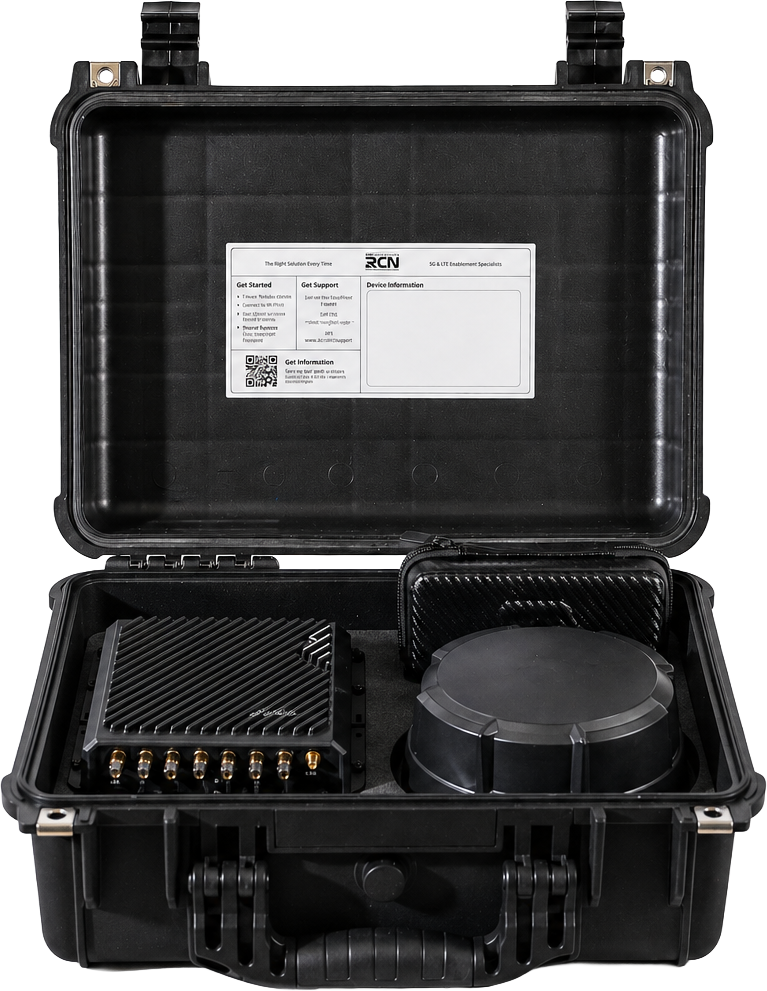
A true deployable 5G network like the RCN Pop-Up Network Kit (PNK) handles all of that before the case ships back to the district:
- Submitted router inspected, firmware-updated, and factory-reset to a clean baseline before optional configuration work from RCN technicians with the district
- Multi-carrier SIMs (Verizon primary plus AT&T backup, with T-Mobile available) provisioned and carrier-tested
- Panorama Mako 4×4 MiMo antenna integrated for high-gain outdoor performance
- Management platform enrollment complete, with every unit visible from the district IT dashboard
- Rugged Pelican-style case, battery pack, and charging kit assembled and labeled
The Director of IT at the mid-sized Indiana school district did not need to re-provision SIMs. The Director of IT at Fox C-6 did not need to mount gear into the PNK. They received a turnkey solution ready to deliver a 5G deployable network with a single push of a button.
How the PNK Wors for District Operations Teams
The people deploying a PNK in a K-12 environment are not network engineers. They are athletic directors, event coordinators, assistant principals, and facilities staff. The unit is designed around that reality.
- Deploy the case. The router, antenna, battery, and power cables are already connected and secured. Nothing comes loose in transport.
- Press the external power button. One button. It is on the outside of the case, labeled, and lit green when the unit is on.
- Wait 45 seconds. The network broadcasts the pre-configured SSID. District devices connect automatically using stored credentials.
That is the full deployment procedure. It is that simple for anyone, regardless of technical expertise.
What the team does not have to do
- No SIM selection or swapping
- No antenna alignment
- No carrier login or data plan management
- No VPN initiation
- No password distribution to staff
- No firmware checks
- No help-desk ticket to get online
If something goes wrong, which is rare, the team calls RCN’s NOC at the number printed on the case. A technician sees the unit in the management platform in real time and resolves the issue remotely. The event coordinator stays focused on running the event.
What this means operationally
Districts deploying a PNK convert a stranded capital asset into a flexible infrastructure resource. Setup time at a deployment site drops to under two minutes. IT staff do not travel to events to stand up connectivity. The unit goes in the van with whoever is running the program. Districts running 20 to 40 off-campus events per year report eliminating the help-desk ticket category for field connectivity entirely once the PNK is in place.
The second-order benefit is district-wide flexibility. A router that was locked to bus routes is now a network the district can point anywhere it has a need: a temporary classroom in a portable, an outdoor graduation ceremony, a community emergency shelter the district is hosting, or a remote administrative meeting site.
CIPA Compliance for Student-Facing Deployments
The Children’s Internet Protection Act requires school districts to filter harmful content on any network used by students. That requirement does not stop at the building door. A PNK deployed at a field trip, an athletic event, or a district-run community program where students are connecting is subject to the same CIPA obligations as the district’s on-premises network. Districts repurposing bus routers into a PNK need to meet that requirement, and there are three ways to do it depending on what the district already has in place.
RCN can configure the appropriate filtering approach before the unit ships, based on what the district already uses. The Director of IT confirms the method during the conversion evaluation. The field team deploying the unit does not manage any of this.
Case Reference: A Mid-Sized Indiana School District and Fox C-6 School District
A mid-sized school district in Indiana and Fox C-6 School District in Missouri arrived at the same problem from the same direction. Both districts had invested in school bus Wi-Fi programs under the E-Rate expansion. Both had enterprise-grade cellular routers installed, configured, and running. When the FCC reversed the E-Rate bus Wi-Fi eligibility in September 2025, both districts faced the same math: the ongoing operational cost of those programs, carrier data plans and management licensing, was no longer offset by federal reimbursement. Shutting down the programs was the path of least resistance. The hardware went into storage.
The Directors of IT at both districts chose to look at the problem differently. The routers were not a liability. They were a capital asset the district already owned, sitting idle. Both engaged RCN Technologies to evaluate whether that hardware could be converted into a district-owned rapidly deployable cellular network for operational use. It could. RCN inspected the units, updated firmware, rebuilt the configuration from a clean baseline, provisioned multi-carrier SIMs, integrated external antennas, and shipped sealed, deployment-ready cases back to each district.
Both districts now operate PNKs that serve district needs well beyond what the original bus Wi-Fi program covered, including off-campus athletic events, administrative operations, field programs, and emergency preparedness use cases the districts had previously either foregone or patched together with consumer hotspots.
Adjacent districts operating on the same platform include Pennsylvania Leadership Charter School, which runs a 60-unit fleet of PNK devices across its campus operations, the largest single K-12 PNK deployment in RCN’s customer base.
Procurement Vehicles for School Districts and Government Buyers
Districts and government agencies can purchase the PNK without running a competitive bid. RCN Technologies is available through four cooperative purchasing contracts that satisfy most public procurement requirements.
- OMNIA Partners
- Sourcewell
- GSA Multiple Award Schedule (MAS)
- State of Pennsylvania
Contact RCN to confirm which vehicle fits your district’s procurement framework and to obtain contract-specific pricing and documentation.
See if your district's stranded routers qualify.
RCN's engineering team runs a hardware compatibility check, configuration review, and CIPA filtering recommendation in a single 20-minute scoping call. No commitment until the conversion plan is on the table.
Request a Conversion EvaluationFrequently Asked Questions
What is a deployable 5G network for school districts?
A deployable 5G network is a self-contained, pre-configured cellular and Wi-Fi system that gives a school district high-bandwidth connectivity at any location, on demand, without requiring on-site IT support to set up. RCN’s Pop-Up Network Kit (PNK) is a deployable 5G network designed to be operated by non-technical district staff, including coaches, event coordinators, and administrators, with a single power button press.
Can our district's existing bus Wi-Fi routers actually be reused for a PNK?
In most cases, yes. RCN supports conversion of Ericsson Cradlepoint R920, R980, R1900, IBR1700, and IBR900 units; Peplink Max Transit and BR1/BR2 Pro devices; and Semtech (formerly Sierra Wireless) XR and MG series routers. RCN inspects the hardware, updates firmware, rebuilds the configuration, provisions new SIMs, and integrates an external antenna before shipping a deployment-ready unit back to the district. The district’s capital investment is preserved rather than written off.
How does a non-technical staff member deploy the PNK at an off-campus location?
Open the case, press the external power button, and wait 45 seconds. The network broadcasts automatically. Staff devices connect using stored credentials. There is no SIM management, no carrier login, no VPN initiation, and no password distribution. Most district staff stop referring to the laminated instruction card inside the case after their second deployment.
What happens to E-Rate compliance obligations on repurposed hardware?
The PNK is not an E-Rate funded service. It is a district-owned asset with a new use. Districts should confirm with their E-Rate consultant whether their original procurement documentation creates any disposition requirements on the hardware. RCN is not an E-Rate consultant and cannot advise on that question. What RCN can confirm is that the PNK’s configuration and service model is entirely independent of the E-Rate program.
How does the PNK handle CIPA content filtering requirements for student-facing deployments?
CIPA obligations follow students onto any district-operated network, including a PNK deployed at an off-campus event. Districts can meet that requirement three ways: content filtering policies applied at the router level via the device’s management platform, carrier-based filtering through compatible SIM plans such as Kajeet, or a DNS-based software overlay that extends the district’s existing filtering platform to the PNK. RCN configures the appropriate method before the unit ships based on what the district already uses.
What if a deployment site has weak cellular coverage?
The PNK includes a Panorama Mako antenna, which significantly improves signal capture in marginal coverage areas ranging from indoor facilities to large outdoor venues. For sites with no reliable cellular coverage at all, RCN offers a Starlink-ready PNK configuration that adds satellite connectivity alongside cellular.
What does ongoing management look like after the district receives the unit?
Every PNK is enrolled in a cloud-based network management platform. The district’s IT staff can monitor all deployed units from a single dashboard, tracking signal quality, data usage, connected devices, and unit status, without physically visiting the deployment site. RCN’s NOC can provide remote support if the field team encounters a problem. In most cases, the NOC resolves the issue before the event coordinator is even aware something was wrong.
Can school districts purchase the PNK without running a competitive bid?
Yes. RCN Technologies is available through OMNIA Partners, Sourcewell, GSA Multiple Award Schedule (MAS), and the State of Pennsylvania cooperative contract. Each vehicle was competitively solicited, satisfying most public procurement requirements without a separate district RFP. Contact RCN for contract-specific pricing and documentation.
You May Also Be Interested In…

AT&T FirstNet for Fire and EMS: A Command Network You Own
Speak with a Connectivity ExpertReady to deploy one-button connectivity for your mobile blood drives? Want to Learn More? Request a custom quote.

Hurricane Season 2026: Emergency Connectivity Before the Storm Hits
Speak with a Connectivity ExpertReady to deploy one-button connectivity for your mobile blood drives? Want to Learn More? Request a custom quote.

Satellite vs. 5G: Which Wins for Remote and Temporary Sites?
Speak with a Connectivity ExpertReady to deploy one-button connectivity for your mobile blood drives? Want to Learn More? Request a custom quote.
Speak with a Connectivity Expert
Ready to deploy one-button connectivity for your mobile blood drives?


Want to Learn More?
Request a custom quote.