

Wireless Insights
Satellite vs. 5G: Which Wins for Remote and Temporary Sites?
When the site has no fixed line, the real question is not which technology is better in the abstract. It is which path keeps your team online when the work cannot wait. Here is how cellular 5G and satellite internet actually compare, and the kit that runs both.
Talk to a PNK specialistIf you need connectivity at a place where there is no wired internet, a pole barn, a disaster staging area, an election warehouse, a construction trailer, a parking lot turned event venue, you are really choosing between two paths: cellular 5G or low-earth-orbit satellite. The honest answer is that neither one wins every time, and the most resilient setups treat them as teammates inside a single deployable 5G network rather than as rivals.
Cellular 5G gives you high throughput and low latency wherever there is carrier coverage, and it works on the move. Built on a purpose-built 5G router, a multi-carrier setup can aggregate several major carriers so the device rides whichever signal is strongest. Satellite, by contrast, does not care whether a cell tower exists. As long as the dish has a clear view of the sky, modern low-earth-orbit service delivers usable broadband almost anywhere on earth, which is exactly what you want when the nearest tower is down or was never built.
The Pop-Up Network Kit (PNK) is RCN Technologies' answer to the choice itself. It is a ruggedized, pre-provisioned network in a case that can run multi-carrier 5G, satellite, or both together, with RCN's 24/7 U.S.-based NOC watching the connection the whole time. Below is the comparison that tells you which path fits your deployment, followed by how the PNK removes the need to pick just one.
Use 5G when there is cellular coverage at the site. It is faster, lower latency, cheaper to run, and it works while a vehicle is moving. Use satellite when there is no tower, the towers are down, or the site is truly off-grid. It needs only a clear view of the sky. For mission-critical work, use both: a deployable kit that aggregates multiple carriers and adds a satellite path gives you a connection that survives a tower outage, a congested cell, and a cut fiber line.
How 5G works for remote and temporary sites
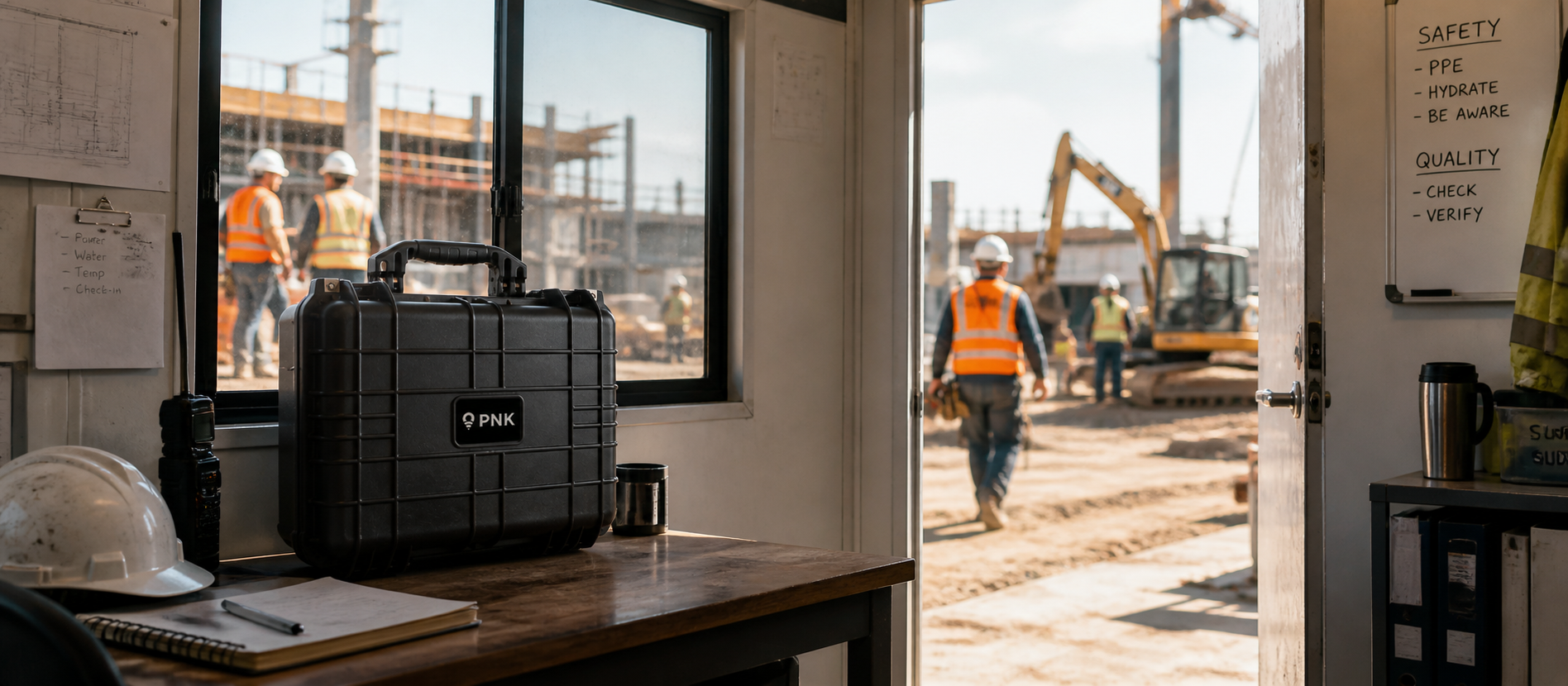
Cellular 5G is the default for any site within reach of a carrier network, and most sites are. A purpose-built 5G router connects to the macro network the same way a phone does, then shares that connection over Wi-Fi and Ethernet to everyone on site.
Three things make cellular the strong default. First, performance: 5G commonly delivers download speeds in the 100 to 300 Mbps range with low latency, which is enough for video, voice, cloud applications, and live data reporting. Second, mobility: cellular keeps working while a vehicle moves, so it fits patrol units, command vehicles, and mobile clinics in a way a fixed satellite dish does not. Third, redundancy through carrier diversity: when a router carries SIMs from more than one carrier, it can ride whichever network is strongest and fail over automatically if one degrades.
Cellular can also carry public safety priority service, where first responder traffic is moved to the front of the line when the network is busy. A properly provisioned kit can be set up to use that priority on the carriers that offer it.
The limits are real, though. Where there is no coverage, there is no cellular. And in a dense crowd, a single carrier's local cell congests fast, which is why event and incident sites benefit from multi-carrier aggregation rather than one SIM.
How satellite internet works for remote and temporary sites
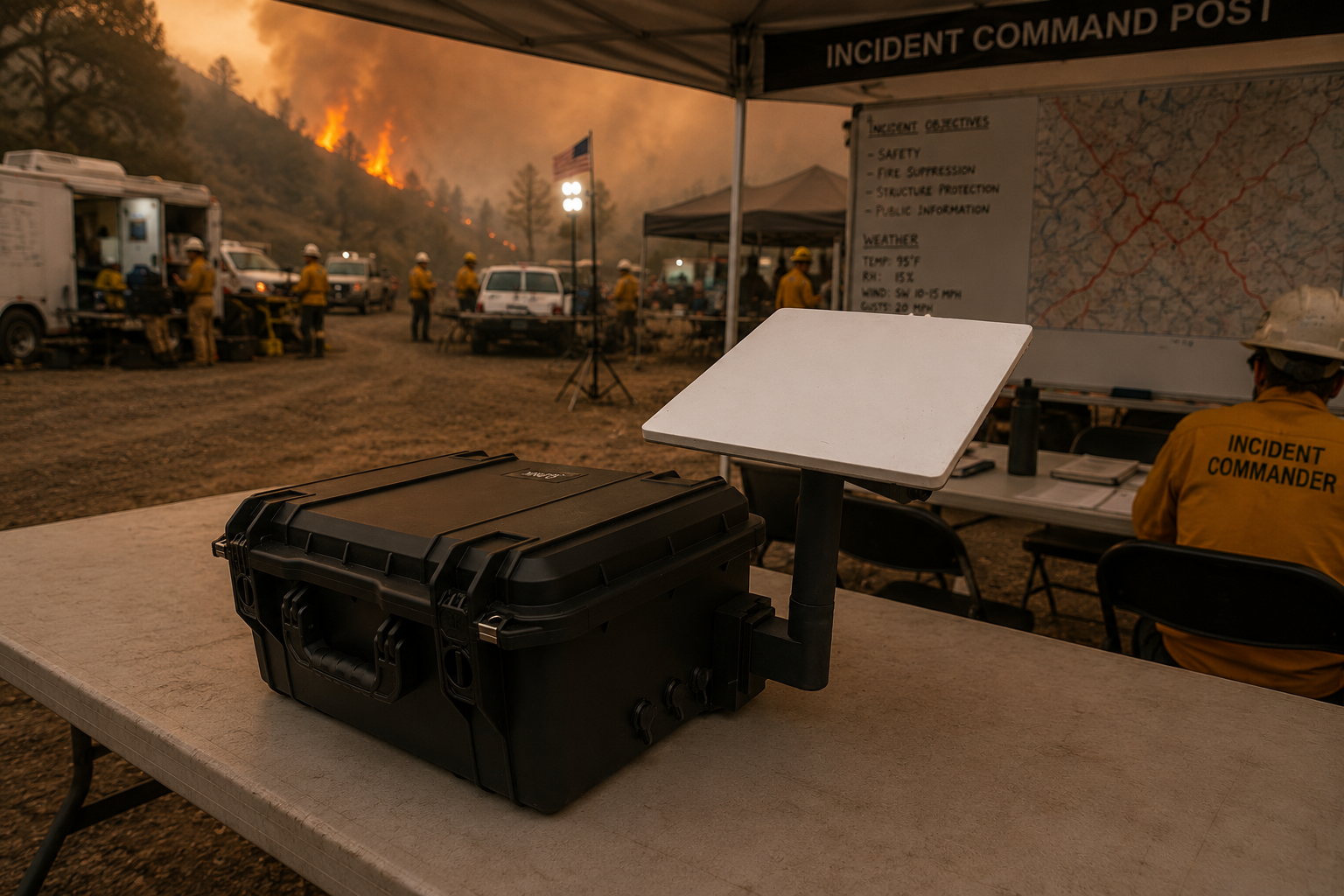
Satellite internet now connects through constellations of low-earth-orbit satellites instead of the distant, slow satellites of a decade ago. The dish acquires satellites overhead and routes traffic up and back down through a ground station, which means the one thing it requires is an unobstructed view of the sky.
That single requirement is also its superpower. Satellite works at sites where cellular was never built and where it has failed: backcountry staging areas, storm zones where towers lost power, remote infrastructure, maritime and island sites. Modern low-earth-orbit service delivers business-grade broadband, commonly in the 100 to 300 Mbps range with newer constellations pushing higher, so it is no longer a slow last resort. It is a primary-quality link in places cellular cannot reach.
The trade-offs to plan around: the dish needs sky clearance and a relatively stable mount, so it is less suited to a vehicle moving at speed than cellular is. Heavy weather can affect the link. And on its own, a single satellite path is still a single path, which is why pairing it with cellular matters for anything mission-critical.
Satellite vs. 5G at a glance
| Factor | Multi-carrier 5G | Low-earth-orbit satellite | Both, in one PNK |
|---|---|---|---|
| Coverage | Anywhere with a carrier tower | Anywhere with a clear view of the sky | Cellular first, satellite where there is no tower |
| Typical speed | ~100 to 300 Mbps | ~100 to 300 Mbps on business plans | Rides the best available path |
| Latency | Low | Low for satellite, higher than cellular | Lowest available path wins |
| Setup time | Minutes | Minutes once the dish has sky view | Operational within about 5 minutes |
| Works on the move | Yes | Limited, the dish needs sky view and a stable mount | Yes, cellular while moving, satellite when parked |
| Congestion behavior | A single cell can congest in dense crowds | Less affected by local crowd density | Multi-carrier plus satellite spreads the load |
| Public safety priority | Available on carriers that offer priority service | Not a carrier priority network | Yes, through the cellular path |
| Best fit | Sites with coverage, mobile use, dense events | Off-grid, tower-down, no-coverage sites | Mission-critical work that cannot tolerate one point of failure |
You do not have to choose: the deployable 5G network that also runs satellite
The reason RCN built the Pop-Up Network Kit is that the field rarely cooperates with a single-path plan. A deployable 5G network has to keep working when one carrier's tower goes dark, when a crowd congests the local cell, and when the site has no terrestrial coverage at all. The PNK is engineered for exactly that.
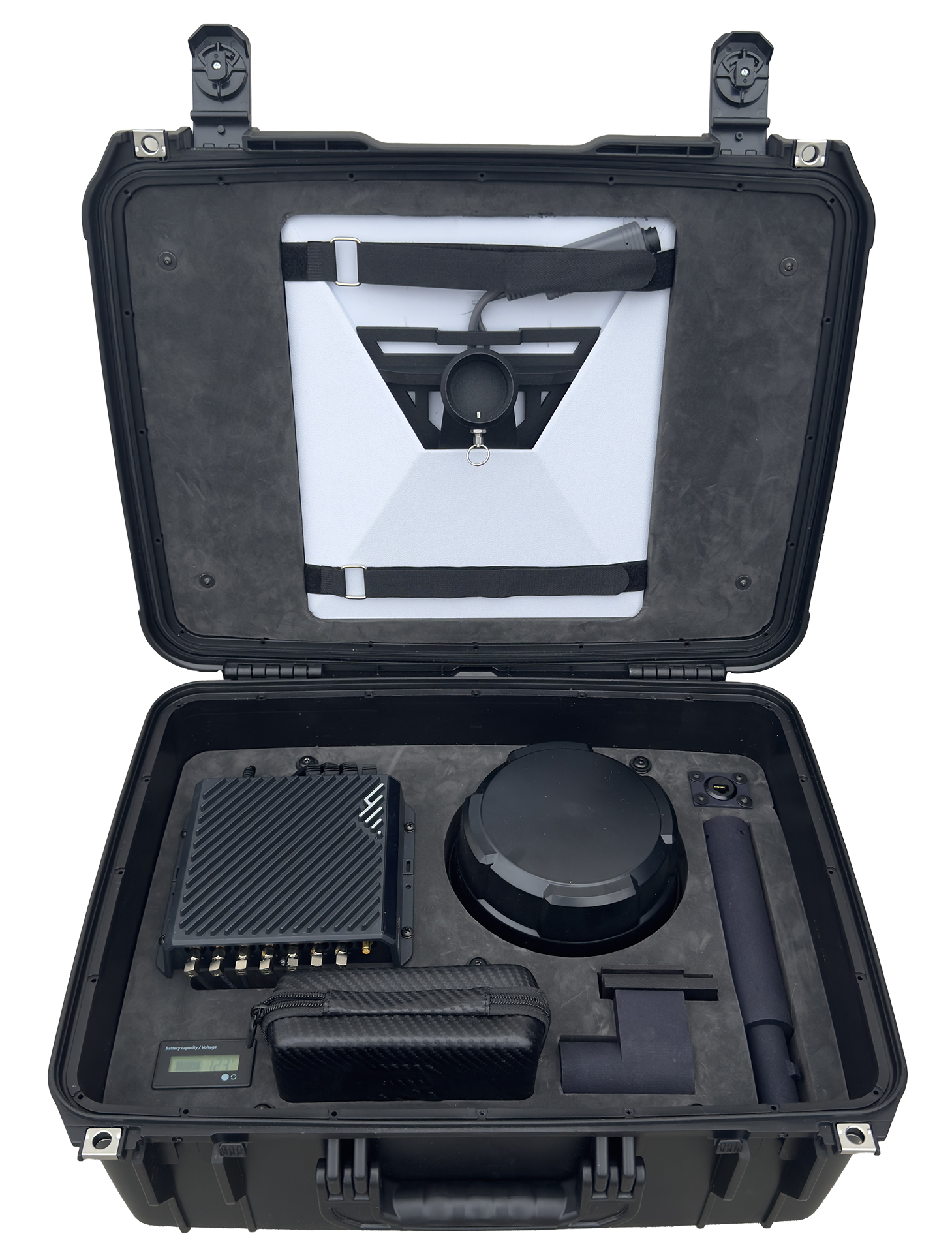
Inside an IP64-rated case, the PNK pairs a purpose-built 5G router with a high-gain antenna, carrier-aggregating SIMs, and RCN provisioning. A compact single-modem PNK runs multiple carriers with automatic failover, so if one network degrades the kit moves traffic to the next. A dual-modem PNK runs two routers on two separate carriers in active-active mode, which means there is no switchover gap at all because both paths are already carrying traffic. A satellite-ready PNK adds a satellite path for sites that have no tower to reach. It supports up to 100 connected devices, full VLAN segmentation for multi-agency operations, WPA3 and end-to-end encryption, and it is operational within about five minutes of arriving on site.
This is also where RCN's full-stack model earns its keep. The kit is pre-staged and pre-provisioned before it ships, and the 24/7 U.S.-based NOC monitors every deployed PNK, often catching a problem before the team in the field notices it. An election authority, for example, might deploy dozens of high-capacity PNKs across its polling places to keep electronic poll books and vote reporting online, while a storm-recovery team in the same county leans on the satellite-ready configuration to stand up a command post where the towers are gone. Same managed model, two different paths to the internet.
Which should you choose? A quick decision framework
Match the deployment to the path:
- Dense event or incident with coverage: Multi-carrier 5G, ideally a dual-modem PNK so a congested or downed carrier never takes you offline.
- Truly off-grid, no tower in range: A satellite-ready PNK, with cellular added wherever any signal exists.
- Disaster or storm recovery with towers down or unstable: Both paths in one kit, so the link survives a tower outage and a cut circuit.
- Construction or remote work site: 5G as the primary link where coverage exists, satellite as the backstop for the corners of the site that lose signal.
- Public safety incident command: A dual-modem 5G kit for active-active carrier redundancy, set up with carrier public safety priority, and satellite available when the incident moves beyond coverage.
The throughline: if losing the connection is an inconvenience, pick the path that fits the site. If losing the connection is unacceptable, run both.
Not sure which path fits your deployment?
Tell us about the site and the mission. RCN's PNK team will recommend the right mix of multi-carrier 5G and satellite, then scope and stage the kit for you.
Talk to a PNK specialistFrequently asked questions
What is a deployable 5G network?
A deployable 5G network is a self-contained, multi-carrier cellular and Wi-Fi system that delivers secure connectivity to a temporary, remote, or emergency site without relying on the local wired infrastructure. RCN's Pop-Up Network Kit is a deployable kit in a ruggedized case that powers on in about five minutes and can add a satellite path where no cell tower exists.
Is satellite or 5G better for business?
It depends on the site. 5G is better where carrier coverage exists because it is faster, lower latency, cheaper to run, and works on the move. Satellite is better where there is no tower or the towers are down, because it needs only a clear view of the sky. Many resilient deployments run both.
Can you use satellite and 5G together?
Yes. A deployable kit can aggregate multiple cellular carriers and add a satellite path, then route traffic over whichever connection is performing best. RCN's satellite-ready PNK is built to do this, so a tower outage, a congested cell, or a cut fiber line does not take the site offline.
Which has lower latency, satellite or 5G?
Cellular 5G generally has lower latency than satellite for latency-sensitive tasks like voice and video calls. Modern low-earth-orbit satellite latency is much lower than older satellite internet and is workable for most business applications, but where both are available, the cellular path is typically the lower-latency choice.
Does 5G work where there is no cell tower?
No. Cellular 5G requires a carrier tower within range. If the site has no coverage, you need satellite. This is the single most common reason deployments add a satellite path to a cellular kit.
Is satellite internet reliable enough for public safety and mission-critical work?
Modern satellite delivers business-grade broadband and is a strong primary link where no tower exists, but on its own it is not a carrier priority network. For mission-critical public safety work, the resilient approach is a kit that runs prioritized cellular and satellite together so neither a tower outage nor a sky obstruction takes the site down.
How fast can a deployable connectivity kit be set up?
RCN's Pop-Up Network Kit is operational within about five minutes of arriving on site. It ships pre-provisioned, so staff power it on without a network engineer present, and RCN's 24/7 NOC monitors the connection from the moment it comes online.
Does the PNK support public safety priority networks?
Yes. The PNK can be provisioned to use carrier public safety priority service, so first responder traffic is prioritized on whichever network is in use.
Speak with a Connectivity Expert
Ready to deploy one-button connectivity for your mobile blood drives?


Want to Learn More?
Request a custom quote.