
POTS Link vs. MetTel POTS in a Box: Which POTS Replacement Is Right for You?
A direct comparison on hardware ownership, multi-carrier architecture, SD-WAN path intelligence, NFPA 72 compliance, and federal procurement, so you can make the right call for your facility.
If you’re evaluating POTS replacement, MetTel’s POTS Transformation solution has almost certainly surfaced in the conversation. It carries real credentials. A high-profile VA deployment, widespread commercial installations, and consistent Gartner recognition in managed network services. This page isn’t written to dismiss any of that. It’s written to help you understand what you’re actually buying when you buy MetTel, and where the two solutions genuinely differ.
The first distinction is one MetTel’s marketing doesn’t foreground: MetTel does not manufacture its POTS replacement hardware. The device powering MetTel POTS Transformation is DataRemote’s POTS IN A BOX®, a third-party platform that MetTel configures and wraps in a managed service layer. The same hardware is sold under different brand names by multiple other resellers, and six major national carriers white-label a version of the same solution.
The second distinction goes deeper. MetTel is a managed services integrator. POTS Link by RCN is built by a wireless WAN specialist with 13 years of experience deploying carrier-grade cellular infrastructure in RF-severe environments. Those are fundamentally different engineering foundations. For a solution that lives or dies on the quality of its wireless connection, the difference matters more than most buyers realize until they encounter a problem in the field.
What Is MetTel POTS in a Box?
MetTel POTS Transformation is a fully managed POTS replacement service built on DataRemote’s POTS IN A BOX® hardware, specifically the DataRemote 90X1 (5G) and 90X2 (4G/LTE) devices. MetTel configures the hardware, manages professional installation, and provides 24/7 NOC monitoring and support.
DataRemote owns the hardware IP, the firmware roadmap, and the Ara device management platform that underlies the MetTel offering. MetTel manages cellular connectivity as part of its service, providing access to all three major carriers as a managed layer on top of the DataRemote hardware. The same hardware is available through multiple other resellers under different brand names and service wrappers.
What is POTS Link?
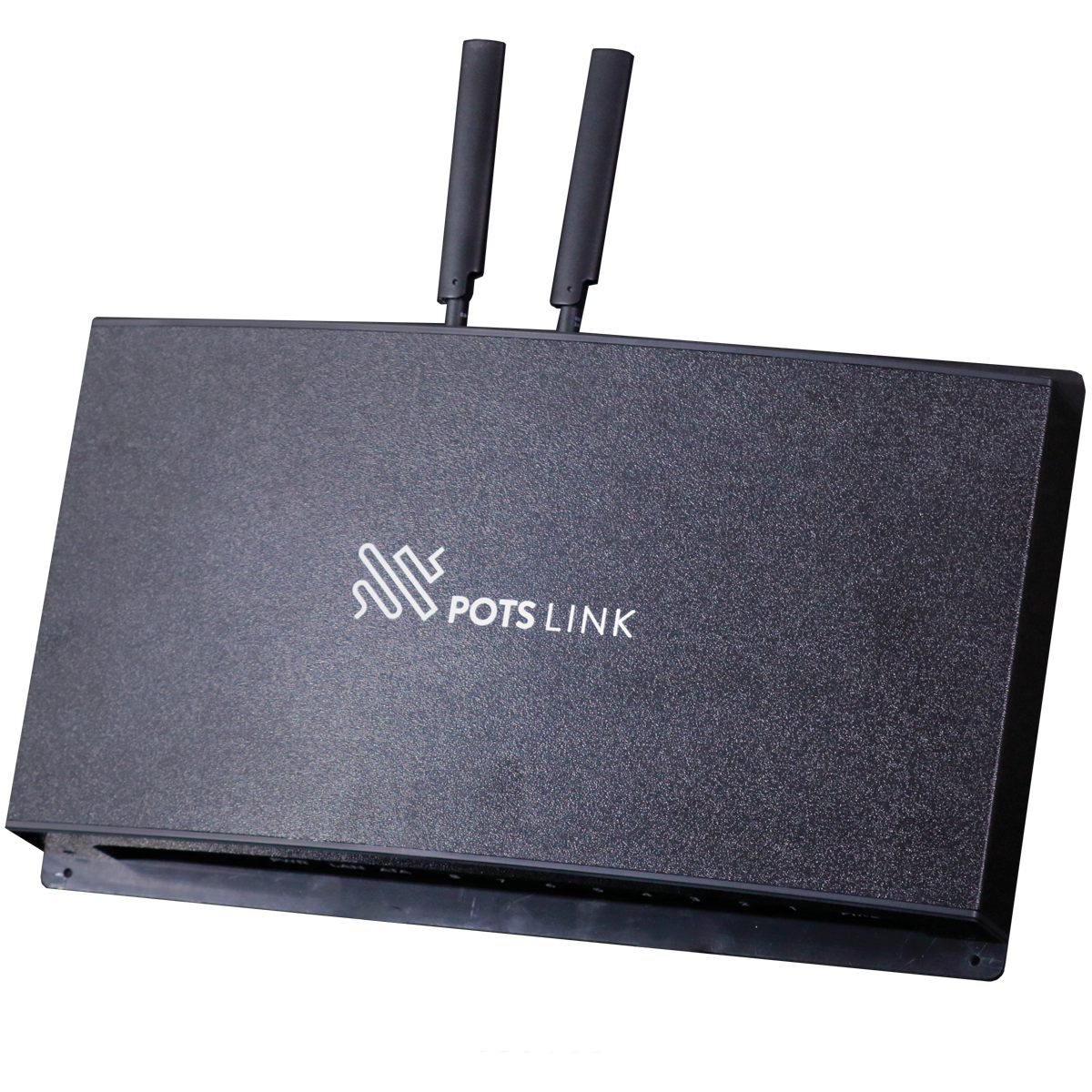
POTS Link is RCN Technologies’ fully managed cellular POTS replacement service. RCN manufactures the POTS Link service gateway, provisions the cellular service, and handles configuration, installation, monitoring, and support, all under a single managed service contract. There is no third-party hardware vendor and no multi-party escalation path when something goes wrong.
RCN is an Ericsson Technical Excellence Partner and a Cradlepoint-certified integrator. That background isn’t a credential footnote. It represents 13 years of engineering wireless WAN deployments in environments where signal variability, building attenuation, and carrier coverage gaps are real operational conditions. POTS Link is built on that foundation: wireless-first architecture designed by engineers who start with the cellular layer and work outward, not VoIP engineers who added a cellular module as a failover option.
RCN holds direct government contract vehicles across GSA Schedule 70, OMNIA Partners, Sourcewell, NASPO ValuePoint, and State contracts for Georgia and Pennsylvania.
How POTS Link and MetTel POTS in a Box Compare
Carrier Redundancy and SD-WAN Path Intelligence
This is where the two solutions diverge most sharply. It’s also the dimension most buyers underweight until they experience a coverage failure on a fire panel at a critical location.
MetTel’s POTS Transformation, built on the DataRemote 90X1, includes dual physical SIM slots and performance-based carrier switching. The hardware monitors signal parameters (packet loss, latency, jitter, signal strength) and dynamically switches between SIM carriers when performance falls below configurable thresholds. MetTel manages carrier access as part of its service, providing access to all three major cellular providers. The architecture is wired broadband primary, with cellular designated as the failover path. MetTel’s own product documentation uses the word “failover” to describe the cellular role.
POTS Link operates on a different architecture at the SIM layer. SIM slot 1 carries the primary single-carrier SIM, either customer-supplied from a major carrier, or RCN-provided based on the strongest RF profile confirmed at that specific site during pre-deployment assessment. SIM slot 2 is always occupied by RCN’s multi-carrier backup SIM, a single physical SIM that connects to whichever of AT&T, Verizon, or T-Mobile is strongest at that location and moment, without requiring a separate physical SIM for each carrier. POTS Link’s SD-WAN continuously monitors both SIM paths for signal quality, latency, and packet loss, and routes traffic between them in real time. When traffic shifts to SIM slot 2, the multi-carrier SIM selects the strongest available carrier automatically.
The distinction is not that MetTel has no multi-carrier capability. They do. The distinction is how that capability is engineered. MetTel’s dual physical SIM architecture triggers a carrier change when performance thresholds are breached. Reactive by design. POTS Link pairs a pre-assessed primary carrier in slot 1 with a multi-carrier backup in slot 2, managed continuously by SD-WAN path intelligence built into the device hardware, not available as a separate network service add-on. For life-safety infrastructure where the window between degraded signal and a missed alarm event can be seconds, the architecture matters.
Across both SIM slots, POTS Link’s SD-WAN technology continuously evaluates signal quality, latency, and packet loss and routes traffic to the optimal path. A customer’s wired Ethernet WAN can also be incorporated into the SD-WAN path mix when available, but it is never required. Cellular is the primary path by design. MetTel offers SD-WAN as a separate managed network service within its broader portfolio; it is not a native function built into the POTS device hardware itself.
The practical implication: RCN engineers the cellular layer site by site, carrier by carrier, as a core part of the deployment. That is a wireless WAN integrator’s approach. Managed telecom resellers typically manage which carriers are available at a site. Wireless WAN integrators engineer how those carriers are used.
POTS Link is also compatible with all three major public safety and priority networks (FirstNet-compatible via AT&T, Verizon Frontline-compatible, and T-Mobile public safety network-compatible), providing priority access to network resources during declared emergencies. For government facilities, public safety campuses, and any site where a fire alarm or emergency phone must perform precisely when the surrounding infrastructure is most stressed, priority network access is a material specification, not a marketing note.
Hardware Ownership and the Accountability Chain
MetTel POTS Transformation is a managed service wrapped around a commercially available third-party hardware platform. When a support issue arises, the resolution path can run through three parties: the customer, MetTel’s NOC, and DataRemote, each owning a different layer of the stack. Cellular carrier performance issues may involve additional complexity depending on how carrier contracts are structured within MetTel’s managed service layer.
POTS Link has no equivalent complexity. RCN manufactures the gateway, provisions the SIM, and manages the full support chain. One vendor. One contract. One escalation path. When a fire alarm panel loses its connection at 2 a.m., the answer to “who owns this?” needs to be immediate and singular.
The same DataRemote hardware powering MetTel POTS Transformation is available through multiple other resellers, and six major national carriers white-label a version of the MetTel solution. Buyers evaluating MetTel are, at the hardware level, evaluating a widely distributed, commercially available platform managed by a reseller, not a proprietary product engineered for this application.
Network Architecture: Cellular-Primary vs. Broadband-Primary
MetTel’s DataRemote hardware uses wired broadband as its primary connection path, with LTE cellular as failover. For sites with reliable wired internet, this delivers adequate uptime. For sites without it, the solution is structurally dependent on infrastructure that may not exist or may not be reliable.
POTS Link is cellular-primary. There is no broadband dependency. Wired Ethernet can be added as an additional SD-WAN path when it is available, but it is never a prerequisite. For rural government facilities, aging municipal buildings with degraded wired infrastructure, remote monitoring sites (pumping stations, cell tower backhaul, storage facilities), and any location where pulling broadband is impractical, POTS Link’s cellular-primary design eliminates a dependency that MetTel’s architecture cannot.
Wireless WAN Expertise and What It Means in Deployment
Most POTS replacement vendors come from a wired VoIP background. Cellular connectivity is an add-on to an architecture that was fundamentally designed for wired networks. When a POTS replacement device gets installed in a basement mechanical room with marginal signal, or a rural facility where one carrier has coverage and two don’t, the difference between a VoIP integrator with a cellular module and a wireless WAN engineer with 13 years of RF deployment experience becomes concrete.
RCN’s Ericsson and Cradlepoint partnerships represent over a decade of designing, commissioning, and troubleshooting wireless WAN deployments in enterprise, government, and public safety environments where cellular performance under adverse conditions is not a theoretical concern. That engineering heritage shapes how POTS Link deployments are scoped before the first device ships: site RF assessment, carrier selection by location, SD-WAN path configuration. Not just how they are supported after installation.
MetTel is a capable managed services integrator. But managed services integration and wireless WAN engineering are different disciplines, and for a product whose reliability depends entirely on the quality of a cellular connection, that distinction is worth understanding before you sign a multi-year contract.
Line Density
The DataRemote 90X2, the primary device in MetTel’s offering, supports up to 8 analog FXS ports per unit. Deployments above that threshold require multiple devices, adding hardware cost, management complexity, and per-location failure points.
POTS Link supports 8 lines natively per service gateway, with extended architecture supporting up to 24 lines per rack-mount unit. For facilities running fire panels, elevator phones, access control, utility monitoring, and voice lines simultaneously, line counts accumulate quickly. The density advantage eliminates the need for stacked units at high-density locations.
Battery Backup and NFPA 72
MetTel’s DataRemote hardware provides up to 48 hours of battery backup. This is a genuine advantage on that specific specification, and one that exceeds POTS Link’s native 24-hour backup.
The relevant compliance baseline is NFPA 72: the National Fire Alarm and Signaling Code, which requires that fire alarm communicators maintain 24 hours of standby power. POTS Link’s native 24-hour backup meets that requirement without add-ons. Both solutions satisfy the NFPA 72 threshold; MetTel’s DataRemote hardware provides additional headroom for customers who require it.
Compliance Certifications
POTS Link is certified against the national standards governing the life-safety devices it serves: NFPA 72 (fire alarm communications), ASME A17.1 (elevator emergency communications), and applicable UL listing standards for life-safety signaling equipment. POTS Link is also compliant with Federal Enhanced E911 requirements, Kari’s Law, and the RAY BAUM’S Act. Kari’s Law requires that multi-line telephone systems permit direct 911 dialing without a prefix; the RAY BAUM’S Act extends that to dispatchable location data. For any facility operating a multi-line system (which describes virtually every POTS replacement deployment), these are legal requirements. POTS Link also carries TAA (Trade Agreements Act) and NDAA (National Defense Authorization Act) compliance, both required qualifiers for federal and defense-adjacent procurement.
MetTel’s DataRemote hardware carries UL-864, UL62368-1, and UL-2054 certifications, along with TAA and NDAA compliance. MetTel has also earned two jurisdiction-specific approvals: California State Fire Marshal (CSFM) listing and MFVN designation by the FDNY and NYPD. These streamline AHJ approval in California and New York City specifically.
Outside those two jurisdictions, the governing standards are NFPA 72 and ASME A17.1, the national codes that apply across virtually every other U.S. jurisdiction, and POTS Link meets both. MetTel’s public documentation does not address NFPA 72, ASME A17.1, Kari’s Law, or RAY BAUM’S Act compliance. Buyers with formal compliance review requirements should request written documentation from MetTel before committing to a deployment at facilities with fire panels or elevator phones.
Government and Cooperative Contract Access
POTS Link is available directly on GSA Schedule 70, OMNIA Partners, Sourcewell, NASPO ValuePoint, State of Georgia, and State of Pennsylvania contract vehicles, without routing through a third-party aggregator. For state agencies, county governments, school districts, healthcare systems, and nonprofits, these cooperative vehicles provide compliant, streamlined procurement access across all 50 states.
MetTel holds the GSA Enterprise Infrastructure Solutions (EIS) contract, a vehicle designed for large-scale federal enterprise telecom transformation. For major federal agencies running multi-thousand-line modernization programs, EIS is a relevant instrument. For the broader SLED and mid-market enterprise buyer, which is the dominant customer segment for POTS replacement, GSA Schedule 70, OMNIA, Sourcewell, and NASPO are the operative vehicles, and POTS Link holds them directly.
Comparison at a Glance
| MetTel POTS in a Box | POTS Link | |
|---|---|---|
| Hardware manufacturer | DataRemote, Inc. (third party) | RCN Technologies (proprietary) |
| Same hardware sold by others | Yes. Resellers and major-carrier white labels | No. RCN only |
| Primary connectivity | Broadband / Wi-Fi (LTE failover) | Cellular-primary (no broadband required) |
| Carrier redundancy | Dual physical SIM; performance-based carrier switching when thresholds breached | SIM 1: primary single-carrier SIM (customer or RCN-provided, strongest RF for site). SIM 2: always RCN multi-carrier backup SIM (AT&T / Verizon / T-Mobile) |
| Path intelligence | Threshold-triggered carrier switching between two physical SIMs | SD-WAN continuously monitors both SIM paths and routes in real time; multi-carrier SIM in slot 2 selects strongest carrier automatically |
| Cellular provisioning | Managed by MetTel; access to all three major carriers | RCN-provisioned, fully managed |
| Public safety / priority networks | Not addressed in public documentation | FirstNet-compatible, Verizon Frontline-compatible, T-Mobile public safety-compatible |
| Lines per device | 8 FXS ports (DataRemote 90X2) | 8 native; up to 24 extended |
| Battery backup | Up to 48 hours (DataRemote 90X1/90X2) | 24 hours native, NFPA 72 aligned |
| Hardware cost | Included in managed service | Included in monthly service |
| Installation | Professional standard (MetTel) | Professional standard (RCN) |
| Service model | MetTel-managed (DataRemote hardware) | RCN fully managed (RCN hardware) |
| Support chain | 3-party: customer / MetTel / DataRemote | Single vendor: RCN |
| NFPA 72 / ASME A17.1 | Not publicly addressed | Certified |
| UL Standards | UL-864, UL62368-1, UL-2054 | UL Standards met |
| TAA / NDAA | Compliant | Compliant |
| CSFM / FDNY-NYPD MFVN | Listed / approved | Not listed |
| Kari's Law / RAY BAUM'S Act | Not addressed in public documentation | Compliant |
| GSA Schedule 70 / OMNIA / Sourcewell / NASPO | Not on these vehicles | Direct |
| GSA EIS | Yes | No |
| State of GA / PA contracts | No | Direct |
| Minimum deployment | 250+ locations (trial program) | No minimum |
| Provider background | Managed network services / telecom integrator | Wireless WAN integrator. 13 years RF and cellular deployment. Ericsson Technical Excellence Partner |
Which Solution Fits Which Buyer?
MetTel POTS in a Box is a reasonable fit if:
Your organization is running a large-scale federal copper retirement program through the GSA EIS contract. Your deployment is concentrated in California or New York City, where CSFM and FDNY/NYPD approvals streamline the AHJ process. You need Gartner Magic Quadrant recognition as a qualifying procurement criterion. And each site has reliable wired broadband to serve as the primary connection path.
POTS Link is the stronger fit if:
- You need continuous multi-carrier routing across AT&T, Verizon, and T-Mobile at the network core, not threshold-triggered switching between two physical SIMs
- You need a single vendor who manufactures the hardware, owns the cellular service, and holds the full support chain with no third-party escalation on life-safety infrastructure
- Your locations lack reliable broadband and require cellular-primary deployment with no wired dependency
- You need documented compliance with NFPA 72, ASME A17.1, Kari's Law, and the RAY BAUM'S Act across all U.S. jurisdictions
- You operate on or need priority access to FirstNet-compatible, Verizon Frontline-compatible, or T-Mobile public safety networks
- Your procurement runs through GSA Schedule 70, OMNIA, Sourcewell, NASPO, or state contracts in Georgia or Pennsylvania
- You want a solution engineered by wireless WAN specialists, not assembled by a telecom reseller from a commercially available third-party device
Frequently Asked Questions
What is a MetTel POTS in a Box alternative for government agencies?
POTS Link by RCN Technologies is a fully managed cellular POTS replacement available directly on GSA Schedule 70, OMNIA Partners, Sourcewell, and NASPO ValuePoint, with state contract coverage in Georgia and Pennsylvania. It operates on a cellular-primary, multi-carrier architecture with SD-WAN path optimization, is compatible with FirstNet, Verizon Frontline, and T-Mobile public safety networks, and is supported end-to-end by RCN under a single managed service contract.
Does MetTel manufacture its own POTS replacement hardware?
No. MetTel POTS Transformation is built on DataRemote’s POTS IN A BOX® platform, the DataRemote 90X1 and 90X2 devices. DataRemote owns the hardware IP, firmware roadmap, and device management platform. The same hardware is resold by multiple other providers. RCN manufactures its own POTS Link service gateways and provisions the cellular service as part of the managed offering.
What is multi-carrier redundancy and why does it matter for POTS replacement?
POTS Link uses a dual-SIM architecture with two distinct roles. SIM slot 1 carries the primary single-carrier SIM, either customer-supplied from a major carrier (BYOD), or RCN-provided based on the strongest RF profile confirmed at that specific site during pre-deployment assessment. SIM slot 2 always carries RCN’s multi-carrier backup SIM, a single physical SIM that dynamically connects to whichever of AT&T, Verizon, or T-Mobile is strongest at that location, without requiring a separate SIM card for each carrier. POTS Link’s SD-WAN continuously monitors both paths for signal quality, latency, and packet loss, routing traffic between them in real time. When conditions shift traffic to slot 2, the multi-carrier SIM selects the strongest available carrier automatically. MetTel’s DataRemote 90X1 also supports dual physical SIMs with performance-based carrier switching, but that architecture requires a threshold breach to trigger a change between two separate SIM cards. POTS Link’s multi-carrier backup SIM eliminates the need for that carrier selection decision entirely on the backup path.
Is MetTel POTS in a Box cellular-primary or broadband-primary?
Does POTS Link meet NFPA 72 and ASME A17.1 requirements?
Yes. POTS Link meets NFPA 72 requirements for fire alarm communications and ASME A17.1 requirements for elevator emergency communications, the national codes governing life-safety signaling across virtually every U.S. jurisdiction. MetTel’s public documentation does not address NFPA 72 or ASME A17.1. Buyers should request written compliance documentation from any POTS replacement vendor before deploying at facilities with fire panels or elevator phones.
What government procurement vehicles does POTS Link support?
POTS Link is available directly on GSA Schedule 70, OMNIA Partners, Sourcewell, NASPO ValuePoint, State of Georgia, and State of Pennsylvania, without routing through a third-party distributor. These are the operative cooperative contract vehicles for state, local, education, and most mid-market enterprise procurement. MetTel’s primary vehicle is GSA EIS, which is structured for large federal enterprise transformation programs.
Why does wireless WAN expertise matter for POTS replacement?
Most POTS replacement solutions are built by VoIP companies that added cellular connectivity as a failover layer. POTS Link is built by a team with 13 years of wireless WAN deployment experience in RF-severe environments. Facilities where signal variability, building attenuation, and carrier coverage gaps are real operational conditions, not edge cases. That expertise shapes how POTS Link deployments are scoped: site RF assessment, carrier selection by location, SD-WAN path configuration, before the first device ships. When a fire alarm panel or elevator phone needs to work in a basement mechanical room with marginal signal, the difference between a telecom reseller shipping a commercial device and a wireless WAN integrator engineering the connection is not abstract.
Get a no-cost POTS Link assessment for your facility.
RCN Technologies provides no-cost POTS line assessments for government agencies, enterprise facilities, and nonprofits evaluating POTS replacement options. A wireless WAN specialist will scope your site and walk you through what a managed cutover looks like.
Call RCN directly: 865-315-7373
Speak with a Connectivity Expert
Fill out the interest form to request that one of our 5G & LTE experts contact you to discuss how we can best support your organization’s connectivity needs.