

Wireless Insights
Hospital-at-Home Kit Logistics: Why Turnaround Time Caps Your Census
Every kit sitting in a storeroom waiting to be cleaned, reset, and revalidated is a bed your program cannot fill. Here is the math, the workflow that fixes it, and the build-or-outsource decision behind both.
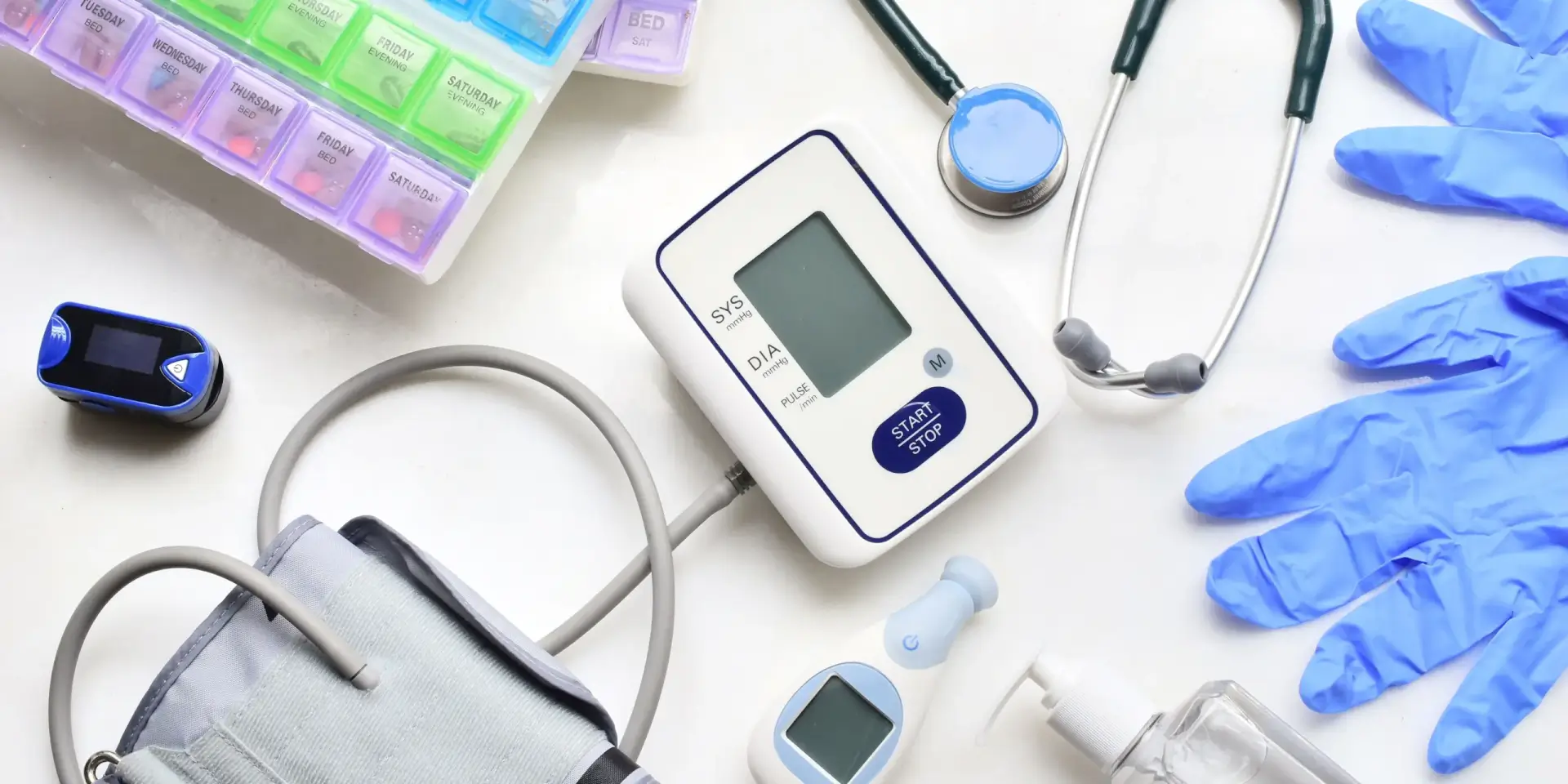
Talk to a kit logistics specialistA hospital-at-home episode ends the way it is supposed to: the patient recovers, the clinical team discharges them, and a courier picks up the kit. Then the tote lands back at the program's storeroom: a tablet, a cellular hub, a blood pressure cuff, a pulse oximeter, a scale, chargers, and cables, all of it used, unsanitized, and logged out of service.
What happens over the next several days decides more about your program's capacity than almost anything on the clinical side. Because until that kit is cleaned, wiped, reconfigured, revalidated, and shipped to the next admission, it is not equipment. It is inventory.
Kit turnaround time is a census cap. A program with 40 kits, 5-day average episodes, and a 5-day kit turnaround can sustain an average daily census of about 20. Cut turnaround to 2 days and the same 40 kits support a census of about 29. Faster reprocessing is the cheapest capacity a hospital-at-home program can buy: no new devices, no new clinicians, nine more occupied beds.
Kit turnaround time is a census cap
Hospital-at-home programs measure themselves on daily census. Chartis puts the minimum viable census around 15 patients a day, and the programs that make the model pencil out run well above that: Cleveland Clinic has averaged about 24 patients a day since April 2023, and Tampa General is building toward a 50-patient daily capacity.
The census conversation usually centers on referrals, clinician staffing, and payer mix. The equipment fleet gets a line in the budget and an assumption that it will be where it needs to be.
Here is the math that assumption hides. Every kit in your fleet cycles through the same loop: days deployed with a patient, then days in reprocessing before it can deploy again. If episodes average 5 days and reprocessing takes 5 more, each kit supports one admission every 10 days. Forty kits gets you four admissions a day, and at a 5-day length of stay that is an average daily census of 20.
Nothing about the clinical program changed in that sentence. The storeroom set the cap.
Now cut reprocessing to 2 days. The cycle drops to 7 days, the same 40 kits support about 5.7 admissions a day, and average census climbs to roughly 29. Nine more occupied beds, purchased entirely with logistics.
The inverse is more common and more expensive: programs that cannot compress turnaround buy more kits instead, then watch capital sit in totes waiting to be processed. Slow turnaround does not just cap census. It quietly doubles the fleet you need to hit the census you promised.
What kit reprocessing actually involves
"Clean it and ship it" undersells what has to happen between patients. A kit that reaches the next patient with a dead SIM, a tablet still enrolled to the previous episode, or a missing cuff does not generate a support ticket. It generates a failed admission.
Recover & receive
Inbound inspection and inventory reconciliation. What came back, what is missing, what is damaged, and what the program gets billed for.
Clean, reset & reconfigure
Sanitization to healthcare standards, a documented device wipe that supports the technical safeguards required under HIPAA, re-enrollment into device management, and connectivity checks on every cellular component.
Replace, RMA & replenish
Swap consumables and failed peripherals, run manufacturer returns, and keep spare-parts inventory ahead of demand so one dead cuff does not strand an expensive kit.
Rekit, QA & redeploy
Reassemble to the current kit spec, validate end to end the way a patient would use it, and ship patient-ready.
Programs feel this workload in people, not process diagrams. At 4 admissions a day the loop runs 120 times a month, every month, with clinical-grade documentation each time. That is a full-time operation wearing the badge of a side duty.
Connectivity is where kits die
Most reprocessing failures that reach a patient are connectivity failures. The cuff pairs, the tablet boots, and nothing reaches the command center, because the home has no usable Wi-Fi, or the SIM was never reactivated, or the carrier that worked at the last address has no signal at this one.
This is why hospital-at-home kits run on cellular, and why the cellular layer is the part a general-purpose depot cannot own. Getting it right means provisioning and validating SIMs across AT&T, Verizon, and T-Mobile, checking signal against the next patient's address rather than the warehouse loading dock, and having somewhere for a field escalation to go at 2 AM.
That is the gap hospital-at-home technology logistics exists to close: a reprocessing operation built connectivity-first, with RCN's 24/7 U.S.-based NOC behind every deployed kit. It is the same operational model RCN runs for connected healthcare fleets like the mobile blood drives that deploy Cradlepoint R980 kits at drive sites, applied to the patient's living room.
In-house, 3PL, or connectivity-first partner
Three ways programs staff the loop:
| Capability | In-house biomed / clinical engineering | General 3PL or depot | Connectivity-first logistics partner |
|---|---|---|---|
| Clinical-grade cleaning & documentation | Strong, but competes with hospital equipment duties | Varies by contract | Built into the workflow |
| Device wipe & re-enrollment | IT-dependent, often queued | Basic factory resets | Standard, documented per kit |
| SIM provisioning & multi-carrier signal validation | Rare in-house skill | Not offered | Core competency |
| RMA & spare-parts management | Ad hoc | Receiving and shipping only | Managed with replenishment thresholds |
| Kit-spec changes without a change-order cycle | Fast but undocumented | Slow, contract-bound | Flexible by design |
| 24/7 escalation path | Pager-dependent | Business hours | 24/7 U.S.-based NOC |
In-house works at pilot scale, while the census is in single digits and the biomed team can absorb the volume. A general 3PL solves shipping but treats a connected medical kit like any other box. The connectivity-first model exists because the failure mode that matters is not a late package. It is a kit that arrives and cannot connect.
The 2030 extension makes this a five-year operating problem
Congress extended the Medicare Acute Hospital Care at Home waiver on February 3, 2026, through September 30, 2030. As of January 2026, CMS counted 373 approved hospitals across 140 health systems in 37 states, and the 2026 launch list keeps growing: NewYork-Presbyterian, Penn Medicine across three hospitals, Cleveland Clinic expanding into Florida.
Five years of runway changes the question. A program could justify duct-tape logistics quarter to quarter while the waiver lived on 90-day extensions. It cannot justify duct-tape logistics as the operating model for a program it now expects to scale through the decade. The programs that grow census fastest between now and 2030 will be the ones whose kits spend the fewest days in the storeroom.
Ready to take kit logistics off your program's plate?
Tell us your fleet size, episode length, and current turnaround. RCN will map the reprocessing loop, find the days it is losing, and show you what a connectivity-first operation would return in census.
Talk to a kit logistics specialistFrequently asked questions
What is hospital-at-home technology logistics?
Hospital-at-home technology logistics is the management of connected patient-care kits across their full lifecycle: recovering kits after discharge, cleaning and resetting devices, provisioning cellular connectivity, replacing failed components, and reassembling, validating, and redeploying patient-ready kits. It covers hospital-at-home programs, remote patient monitoring, mobile acute care, and virtual care carts.
How does kit turnaround time affect hospital-at-home census?
Kit turnaround time directly caps daily census. Each kit supports one admission per cycle of episode days plus reprocessing days. A 40-kit fleet with 5-day episodes and 5-day turnaround sustains a census of about 20; cutting turnaround to 2 days lifts the same fleet to about 29.
What is in a hospital-at-home kit?
A typical kit includes a patient tablet, a cellular connectivity hub, and connected peripherals such as a blood pressure cuff, pulse oximeter, scale, and thermometer, plus chargers, cables, and instructions, packed in a transportable case. Exact contents follow each program's kit specification.
What happens to a kit between patients?
The kit is recovered and inspected, sanitized, wiped, and reconfigured; failed or consumed components are replaced and RMAs filed; then it is reassembled to spec, quality-checked end to end, and shipped ready for the next admission.
Why do hospital-at-home kits use cellular instead of the patient's Wi-Fi?
Patient Wi-Fi is unverifiable before admission and unsupportable during one. Cellular connectivity with multi-carrier SIM options across AT&T, Verizon, and T-Mobile lets the program validate signal for a specific address before the kit ships and monitor the connection remotely throughout the episode.
Does kit reprocessing support HIPAA compliance?
Reprocessing supports the technical safeguards required under HIPAA through documented device wipes, controlled re-enrollment, and chain-of-custody records for every kit. Compliance itself rests with the covered entity; a disciplined reprocessing workflow gives the program the documentation to stand behind it.
Should a program build kit logistics in-house or outsource it?
In-house handling generally fits pilot scale, when census is in the single digits. As admissions grow, the reprocessing loop becomes a full-time, documentation-heavy operation with a cellular-connectivity skill set most biomed teams do not staff. Programs planning to scale census through the 2030 waiver window typically outsource to a partner that owns both logistics and connectivity.
Speak with a Connectivity Expert
Ready to take kit logistics off your program’s plate?


Want to Learn More?
Request a custom quote.