

Wireless Insights
Cradlepoint R1900 for 911 Dispatch Centers: Backup PSAP Connectivity
When a fiber cut takes down the primary path, the backup answering site needs its own network in minutes, not a promise that calls will reroute.
Configure your PNKAt about 2 p.m. on September 25, 2025, dispatch centers across Louisiana and Mississippi stopped receiving 911 calls. A contractor had accidentally cut AT&T fiber lines, and for nearly three hours agencies in two states, including New Orleans and Baton Rouge, posted ten-digit administrative numbers on social media and hoped callers would find them. The dispatchers were at their consoles. The buildings had power. The network path was gone. That is the failure a deployable 5G network exists to absorb, and it is the piece most PSAP continuity plans still leave to assumption.
Ericsson Cradlepoint's R1900 is the router built for exactly this class of problem: a ruggedized 5G platform designed for mobile and portable deployments, managed remotely through NetCloud, with a dual-modem configuration that holds simultaneous connections on two different carriers. If one carrier's network is degraded, traffic keeps moving on the other. For a dispatch operation, that is the difference between a backup plan and a backup path.
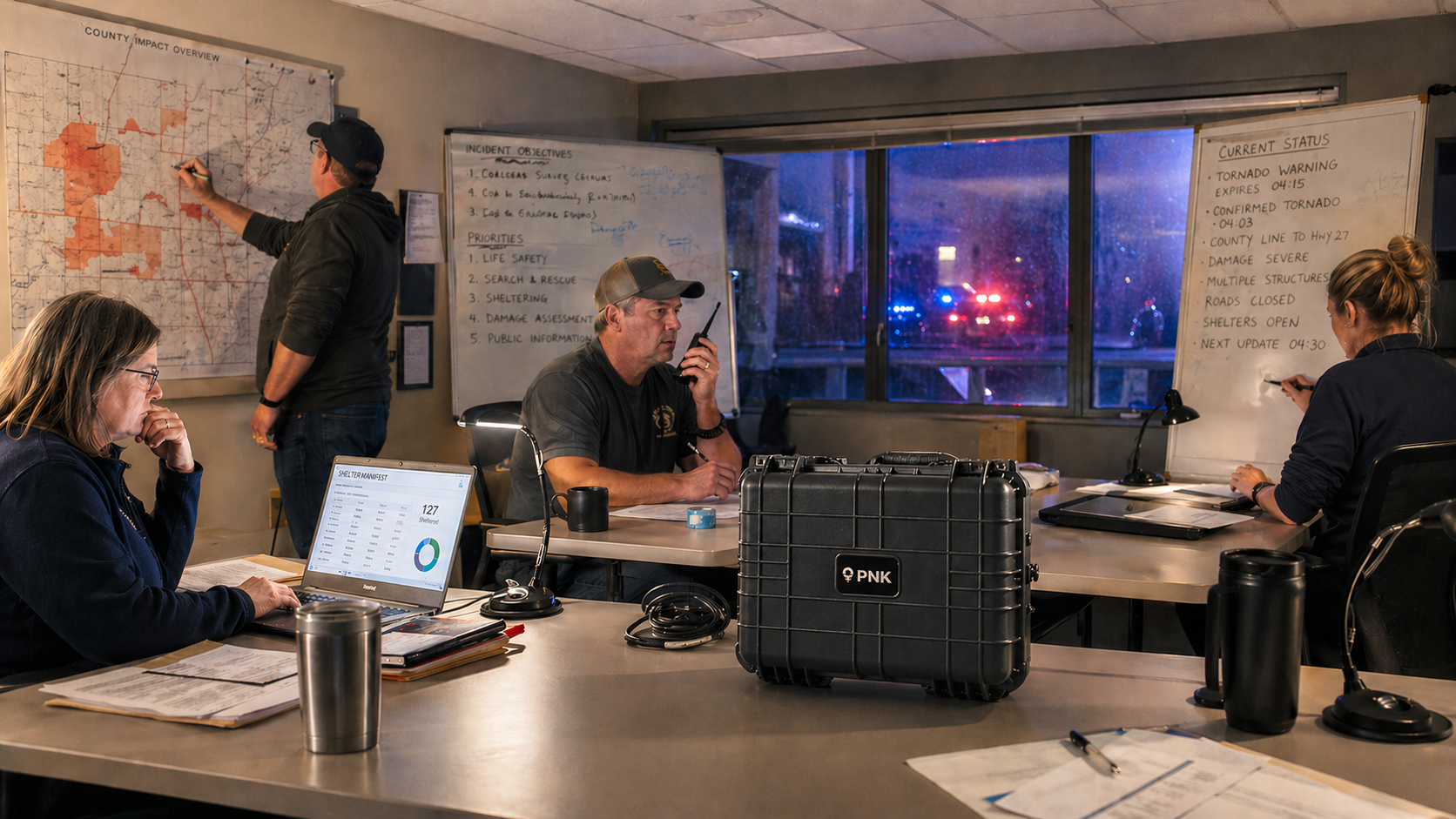
RCN Technologies builds the R1900 into the Pop-Up Network Kit (PNK), a deployable 5G network in an IP64-rated case: router, Panorama Antennas, pre-activated multi-carrier SIMs, pre-provisioned NetCloud management, and RCN's 24/7 NOC watching the connection. It arrives at the alternate answering site, powers on, and is typically operational within 5 minutes.
Americans place roughly 240 million 911 calls a year through roughly 5,700 public safety answering points. When a PSAP loses its network path, the continuity plan assumes calls reroute to a backup site. The statewide outages of 2024 and 2025 each lasted two to three hours. A backup PSAP is only as real as the network path underneath it: independent of the failed circuit, multi-carrier, and live within minutes.
The outage record: single points of failure, statewide consequences
The recent history of American 911 outages is not a history of sophisticated attacks. It is a history of ordinary infrastructure failing in ordinary ways, with extraordinary blast radius.
| When | Where | What failed | Impact |
|---|---|---|---|
| April 2024 | Nebraska, Nevada, South Dakota, Texas | A light pole installation in Missouri cut a Lumen fiber line | Millions temporarily lost 911 access across four states |
| June 18, 2024 | Massachusetts, statewide | A firewall malfunction at the state 911 vendor | About 2 hours across all 204 PSAPs, which together handle an average of 8,800 calls a day |
| May 2025 | Otoe and Cass counties, Nebraska | Fiber cut | County 911 service down; callers routed to alternate numbers |
| September 25, 2025 | Louisiana and Mississippi | Accidental cut to AT&T fiber lines | About 2 hours 45 minutes, including New Orleans and Baton Rouge |
Not one of these was a cyberattack. Investigators confirmed as much in Massachusetts and in the Gulf states. A backhoe, a light pole crew, and a firewall rule each did what no adversary bothered to. And because 71.3 percent of 911 calls now originate from wireless devices, the old fallback of walking to a landline or a call box no longer describes how the public actually reaches dispatch.
Rerouting to a neighboring PSAP helps when the failure is local. When the cut is upstream, as it was in each of these events, entire regions discover that their diverse paths converge on the same conduit.
How a deployable 5G network keeps a backup PSAP answering
Every serious continuity-of-operations plan names an alternate answering site: an emergency operations center, a neighboring agency's floor, a training room, a mobile command vehicle. The plan usually specifies consoles, seats, and call-handling positions. The quiet assumption is that the site will have dispatch-grade connectivity the moment it is needed. The outage record says otherwise: if the alternate site rides the same fiber, it fails with the primary.
A PNK gives the backup site its own path, with the properties dispatch actually needs:
- Carrier diversity by design. The R1900 Dual PNK runs two modems on two different carriers at once, so a single carrier's regional failure does not silence the site.
- Public safety network access. The PNK works on FirstNet via AT&T SIMs, is Verizon Frontline Verified, and is T-Mobile public safety-compatible, so priority and preemption follow the agency onto the backup path.
- Speed that matches the incident. The kit is typically operational within 5 minutes of arriving on site, against outages that have run two to three hours.
- Eyes on the connection. RCN's 24/7 NOC monitors every deployed PNK, so the agency staffs consoles instead of troubleshooting routers mid-incident.
For agencies that route CAD, records, or other criminal justice traffic through the backup path, the PNK supports the technical safeguards required under CJIS, and RCN can help configure the deployment to meet the organization's compliance requirements.
County governments already operate PNKs at real scale. Harris County Elections deployed 130 R1900 PNKs across its 2025 polling operations, and sheriff's offices and fire departments run them for mobile command. Dispatch continuity is the same discipline pointed at a different room.
Choosing the right PNK configuration for dispatch continuity
The right configuration depends on how many positions the backup site must carry and what happens to local cell infrastructure in your worst case.
- R980 PNK: the smaller, most portable configuration, suited to a limited backup answering operation or a supervisor element that must stand up fast.
- R1900 PNK: the higher-capacity single-modem configuration for a full alternate answering site.
- R1900 Dual PNK: the dual-modem, multi-carrier configuration, and the default recommendation for PSAP continuity, because the scenario that activates the site is usually a network failure.
- Starlink-Ready PNK: the satellite-cellular hybrid for cases where the threat is a hurricane or wildfire that can take down cell sites along with the fiber.
The full decision logic between the R980 and R1900 platforms is covered in RCN's configuration comparison, and agencies that already field R1900-based mobile command deployments can fold dispatch continuity into the same kit standard.

What the FCC's NG911 timeline means for continuity planning
The regulatory clock is running. In July 2024 the FCC adopted its first nationwide Next Generation 911 transition rules (FCC 24-78): once a 911 authority certifies readiness and makes a valid request, facilities-based wireless and fixed providers have 6 months to deliver 911 traffic in IP form to designated delivery points, and other covered providers have 12 months. As of 2024, 41 states and jurisdictions already operate Emergency Services IP Networks, and a federal cost study published in April 2026 put the remaining nationwide transition bill at 5.8 to 9.3 billion dollars over roughly seven years.
In June 2026 the Commission went further, adopting a Second Further Notice of Proposed Rulemaking on NG911 reliability and interoperability, with comments due August 10, 2026. Among the proposals: requiring NG911 core service and ESInet providers to demonstrate they can hand off calls, with location and media intact, across state lines and between different providers.
Here is what the transition means for a continuity planner. IP-based 911 is more capable and, in important ways, more resilient. It is also more concentrated: the Massachusetts outage was a firewall in an NG911-era system, not a cut copper trunk. The FCC's 911 reliability rules already require covered 911 service providers to certify annually to circuit diversity, backup power, and network monitoring, but a certification has never stopped a backhoe. The layer the rules do not provide is the one the agency controls itself: an independent, multi-carrier network path that can be standing at the alternate answering site before the vendor's ticket clears.
Procurement: buying dispatch continuity without an RFP cycle
Dispatch continuity purchases rarely line up with budget season, so the buying path matters as much as the hardware. The Pop-Up Network Kit is available on GSA Schedule, and RCN Technologies sells through Sourcewell, NASPO ValuePoint, OMNIA Partners, and Equalis Group cooperative contracts, with Carahsoft supporting federal IT buyers. Most city, county, and state agencies can buy against a pre-competed vehicle instead of running a solicitation; the mechanics are covered in RCN's guide to simplified PNK procurement.
RCN's full-stack model carries the rest: carrier and SIM strategy across AT&T, Verizon, and T-Mobile, kitting and pre-provisioning, nationwide installation where fixed antennas make sense, and the 24/7 NOC behind every deployment.
Stand up the backup path before the fiber cut
RCN's PNK team scopes dispatch continuity deployments end to end: an RF assessment at your alternate answering site, a configuration and carrier mix recommendation, and a kit that arrives pre-provisioned. RCN Technologies is an Ericsson Technical Excellence Partner and a Cradlepoint-certified integrator.
Configure your PNKFrequently asked questions
What is a deployable 5G network for 911 dispatch continuity?
A deployable 5G network is a self-contained connectivity kit, built around a cellular router, antennas, and multi-carrier SIMs, that stands up dispatch-grade internet at an alternate answering site within minutes. RCN's Pop-Up Network Kit pairs an Ericsson Cradlepoint R1900 with Panorama Antennas, pre-activated SIMs, and 24/7 NOC monitoring in a single IP64-rated case.
How fast can a backup PSAP site be online with a PNK?
Typically within 5 minutes of the kit arriving on site. The PNK ships pre-provisioned in NetCloud with SIMs already activated, so the sequence is power on, antenna up, and connect call-handling positions. The 2024 and 2025 statewide 911 outages each lasted roughly two to three hours.
Is the PNK FirstNet-compatible for public safety traffic?
Yes. The PNK works on FirstNet via AT&T SIMs, is Verizon Frontline Verified, and is T-Mobile public safety-compatible, so agencies keep priority and preemption on the backup path during an incident.
What is the difference between the R1900 PNK and the R1900 Dual PNK for dispatch continuity?
The R1900 Dual PNK runs two cellular modems on two different carriers simultaneously, while the standard R1900 PNK runs one. For PSAP continuity the Dual is the default recommendation, because the event that activates the backup site is usually itself a network failure, and a second live carrier removes the single point that caused the outage.
Does the FCC require a backup PSAP?
No rule requires a PSAP to maintain a backup answering site. FCC reliability rules require covered 911 service providers to certify annually to circuit diversity, backup power, and network monitoring, and the 2024 NG911 order sets IP delivery deadlines for originating service providers. Continuity of the answering site itself is governed by state 911 programs and each agency's continuity-of-operations plan, which is where a rapidly deployable kit fits.
What procurement vehicles cover the PNK for government buyers?
The Pop-Up Network Kit is available on GSA Schedule, and RCN Technologies sells through Sourcewell, NASPO ValuePoint, OMNIA Partners, and Equalis Group cooperative contracts. Carahsoft supports federal IT procurement. Most agencies can buy against a pre-competed vehicle rather than running a full solicitation.
Speak with a Connectivity Expert
Ready to put clinic-grade connectivity on every clinic stop?


Want to Learn More?
Request a custom quote.