

Wireless Insights
The R980 vs. R1900 Decision: Which PNK Configuration Fits Your Mission
Both are ruggedized networks in a box. Both deploy with a single button press. The router inside is the difference, and four operational questions tell you which one your deployment needs.
Talk to a PNK specialistEvery Pop-Up Network Kit starts with the same question: R980 or R1900?
Both are configurations of the same deployable 5G network: ruggedized, pre-configured, deployed with a single button press, and connected to NetCloud for remote management. But the two Ericsson Cradlepoint routers inside them are built for different missions, and picking the wrong one for your deployment costs either capacity you needed or money you didn't.
We've stood up both across public safety agencies, blood centers, elections offices, and incident command teams. Here's how to decide.
Choose the R980 PNK when your peak device count stays under 100 and a brief carrier failover pause is tolerable. It is smaller, lighter, and lower cost. Choose the R1900 PNK when device counts push past 100 or the environment is dense. Choose the R1900 Dual Modem when a 30-second connectivity gap is unacceptable: two active carriers carry traffic at the same time, so there is no failover pause at all.
The four questions that decide it
You don't need to memorize spec sheets. The decision comes down to four operational questions.
1. How many devices will connect at once?
The R980-based PNK supports a comfortable 100 concurrent devices inside a 300-foot Wi-Fi 6 radius. That covers most field scenarios: a polling location, a bloodmobile staging area, an incident command zone. If your peak device count is under 100 and stays there, R980 is enough router.
The R1900 steps up to higher capacity and better density handling. Large public safety events, multi-team incident command with dozens of body cams, or field hospitals with medical equipment plus tablets plus staff phones can push past R980 headroom. R1900 is built for those loads.
The test: count every connected thing at your peak moment. If the number lives below 100 and doesn't spike, R980. If it crosses 100 regularly or spikes past 150, R1900.
2. Do you need dual-modem zero-lag failover?
The R1900 supports a Dual Modem configuration that the R980 does not. Two active cellular connections, traffic load-balanced or hot-standby across both. If one carrier degrades or drops, the other is already online and carrying traffic. No failover gap, no 30 to 90 second handoff pause.
The question is: can your operation tolerate a 30-second blackout? If your operation has moments where connectivity loss costs something concrete, Dual Modem R1900 is the answer. If the worst case is a brief pause that resolves on its own, R980 is enough.
3. What does the site look like?
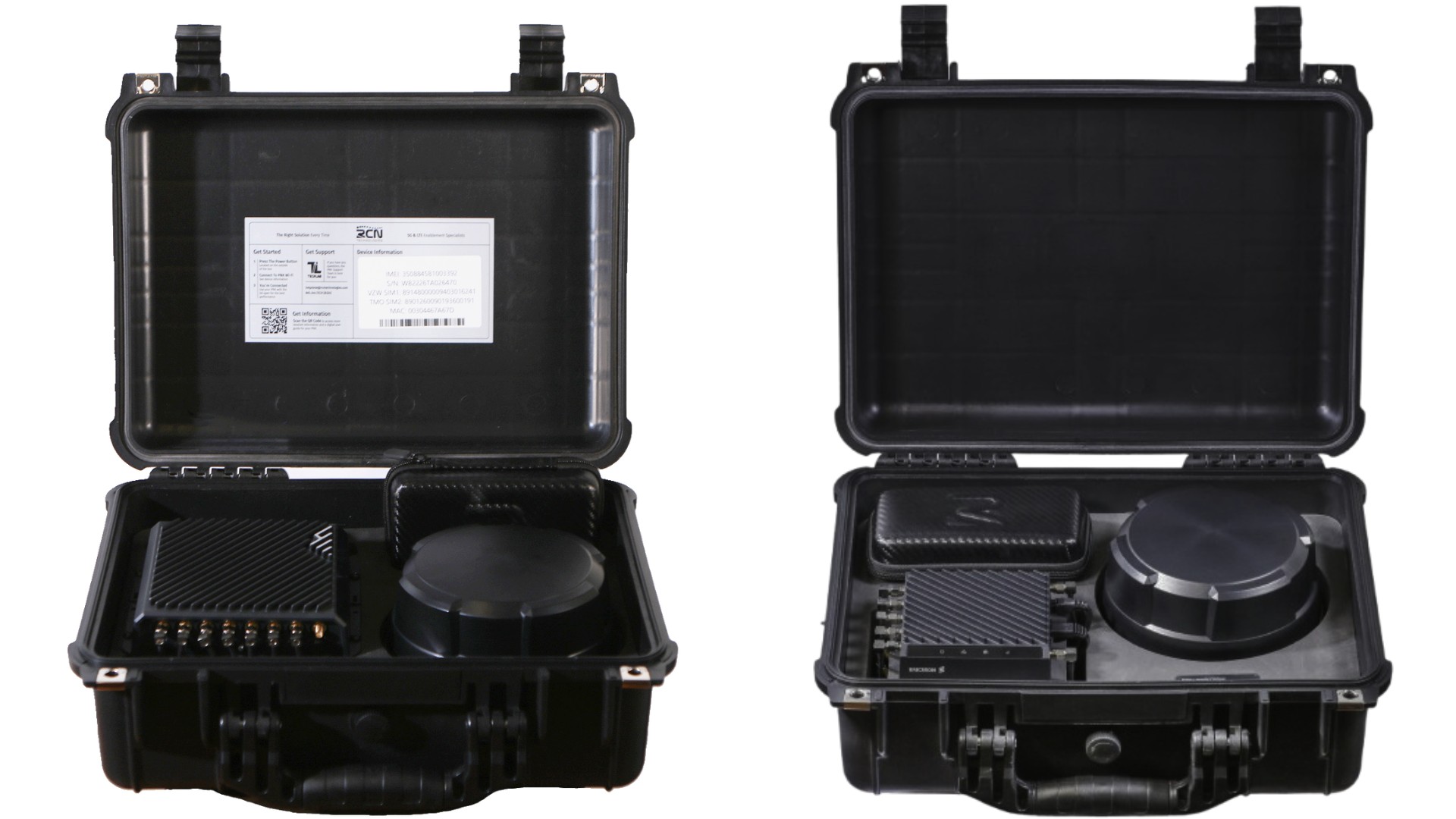
R980 is smaller, lighter, faster to hand-carry. It packs into an IP64-rated hard case the size of a small camera bag. One person can walk it into a school gym, a church parking lot, a rural clinic.
R1900 is larger and more power-hungry. It still fits in a ruggedized case and still deploys in minutes, but it's less a "throw it over your shoulder" kit and more a "roll it in on a cart" kit.
4. What's the budget shape?
The R980 PNK is the lower-cost option. For smaller agencies, non-profits, or rural deployments where the grant budget is fixed, R980 is often the difference between deploying and not deploying.
The R1900 costs more, and the Dual Modem configuration costs more still. That extra cost buys capacity, density, and zero-lag failover. If your mission doesn't need those, you're paying for capability you won't use.
The right math: what's the cost of an outage on your worst day? If a 30-second drop during peak operations costs you more than the R1900 premium, the R1900 is cheaper over time.

Side-by-side: the spec differences that matter
We've pulled the spec comparison down to the points that change the decision. Full specs live on the Pop-Up Network Kit product page; what's below is what actually matters for the configuration choice.
| Spec | R980 PNK | R1900 PNK (Single) | R1900 PNK (Dual Modem) |
|---|---|---|---|
| Concurrent Wi-Fi 6 devices | ~100 | ~150 | ~150 |
| Cellular modems | 1 | 1 | 2 (active-active) |
| Failover behavior | Single carrier | Single carrier | Zero-lag multi-carrier |
| Case size / weight | Smaller, lighter | Larger, heavier | Larger, heavier |
| Typical deployment | 1-person carry | 1–2 person | 1–2 person |
All configurations include NetCloud Manager remote provisioning, pre-provisioned carrier SIMs (AT&T, Verizon, T-Mobile, US Cellular), an IP64-rated case, 24/7 NOC support, and RCN install team availability for complex deployments.
Real deployments: how it played out
Small rural blood drive (R980)
A mobile blood drive operating across rural counties standardized on the R980 PNK. Typical site: church parking lot, ~40 donors queued, 4 to 6 staff tablets plus a wristband printer. Peak concurrent devices never crosses 50. R980 is the right answer: smaller case, lighter, cheaper, deploys by one staffer. Blood centers like LifeSouth Community Blood Centers run the R980 PNK at mobile drive sites for exactly this profile.
Consolidated vote center (R1900 Dual Modem)
A single consolidated vote center handling 2,000+ voters per day with 40 check-in stations plus e-pollbook printers plus staff communications pushes past R980 headroom, and zero tolerance for Election Day connectivity drops makes R1900 with Dual Modem worth the premium. It's the same math that led Harris County Elections to deploy 130 R1900 PNKs in 2025.
Incident command (R1900 Dual Modem)
When a police department stands up incident command for a large outdoor event, peak density pushes past 150 devices across radios, body cams, tablets, and staff phones. Zero tolerance for drops during the event. R1900 Dual Modem, no question.

When you still can't decide
Three tiebreakers we use on the sales call:
- If this PNK has to work on the worst day of the year, pick the configuration built for that day. Not the average day. That's usually R1900 for public safety, R980 for routine operations.
- If one person is carrying it to the deployment, R980. If you have a truck, R1900 is on the table.
- If the mission involves sustained multi-carrier resilience: rural coverage gaps, carrier dead zones, or federal compliance around network diversity. R1900 Dual Modem.
The same deployable 5G network, two different routers
Worth saying explicitly: the RCN wrapper around the PNK doesn't change between R980 and R1900. Same pre-provisioning, same NetCloud-managed configuration, same 24/7 U.S.-based NOC coverage, same install team availability, same multi-carrier SIM options, same rugged case quality. The decision is about the router inside the box, not about whether RCN stands behind the deployment.
Ready to make the call?
The R980 / R1900 question is exactly what a 20-minute scoping call is for. Bring your peak device count, your tolerance for a 30-second outage, your deployment cadence, and your budget shape. We'll run the math and end the call with a clear recommendation.
Talk to a PNK specialistFrequently asked questions
What is a deployable 5G network?
A deployable 5G network is a self-contained, multi-carrier cellular and Wi-Fi system that delivers secure connectivity to a temporary, remote, or emergency site without relying on local wired infrastructure. RCN's Pop-Up Network Kit is a deployable 5G network in a ruggedized case, and the R980 and R1900 are the two router configurations it is built around.
What is the difference between the R980 PNK and the R1900 PNK?
The R980 PNK supports about 100 concurrent devices in a smaller, lighter, lower-cost case. The R1900 PNK steps up to roughly 150 devices with better density handling, and it is the only configuration that supports Dual Modem operation with two active cellular connections.
How many devices can each PNK support?
The R980-based PNK comfortably supports about 100 concurrent devices inside a 300-foot Wi-Fi 6 radius. The R1900 handles roughly 150, with better performance in dense environments like large events and incident command.
What is the Dual Modem PNK configuration?
A Dual Modem PNK runs two active cellular connections on separate carriers at the same time, load-balanced or hot-standby. If one carrier degrades or drops, the other is already carrying traffic, so there is no failover gap. It is available on the R1900 only.
Does the PNK work on FirstNet and Verizon Frontline?
Yes. The PNK is FirstNet-compatible via AT&T SIMs and Verizon Frontline-compatible, and it can be provisioned to use carrier public safety priority service so first responder traffic is prioritized on whichever network is in use.
How fast can a PNK be set up?
Either configuration is operational within about five minutes of arriving on site. The kit ships pre-provisioned and deploys with a single button press, and RCN's 24/7 NOC monitors the connection from the moment it comes online.
Is the PNK available on government purchasing contracts?
Yes. The PNK is available on GSA Schedule, NASPO ValuePoint, Sourcewell, OMNIA Partners, and Equalis Group, which lets public agencies buy without running a separate competitive solicitation.
Speak with a Connectivity Expert
Ready to scope the right PNK configuration for your mission?


Want to Learn More?
Request a custom quote.