

Updated for 2027
The 2027 Guide to POTS Line Replacement
The copper phone network is being shut off on a schedule. Here is what changed in 2026, which of your lines are at risk, and how to replace them before your carrier's date.
Download the 2027 GuideAT&T's copper shutdowns are no longer a forecast. Discontinuance in its first approved group of about 500 wire centers, roughly 10% of its footprint, was authorized to take effect June 30, 2026. In November 2025 it notified about 90,000 more customers across 18 states that their copper landline service would end on or after November 15, 2026, and that application cleared the FCC in January. For buildings in those wire centers, the line behind the fire alarm panel or the elevator phone now has an end date.
More is coming. AT&T's stated goal is to exit legacy copper across the large majority of its footprint by the end of 2029, California's transition is set to begin on or after June 1, 2027, and Verizon, Frontier, and Lumen have filed copper retirement notices of their own. This guide covers what changed, which lines you probably still have, and a practical plan for POTS line replacement in 2027.
POTS line replacement moves the devices that depend on a copper phone line (fire alarm communicators, elevator phones, alarms, fax) onto a managed cellular service so they keep working after the carrier retires the copper. If your building sits in a wire center with a discontinuance notice, the date on that notice is your deadline. AT&T's next large group of discontinuances can take effect on or after November 15, 2026.
What is a POTS line, and why do you still have them?
POTS stands for Plain Old Telephone Service: the analog phone line delivered over copper wire. Most offices moved their desk phones to VoIP years ago, which is why many organizations assume they no longer have POTS lines.
The lines that remain are the quiet ones. They connect equipment that was built to dial out over analog copper and has not been touched since it was installed:
- Fire alarm communicators that report to a monitoring center
- Elevator emergency phones and area of refuge call stations
- Blue-light emergency phones and parking lot call boxes
- Security and intrusion alarm dialers
- Fax lines in healthcare, legal, and records offices
- Gate controllers, access control panels, and point-of-sale terminals
These are often life-safety lines. When the copper is cut, they do not fail loudly. They simply stop being able to call for help.
The copper retirement timeline, 2025 to 2029
| Date | What happened |
|---|---|
| March 2025 | Effective on or after March 17, AT&T grandfathers retail and wholesale POTS in portions of wire centers across 18 states. Existing customers keep service, but new orders, renewals, and moves end. |
| September 2025 | The FCC approves AT&T's discontinuance of copper service in about 500 wire centers, roughly 10% of its footprint, effective June 30, 2026. |
| November 2025 | AT&T notifies about 90,000 customers in 18 states that copper landline service will be discontinued on or after November 15, 2026. |
| January 2026 | That application is granted automatically. AT&T describes it as an additional 25% of its wire centers. |
| March 26, 2026 | The FCC adopts its Network and Services Modernization Order (FCC 26-19), which streamlines how carriers grandfather and discontinue legacy service. |
| June 29, 2026 | AT&T's applications to discontinue copper voice for about 184,000 California residential customers, plus about 15,000 business customers, are granted, with service ending on or after June 1, 2027. The California PUC has asked the FCC to reverse that grant. |
| June 30, 2026 | Discontinuance in AT&T's first approved group of about 500 wire centers can take effect. |
| October 15, 2026 | The FCC order's core grandfathering and 31-day discontinuance rules take effect. |
| November 15, 2026 | The earliest date the 18-state, 90,000-customer discontinuances can take effect. |
| End of 2029 | AT&T's goal to exit legacy copper across the large majority of its footprint. |
RCN tracks these filings wire center by wire center. The POTS Shutdown Tracker covers 1,948 wire centers across 22 states and lets you search by ZIP code or street address.
What the 2026 FCC order changes for you
The order matters because it shortens the runway. Carriers can now grandfather legacy voice service on copper with customer notice and no Section 214 application. Full discontinuance still requires a Section 214 application, but the automatic grant period for those applications is now 31 days for every carrier, down from 60 days for the largest ones. Carriers also no longer file copper retirement notices with the FCC; they post them publicly and give interconnected carriers 90 days' notice. The core rules take effect October 15, 2026, and the order is under appeal in the Ninth Circuit.
In practice, a grandfathered line still works, but you cannot add to it, move it, or renew its service agreement. Grandfathering is usually the step before discontinuance, and discontinuance can now move faster than it did a year ago. Our breakdown of the order covers the details.
Your POTS line replacement options
| Option | Works with existing equipment | Life-safety lines | Best fit |
|---|---|---|---|
| Carrier VoIP or fiber voice | Often, with an adapter | Needs AHJ acceptance for fire and elevator lines | Sites with fiber already in the building |
| Replace the endpoints | No, new panels and phones | Yes, at full equipment cost | Systems already due for replacement |
| Managed cellular POTS replacement | Yes, standard analog ports | Yes, when built to NFPA 72, ASME A17.1, and UL 864 | Fire alarms, elevators, call boxes, multi-site portfolios |
For most organizations the answer is a mix. Voice lines move to VoIP, and the code-governed lines move to a managed cellular gateway that plugs into the equipment already on the wall.
What code compliance requires
Life-safety lines are not just phone lines. A fire alarm communicator falls under NFPA 72, which governs how alarm signals reach the monitoring center. Elevator emergency phones fall under ASME A17.1. Both expect a reliable, supervised path and backup power, and your local authority having jurisdiction (AHJ) makes the final call on any replacement.
That is why the replacement has to be planned with the AHJ in mind, not just the IT budget. For a detailed walk-through of what NFPA 72, ASME A17.1, and UL 864 expect, see The Ultimate Guide to POTS Replacement Code Compliance.
A five-step plan for 2027
- Inventory every line. List each analog line by site and what it serves. It is common to find active lines nobody remembers.
- Check your wire centers. Look up each site in the POTS Shutdown Tracker and note any discontinuance date.
- Put the life-safety lines first. Fire alarm and elevator lines carry the most risk and need AHJ sign-off, so schedule them ahead of fax and voice.
- Choose the buying path. Public agencies can usually buy through a cooperative contract instead of running a new bid.
- Cut over and monitor. Replace site by site so nothing goes dark, and make sure someone is watching the new lines around the clock.
How POTS Link fits
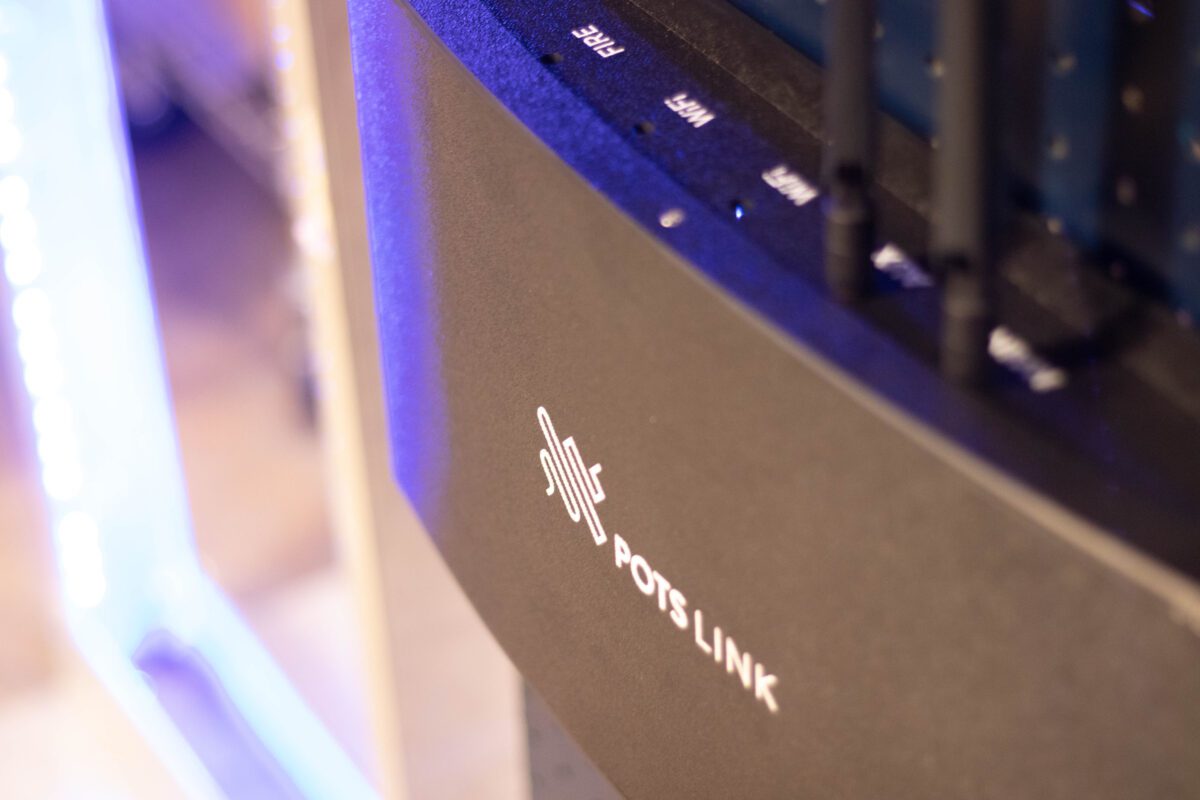
POTS Link is RCN's fully managed replacement for copper analog lines. A single gateway connects to existing equipment through standard RJ-11 analog ports and carries up to 8 lines over dual-carrier LTE with automatic failover. Each unit has 24+ hours of battery backup, supports SIA and Contact ID signaling for alarm panels, and is built to comply with NFPA 72, ASME A17.1, and UL 864, along with E911 requirements under Kari's Law and RAY BAUM'S Act.
RCN handles the line inventory, coverage check, installation, and carrier activation, and the RCN Network Operations Center supports every line 24/7/365. The City of Round Rock, Texas replaced more than 200 POTS lines across 49 city facilities this way.
POTS Link is the only POTS replacement approved on the U.S. GSA Schedule for federal purchasing, and it is also available through NASPO ValuePoint, Sourcewell, OMNIA Partners, and Equalis Group. See all government procurement contracts.
What it costs
Copper lines have gotten expensive to keep. Many organizations now pay $100 or more per line each month, and grandfathered lines cannot be renewed or moved. RCN customers typically save 40-60% on telecom costs after replacing POTS lines. Use the POTS line replacement calculator to estimate your own numbers.
Free download
Get the 2027 POTS Line Replacement Guide
The free 2027 edition puts it all in one short download: the copper shutdown dates, the lines most likely to be at risk in your buildings, and how to replace them before your carrier's date.
Download the 2027 Guide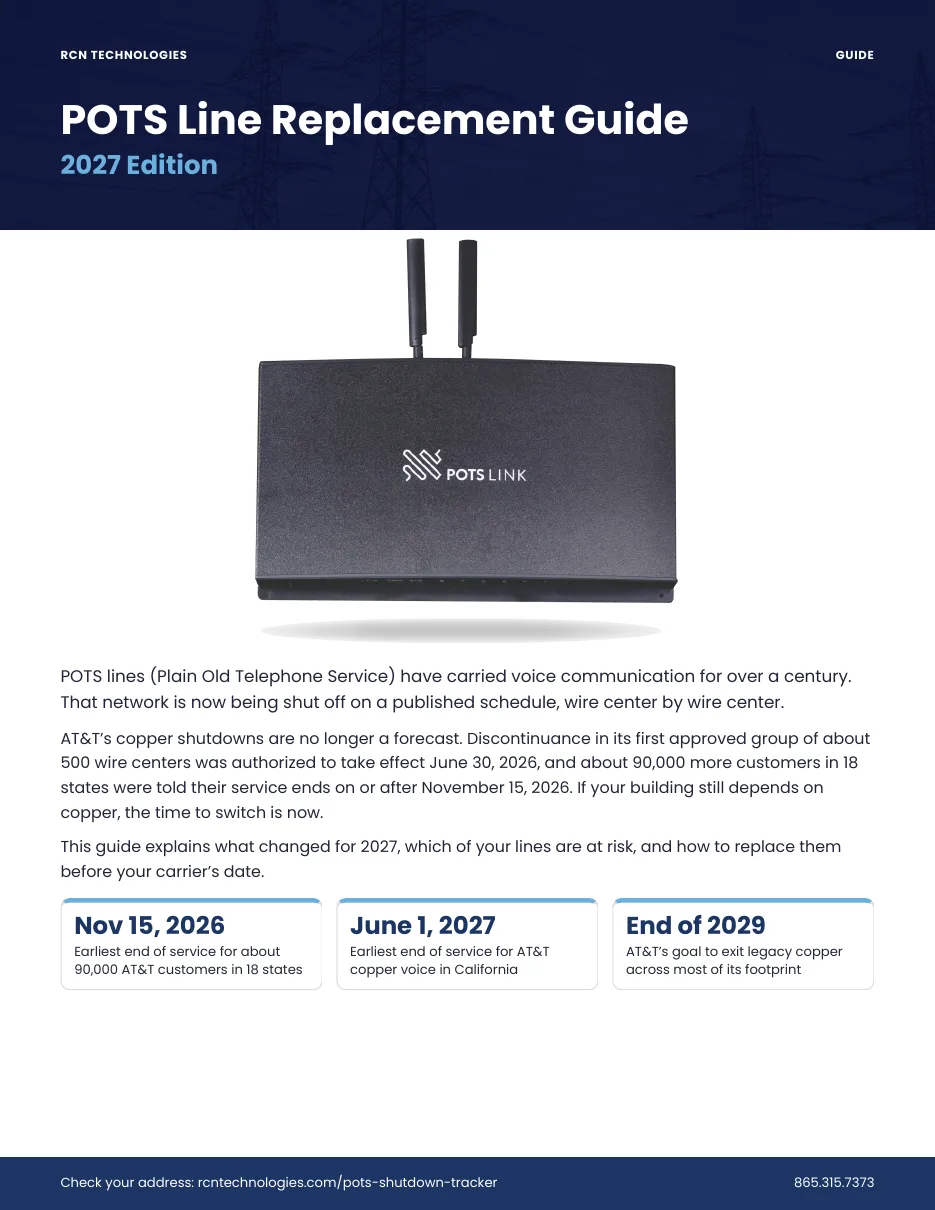
Frequently asked questions
When will AT&T shut off POTS lines?
It depends on the wire center. Discontinuance in AT&T's first approved group of about 500 wire centers could take effect June 30, 2026, and about 90,000 more customers in 18 states were notified that service ends on or after November 15, 2026. California discontinuances are set for on or after June 1, 2027, and AT&T's goal is to exit legacy copper across the large majority of its footprint by the end of 2029.
How do I know if my building is affected?
Search your address or ZIP code in RCN's free POTS Shutdown Tracker. It maps 1,948 wire centers across 22 states with carrier retirement filings and shows the status of each.
What happens to a grandfathered POTS line?
It keeps working for now, but you cannot place new orders, renew the service agreement, or move it to a new address. Grandfathering is usually the step before discontinuance.
Can a cellular POTS replacement handle a fire alarm or elevator line?
Yes, when the replacement is built for it. POTS Link is built to comply with NFPA 72, ASME A17.1, and UL 864 and supports SIA and Contact ID signaling. Your local authority having jurisdiction makes the final approval.
What happens to a POTS Link line during a power outage?
Each POTS Link unit carries 24+ hours of battery backup, so life-safety lines keep working when building power is out.
How can a public agency buy POTS line replacement?
POTS Link is the only POTS replacement approved on the U.S. GSA Schedule and is also available through NASPO ValuePoint, Sourcewell, OMNIA Partners, and Equalis Group, so most agencies can buy through a contract they already use.
ADDITIONAL POTS REPLACEMENT RESOURCES
Use these resources to deepen your understanding of POTS modernization.

POTS Link Risk Assessment
Uncover hidden costs, risks & inefficiencies in your POTS setup with our 3-min, 15-question VLE Score assessment.

Code Compliant Replacement Bible
Discover how to replace POTS lines without violations or downtime. Get code compliance tips for NFPA 72, ASME A17.1, ADA, and more. Free guide.

GSA EIS Guide
Many public sector organizations continue to use POTS for life safety, compliance, and facility management functions, but without a migration strategy, they face serious risk.
Download the 2027 Guide to POTS Line Replacement
Fill out the form to get your free copy of the 2027 POTS Line Replacement Guide.