

POTS Replacement Comparison
POTS Link vs. NAPCO StarLink Fire: Which Fire Panel POTS Replacement Is Right for You?
A direct comparison on cellular architecture, carrier redundancy, line density, compliance, and who should actually be making the cellular infrastructure decision for your fire alarm system.
Request a POTS Link AssessmentIf your fire alarm contractor has recommended NAPCO StarLink Fire as your POTS replacement, they are giving you sound advice about the panel side of the equation. StarLink Fire is a well-engineered, purpose-built DACT communicator with real UL credentials and a strong track record in the fire integrator channel. This page is not written to dismiss it.
What this page addresses is the question your fire alarm contractor is not equipped to answer: whether the cellular path StarLink Fire depends on is the right cellular architecture for your facility. That question takes a different kind of expertise than fire alarm installation. It takes wireless WAN engineering, and that gap is where the meaningful differences between StarLink Fire and POTS Link begin.
StarLink Fire is built by a fire alarm hardware manufacturer. POTS Link by RCN is built by a wireless WAN specialist with 13 years of Ericsson and Cradlepoint deployment experience in RF-severe environments. For a life-safety communication path that lives or dies on the quality of its cellular connection, that difference matters more than most buyers realize until they meet a problem in the field.
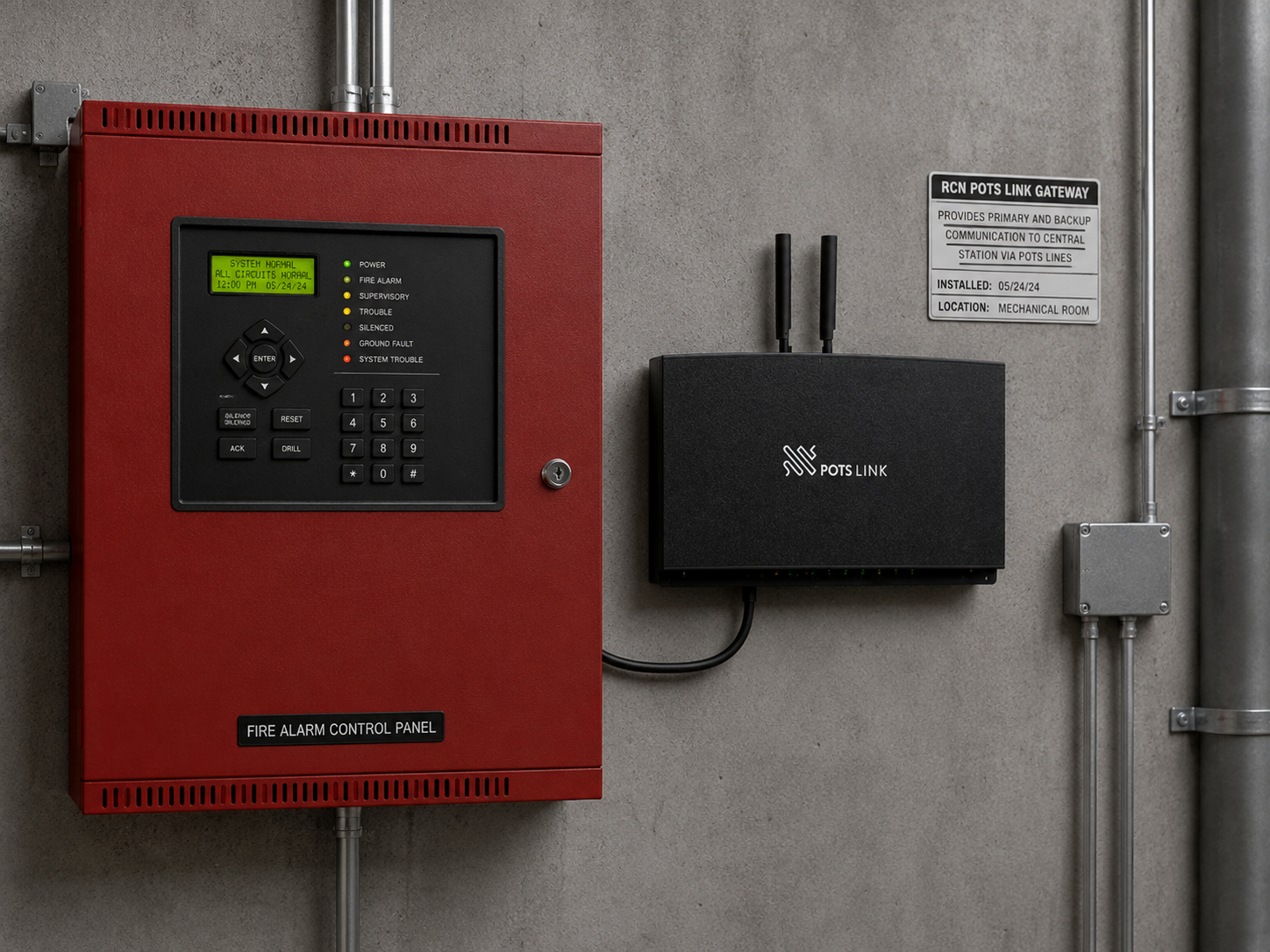
What Is NAPCO StarLink Fire?
NAPCO StarLink Fire is a line of cellular DACT communicators manufactured by NAPCO Security Technologies, designed specifically to replace the two dedicated POTS lines required by most commercial fire alarm control panels (FACPs). The flagship current model, the MAX2, carries dual SIM slots supporting Verizon and AT&T cellular networks on 5G LTE-M, with FirstNet Ready certification available on select SKUs. The device is panel-powered, which removes the need for a separate power supply or additional conduit, a meaningful installation efficiency for fire alarm technicians. It is end-to-end UL 864 listed from the communicator through NAPCO’s own network operations center in New York to any central station’s UL-listed receiver.
StarLink Fire is sold through licensed fire alarm dealers and integrators and is priced as a hardware product, typically with a monthly service fee for cellular connectivity and NOC monitoring. It is a well-regarded product in its category and one of the most widely deployed fire alarm communicators in the US market.
What Is POTS Link?
POTS Link is RCN Technologies’ fully managed cellular POTS replacement service. Unlike a product sale, POTS Link is a service relationship. RCN manages the hardware, the carrier connectivity, and the ongoing health of your lines. The service gateway is included in the monthly cost, and RCN’s team of wireless WAN specialists handles configuration, installation, monitoring, and support.
RCN is an Ericsson Technical Excellence Partner and a Cradlepoint-certified integrator with over 13 years of experience deploying wireless WAN solutions in enterprise, government, and public safety environments. That depth of RF and cellular engineering expertise is the technical foundation POTS Link is built on, and it is the credential most directly relevant to the decision your fire alarm contractor is not positioned to make. RCN also holds direct government contract vehicles across GSA, OMNIA Partners, Sourcewell, and NASPO ValuePoint, with state contract access in Georgia, New York, and Pennsylvania.
The Question Your Fire Alarm Contractor Cannot Answer
Fire alarm integrators are expert at what they do. They know panel brands, DACT wiring, NFPA 72 code requirements, and central station reporting protocols. What they are not is cellular WAN engineers. When a fire alarm contractor installs a StarLink Fire communicator, they are making a cellular infrastructure decision: selecting a carrier path, relying on automated signal selection, and staking life-safety communications on RF performance at your specific site, without the training or tools to evaluate whether that cellular path is actually the right one for that environment.
This is not a criticism of fire alarm integrators. It is a structural reality of the market. StarLink Fire was designed to minimize the cellular engineering burden on the installer, which is exactly right for that channel. But minimizing the engineering burden is not the same as optimizing the RF architecture. In a basement mechanical room, a high-rise elevator shaft, a multi-building campus with variable carrier coverage, or any site where signal attenuation is a real condition, the difference between automated carrier selection at installation and active RF site assessment with multi-carrier path design is not theoretical. It is the difference between a fire alarm communication path that works on the day it is installed and one that is engineered to work on the day it has to.
RCN’s 13 years of wireless WAN deployment experience, built through Ericsson and Cradlepoint partnerships across RF-severe environments, is what POTS Link brings to that problem. Most fire alarm contractors stock one communicator SKU. RCN engineers a wireless path for each site.
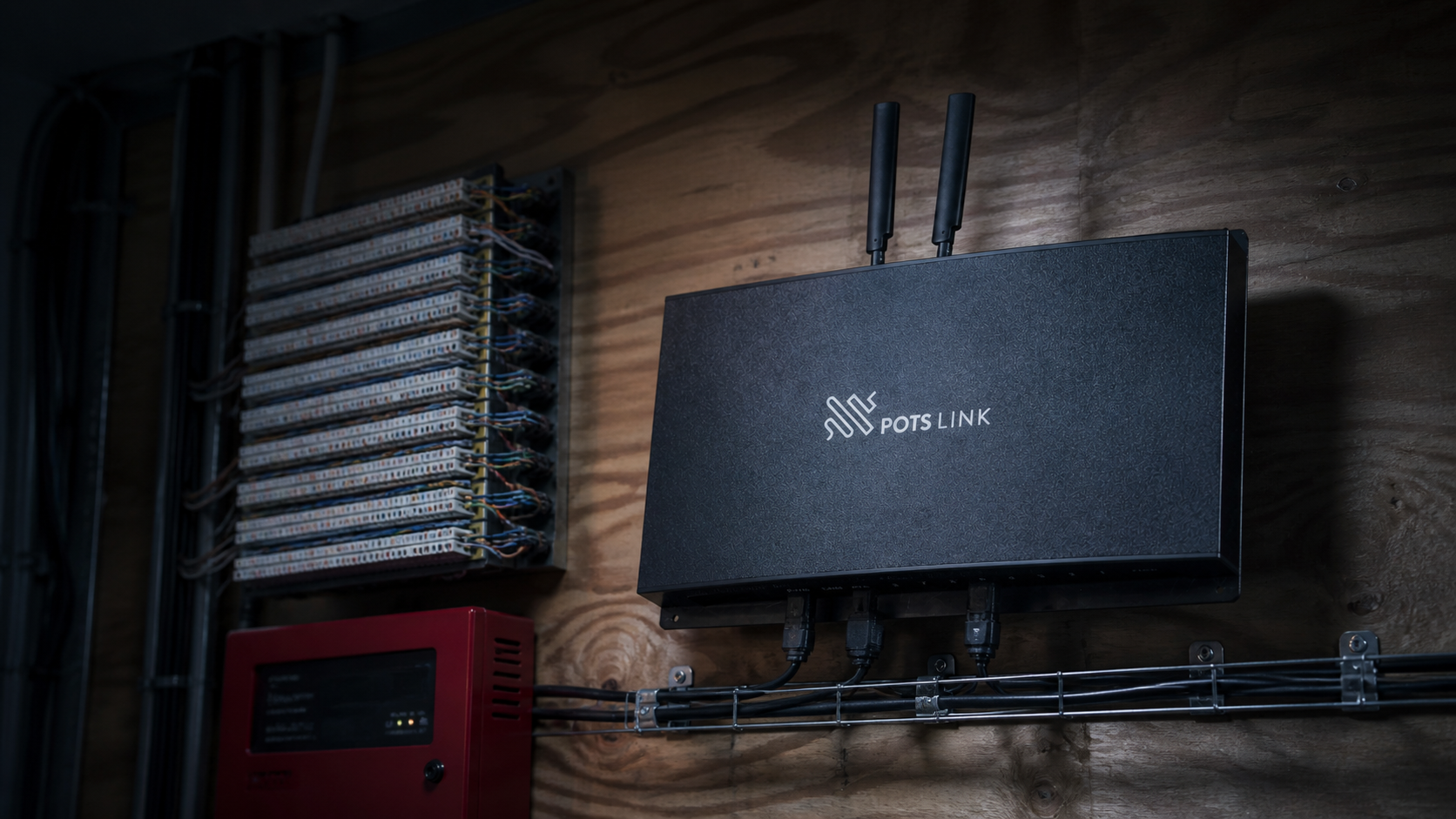
How POTS Link and NAPCO StarLink Fire Compare
Six dimensions where the two solutions diverge. Expand each for the detail.
Cellular Architecture: Automated Selection vs. Engineered Path
This is the most consequential difference between the two solutions, and the one least likely to surface in a fire alarm contractor’s proposal.
NAPCO StarLink Fire MAX2 carries dual SIMs for Verizon and AT&T and automatically selects the stronger carrier at installation based on signal strength at that moment. That is a well-designed feature for a product being installed by a technician whose job is to swap the DACT and move to the next site. The device locks in the better carrier and reports status via LED indicators inside the enclosure.
POTS Link is built on a wireless-first, dual-SIM architecture designed by cellular WAN engineers. SIM slot 2 always carries RCN’s multi-carrier SIM, a single physical SIM with tri-carrier redundancy that dynamically routes to the strongest available carrier at the network core in real time, not just at installation. SIM slot 1 gives the customer a choice: bring your preferred carrier SIM, or have RCN deploy the site’s strongest available carrier based on an active RF assessment of that specific location. SD-WAN technology selects the optimal path across both SIM slots continuously, not once at commissioning.
The distinction matters because RF environments change. Carrier coverage maps shift. Network congestion is not uniform across time. A carrier that delivers the best signal on a Tuesday morning installation may not deliver the best path during a declared emergency on a Friday night when surrounding cellular traffic spikes. POTS Link’s active path management accounts for that. StarLink Fire’s static auto-select at installation does not.
Carrier Priority: Public Safety Networks
NAPCO StarLink Fire offers FirstNet Ready certification on select SKUs, specifically the SLE-FNI-FIRE series. On FirstNet-capable models, the device uses FirstNet Band 14 as the primary path and standard AT&T LTE as the secondary path automatically. That is a meaningful credential for fire alarm applications and one RCN respects.
POTS Link is compatible with all three major public safety and priority networks: FirstNet-compatible via AT&T, Verizon Frontline-compatible, and T-Mobile public safety network-compatible. For facilities that want FirstNet priority, POTS Link can deliver it. For facilities where Verizon Frontline is the stronger or preferred public safety path, which is a real condition in many markets, POTS Link can provide that instead. For facilities that want both FirstNet and Verizon Frontline in the same dual-SIM architecture, POTS Link’s multi-carrier design supports that configuration.
StarLink Fire’s public safety priority capability is real but carrier-constrained. POTS Link’s priority network compatibility spans all three carriers and is deployable based on the actual RF environment at your facility, not on which carrier the hardware manufacturer has a certified relationship with.
Multi-Application Coverage: Single-Device FACP vs. Facility-Wide Gateway
StarLink Fire is purpose-built for one job: replacing the POTS lines at the fire alarm control panel. That narrow focus is a feature in the fire integrator channel. It makes the product simple to specify, install, and support.
For most commercial facilities, the fire alarm panel is not the only POTS-dependent device. Elevator emergency phones, building entry intercoms, gate systems, and fax lines all run on copper. A facility that installs StarLink Fire to replace the FACP’s POTS lines still needs separate solutions for each of those other devices. That means multiple vendors, multiple hardware footprints, multiple service relationships, and multiple points of failure.
POTS Link supports 8 analog lines natively per service gateway, with extended architecture supporting 24 to 32 lines per rack-mount unit. A single POTS Link deployment can address the fire panel, the elevator phone, the gate intercom, and the fax line simultaneously, on one device, one service contract, and one managed relationship with a cellular WAN partner who owns the performance of every line on that gateway. For facilities managers dealing with the full scope of the copper sunset, that total-cost-of-ownership difference is significant.

Battery Backup: Code Compliance Without Add-Ons
StarLink Fire is panel-powered, drawing power directly from the fire alarm control panel’s auxiliary output. Battery backup duration therefore depends on the FACP’s own battery capacity, not a dedicated backup in the communicator itself. For many standard commercial panel installations this meets code, but the backup duration is a function of the panel’s battery, not a specified standalone value from NAPCO.
POTS Link delivers 24-hour native battery backup at the service gateway level, with no add-ons and no dependency on a connected panel’s battery configuration. For fire alarm communications specifically, NFPA 72 requires 24 hours of standby power. POTS Link meets that requirement natively and explicitly, which simplifies AHJ documentation and compliance verification.
Compliance Certifications
NAPCO StarLink Fire carries end-to-end UL 864 10th Edition listing, from the communicator through NAPCO’s own NOC to any central station’s UL receiver. That is a tightly auditable compliance chain and a genuine credential that fire-focused buyers should recognize. The device is also NFPA 72 compliant and works with virtually any 12V to 24V FACP using Contact ID or 4/2 formats.
POTS Link is built and tested against NFPA 72 for fire alarm communications, ASME A17.1 for elevator emergency communications, applicable UL listing standards for life-safety signaling, Federal Enhanced E911 requirements, Kari’s Law, and the RAY BAUM’S Act. For multi-device facilities, which describes virtually every real-world POTS replacement deployment, the broader compliance footprint matters. Kari’s Law requires that multi-line systems permit direct 911 dialing without a prefix. The RAY BAUM’S Act extends that to require dispatchable location data. StarLink Fire’s documentation does not address either. Buyers should request written compliance documentation from any vendor before committing.
Service Model: Hardware Product vs. Managed Service
StarLink Fire is a hardware product. The fire alarm contractor installs it, the customer owns it, and ongoing cellular service is managed through NAPCO’s NOC with the fire alarm dealer as the primary support relationship. That model works well when the fire alarm contractor is actively engaged and technically competent to manage cellular connectivity issues. When a coverage degradation or carrier outage affects the communicator’s reporting path, the response chain runs through the dealer to NAPCO, a support structure built around fire alarm expertise, not cellular WAN expertise.
POTS Link is a fully managed service. RCN owns the monitoring, the troubleshooting, and the carrier coordination on an ongoing basis. For facilities managers without a dedicated telecom operations team, and for any facility where life-safety communications cannot wait on a hardware vendor’s support queue, that distinction determines whether a line issue becomes a resolved ticket or an undetected outage on a fire alarm system.
Comparison at a Glance
| NAPCO StarLink Fire (MAX2) | POTS Link | |
|---|---|---|
| Device type | DACT communicator (fire panel only) | Multi-line service gateway (fire, elevator, gate, fax, and more) |
| Cellular architecture | Dual SIM (Verizon + AT&T); auto-selects at installation | Wireless-first dual-SIM (customer carrier + RCN multi-carrier SIM); SD-WAN active path management |
| Public safety networks | FirstNet Ready (select SKUs, AT&T / Band 14) | FirstNet-compatible, Verizon Frontline-compatible, T-Mobile public safety network-compatible |
| Carrier selection | Static auto-select at installation | Dynamic real-time path optimization at network core |
| Lines supported | 2 POTS lines per FACP | 8 native; 24 to 32 extended per rack-mount unit |
| Battery backup | Panel-powered (dependent on FACP battery) | 24-hour native, NFPA 72 aligned |
| UL 864 listing | End-to-end (communicator to NOC to central station) | Life-safety signaling UL standards |
| NFPA 72 compliant | Yes | Yes |
| ASME A17.1 / elevator | No (fire panel only) | Yes |
| Kari’s Law / RAY BAUM’S Act | Not addressed | Compliant |
| Installation | Fire alarm contractor (15-minute panel install) | RCN wireless WAN specialist; RF site assessment standard |
| Service model | Hardware product; dealer-managed | Fully managed service; RCN-owned |
| Hardware cost | Purchased per unit | Included in monthly service |
| Gov contract vehicles | Not available | GSA, OMNIA, Sourcewell, NASPO; State of GA, NY, PA |
| Provider background | Fire alarm hardware manufacturer | Wireless WAN integrator; 13 years RF and cellular deployment experience |
Which Solution Fits Which Buyer?
NAPCO StarLink Fire is a reasonable fit if:
Your POTS replacement scope is limited to fire alarm control panels only, your fire alarm contractor will actively manage the ongoing cellular service relationship, your facility’s Verizon or AT&T coverage has been verified as strong at the panel location, and you have no multi-device POTS replacement needs beyond the FACP.
POTS Link is the stronger fit if:
- Your facility has multiple POTS-dependent devices (fire panels, elevator phones, gate systems, fax lines) and you need one managed solution for all of them
- You need tri-carrier wireless redundancy with active SD-WAN path optimization, not static carrier selection at installation
- You need FirstNet, Verizon Frontline, or T-Mobile public safety compatibility based on your RF environment, not a device maker’s default carrier
- You operate in a complex RF environment such as basement mechanical rooms, high-rise construction, or multi-building campuses, where cellular path engineering matters
- You need documented compliance with Kari’s Law and the RAY BAUM’S Act across a multi-line facility
- You want a managed service provider with cellular WAN expertise owning the performance of your life-safety communications, not a fire alarm contractor managing a hardware product outside their core expertise
- Your procurement runs through GSA, Sourcewell, or a state contract in Georgia, New York, or Pennsylvania
Get a no-cost POTS Link assessment for your facility.
A wireless WAN specialist will scope your site and walk you through what a managed cutover looks like, across the fire panel and every other analog line in the building.
Request a POTS Link AssessmentFrequently Asked Questions
What is a NAPCO StarLink Fire alternative for facilities with multiple POTS-dependent devices?
POTS Link by RCN Technologies is a fully managed cellular POTS replacement service that supports up to 8 analog lines per gateway natively, covering fire alarm panels, elevator phones, gate intercoms, fax lines, and other analog devices simultaneously on a single platform. It is available directly on GSA Schedule, OMNIA Partners, Sourcewell, and NASPO ValuePoint without routing through a third-party distributor.
Does NAPCO StarLink Fire support all three major public safety networks?
No. The FirstNet Ready SKUs in the StarLink Fire line operate on FirstNet Band 14 as the primary path and standard AT&T LTE as the secondary. Verizon Frontline and T-Mobile public safety network compatibility are not available in the StarLink Fire product line. POTS Link supports FirstNet-compatible, Verizon Frontline-compatible, and T-Mobile public safety network-compatible configurations, deployable based on the RF environment at your specific facility.
Why does cellular WAN expertise matter for fire panel POTS replacement?
A fire alarm communicator is a cellular endpoint. Its reliability depends on the quality of the RF path at your site, the carrier’s coverage in that specific building location, and the behavior of that path under network stress during an emergency. Fire alarm contractors are experts in panel installation and DACT wiring; they are not cellular WAN engineers. RCN’s 13 years of wireless WAN deployment experience means every POTS Link installation begins with a real RF assessment, not an automated signal check at installation time. In RF-severe environments such as basements, high-rise shafts, and concrete-dense construction, that expertise is what makes the system work when it has to.
What is the difference between static carrier auto-select and active SD-WAN path management?
NAPCO StarLink Fire MAX2 evaluates signal strength at installation and locks in the stronger of its two SIMs, Verizon or AT&T, at that moment. POTS Link’s SD-WAN architecture continuously evaluates the optimal path across both SIM slots in real time, routing to the best available carrier dynamically at the network core. RF environments change and carrier congestion varies with time and local events. Active path management means your fire alarm communication path is optimized at 2:00 AM on a normal night and at 7:00 PM during a declared emergency with elevated network traffic, not just at the moment a technician installed the communicator.
Does POTS Link meet NFPA 72 battery backup requirements?
Yes. POTS Link provides 24-hour native battery backup at the service gateway level without add-ons or dependency on a connected panel’s battery configuration. NFPA 72 requires 24 hours of standby power for fire alarm communicators. NAPCO StarLink Fire is panel-powered, meaning its effective backup duration depends on the FACP’s own battery capacity.
Is POTS Link available on cooperative contract vehicles for government facilities?
Yes. POTS Link is available directly on GSA Schedule, OMNIA Partners, Sourcewell, and NASPO ValuePoint, with state contract access in Georgia, New York, and Pennsylvania, without routing through a third-party distributor.
Can POTS Link replace fire panel POTS lines and elevator phone lines on the same device?
Yes. A single POTS Link gateway supports up to 8 analog lines natively, covering fire alarm panels, elevator emergency phones, building entry systems, gate intercoms, fax lines, and other analog devices simultaneously. NAPCO StarLink Fire is purpose-built for fire alarm control panels only and does not address other POTS-dependent devices in a facility. Comparing other POTS replacement options? See POTS Link vs. MetTel POTS in a Box and POTS Link vs. MarketSpark.
Speak with a POTS Replacement Specialist
Tell us about your facility and a wireless WAN specialist will scope your POTS replacement, the fire panel and every other analog line in the building included.