

POTS Link Insights
POTS Line Replacement for Senior Living: Nobody Guarantees Your Alarm
The FCC let the alarm compatibility requirement expire in 2025 and declined to replace it. In buildings full of residents who cannot self-evacuate, that changes what POTS replacement for senior living has to prove.
Reed Perryman, VP of Sales & Marketing
Talk to a POTS Replacement SpecialistIn March 2026, the FCC was asked to require that copper replacement services stay compatible with legacy alarm equipment. It declined. That decision now sits underneath every POTS replacement for senior living being planned this year. The Commission noted that the 2016 requirement for “replacement services [to] be compatible with these devices” had already sunset in 2025, and that adding a new one “would introduce unnecessary delay.” In its place it offered a sentence of encouragement: the FCC “encourage[s] carriers to ensure their IP networks are appropriately configured so as to prevent alarm signaling failures.”
Read that twice if you run buildings full of people who cannot self-evacuate. The federal backstop that said your fire alarm has to keep dialing out after the copper leaves is gone, and what replaced it was a word of advice to carriers.
That is the real risk in POTS line replacement for senior living. Not the phone bill. The signal.
The short answer
Copper is being retired on the carriers’ schedule, and no federal rule now guarantees your fire alarm, elevator phone, or area of refuge dial-out survives the migration. Senior living carries more analog life-safety lines per building than almost any other property type, and a CMS-certified building can answer to two different editions of NFPA 72 at once. Inventory the lines, confirm the governing code edition in writing, and hold your replacement vendor to UL 864, loop-start line seizure, and supervised backup power.
What the FCC changed in March 2026
FCC 26-19 is a deregulation package. It eliminated the requirement that carriers file network change disclosures with the Commission, replaced the Adequate Replacement Test and the Alternative Options Test with one consolidated rule, granted blanket grandfathering authority for legacy voice, and applied a 31-day automatic grant to discontinuance applications uniformly. Carriers must still notify affected customers, no later than the day they file. The practical floor between your notice and federal authorization is about a month.
One number to stop repeating: the widely circulated claim that the FCC cut required notice “from 180 days to 90 days” is not supported by the rule text. Treat it as trade folklore. Actual notice varies by carrier and tranche. AT&T’s 18-state discontinuance covering roughly 90,000 customers sent notices in November 2025 for a November 15, 2026 shutoff, close to a year. Nothing guarantees the next one looks like that.
What AT&T and Verizon have already done
The sequence already in motion matters more. As of October 15, 2025, AT&T stopped accepting new installations, moves, adds, or changes on copper across roughly 20 states, which means you cannot add a POTS line for a renovation or a replacement elevator even where copper still works. AT&T received authorization to begin discontinuing copper in wire centers effective June 30, 2026, covering roughly 500 wire centers, about 10 percent of its footprint. Its stated goal is no copper in wireless-first areas by the end of 2027 and none across the vast majority of its footprint by the end of 2029. Verizon is running the same play more quietly, wire center by wire center, and its retirement notices carry a line worth pinning to the wall: Verizon “may require customers and interconnecting entities to migrate services off of copper facilities well before the copper retirement implementation date.”
About 3 percent of AT&T’s customers still use copper. That is exactly why senior living is exposed. The remaining 3 percent is disproportionately life-safety infrastructure, retired on a timetable set by the other 97 percent.
You do not have to take anyone’s word for the pace. RCN maintains a free POTS Wire Center Shutdown Tracker built from AT&T CLEC network disclosures. As of July 26, 2026 it lists 2,024 wire center notices: 1,829 still active, 12 with a deadline inside 90 days, and 183 wire centers already retired. Texas alone carries 187 in one cluster, Florida 106, Georgia 133. You can search it by ZIP code or street address, which is the fastest way to find out whether a specific community is already inside an announced closure zone.
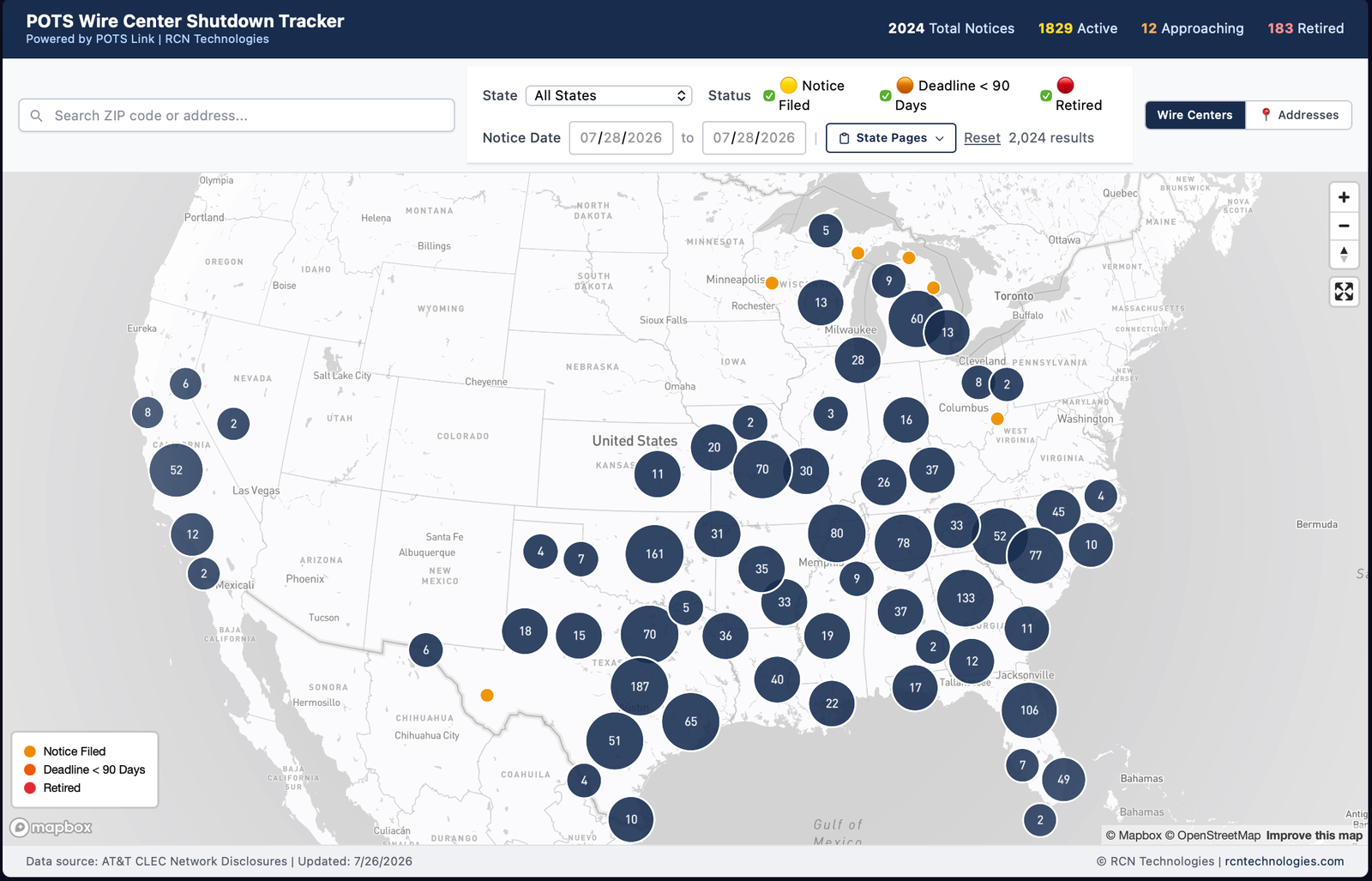
Senior living carries more copper per building than almost any other property type
There are roughly 41,465 assisted living communities in the United States holding nearly 1.4 million licensed beds, averaging 33 beds each, per AHCA/NCAL. Add 14,742 CMS-certified nursing facilities as of July 2025, per KFF. That is about 56,000 buildings, most of them wired when copper was the only option.
Walk one and count what still lands on an analog pair.
- Life-safety. The fire alarm panel’s digital alarm communicator transmitter. Elevator emergency phones. Area of refuge and stairwell two-way communication, which in many jurisdictions must auto-dial a 24-hour monitoring location when the on-site answering point is not staffed around the clock. Fire pump and generator supervisory signals riding the same path.
- Licensure-relevant. Nurse call and emergency call escalation dialers. Resident pull cords and wander management alerts that hand off to an answering service after hours. Medical gas master alarms in skilled nursing. Vaccine and blood product refrigeration alarms.
- Operational. Fax for physician orders, pharmacy, lab results, and MDS submissions. Burglar and duress panels. Lobby phones. Analog PBX trunks. Irrigation and building automation dial-out.
- And the orphans. Lines nobody can identify, on a demarc where the last accurate cross-connect record is 25 years old and the labeling is faded masking tape. In practice these are the largest single category any audit turns up.
What a line audit actually finds
Nobody publishes an average line count per community, and you should be skeptical of anyone who quotes you one. The count is discovered, not known, and it runs higher than the facilities team expects because orphan lines do not appear on any as-built drawing. Cost is equally murky, and it is worth saying plainly: no federal agency and no independent research firm tracks what POTS lines actually cost. Every figure in circulation is a vendor estimate or a customer anecdote. The most defensible public number comes from the Bureau of Labor Statistics, which shows residential phone service up 48 percent between January 2015 and May 2025 against 36 percent general inflation. Business copper has moved harder. But when a vendor shows you a precise national average, ask where it came from.
POTS replacement for senior living: your building may answer to two fire codes at once
This is the part the POTS replacement market does not discuss, and it is why senior living cannot copy an office building’s migration plan.
Under 42 CFR 483.90, CMS requires long-term care facilities participating in Medicare and Medicaid to comply with the 2012 edition of NFPA 101, the Life Safety Code, along with TIA 12-1 through 12-4. That is the edition your Life Safety Code surveyor works from. NFPA 101-2012 in turn incorporates by reference the 2010 edition of NFPA 72.
Meanwhile the state or municipal fire code adopted for that same building may enforce NFPA 72-2016, 2019, 2022, or 2025. A CMS-certified skilled nursing facility can therefore be measured against one edition of the fire alarm code federally and a different one locally, at the same time, on the same panel. That is not academic. The editions disagree about the exact thing you are changing.
Assisted living is a different animal. Most assisted living communities are not CMS-certified under 42 CFR Part 483 and answer to state licensure instead. Those rules generally require an emergency call system and a working telephone, written in functional terms, and they rarely specify the transport. Do not assume a swap is invisible to your surveyor without reading your state’s rule text.
Before you order equipment, confirm in writing which NFPA 72 edition your AHJ enforces, and confirm separately with your Life Safety Code surveyor how they will treat the change. Get both answers. They may not match.
Two copper lines have not been a dual path since 2013
Here is what surprises most facilities directors: the classic installation, a fire alarm panel on two POTS lines, has not satisfied current NFPA 72 for over a decade.
NFPA 72 permitted a DACT to use two telephone lines through the 2010 edition. The 2013 edition eliminated that option. A DACT must now use one telephone line paired with a second, different technology such as cellular, IP, or radio. A second phone line is permitted only by exception where no other technology exists at the premises. Two copper lines count as a single technology path, not a dual path. Many senior living buildings on the newer editions are already out of compliance, independent of anything a carrier does. We break the standard down further in our guide to NFPA 72 requirements for POTS lines.
The 2013 edition also restructured Chapter 26 to be performance-based rather than prescriptive, permitting a single communications path where it is supervised to a higher standard. The supervision math is worth memorizing.
- Single path: supervised at intervals of not more than 60 minutes, with failure annunciated at the supervising station within 60 minutes.
- Multiple paths: each path supervised on a 6-hour cycle.
Compare that to what copper gave you. A legacy DACT may check in only every 6 or 24 hours, so a line cut at 1 a.m. can sit dead until the next scheduled test. A properly supervised cellular path does not degrade your supervision. It improves it, often by an order of magnitude, and that is an argument to make to a skeptical AHJ rather than apologize for.
What counts as a compliant path
NFPA 72 also defines what a replacement has to be. A Managed Facilities-based Voice Network is recognized as an acceptable substitute for a traditional loop-start line, but the definition carries requirements: at least 8 hours of standby power at the premises and 24 hours at the provider’s facility, signals transmitted in real time with formats unchanged, and no routing over the public internet. That definition is the line between a compliant POTS replacement and a generic analog telephone adapter. One caution: Chapter 26’s section numbering shifted across editions, so cite the section alongside the edition or cite by topic.
Elevator phones are not a phone problem
ASME A17.1 asks for things a plain analog line did implicitly and a careless replacement quietly breaks.
The car’s two-way communication must reach a location staffed by authorized personnel who can act, answered by a live person, available 24/7. If the device does not reach authorized personnel within 45 seconds, the call must automatically route to another location. The system must identify the building, the elevator, and the nature of the request. Backup power must carry the communications means for at least 4 hours.
Critically, the standard requires a means to verify operability automatically, at least daily, regardless of whether the underlying service is landline, cellular, or VoIP. That one requirement disqualifies most generic VoIP adapters. It exists because 95 to 98 percent of elevator phone activations are false alarms, which means nobody ever discovers a dead elevator phone through normal use. We cover the mechanics in detail in our piece on compliant elevator line conversions.
What changed in the 2019 edition
A17.1-2019 added in-cab text messaging for passengers who are deaf or hard of hearing, video for entrapment assessment, and help-is-on-site messaging. Adoption is uneven: some states are on 2019, others sit on editions from 2007 to 2016. Check your state’s adopted edition rather than assuming a national video mandate.
One field detail that costs people money: the elevator line often does three jobs, not one. Two-way voice, ringdown to the monitoring center, and modem data for controller diagnostics. A replacement that carries voice but silently drops the modem path breaks remote diagnostics without generating a single alarm.
The thing copper did for free was power
Copper was line-powered and switched from the central office. Every cellular replacement is a locally powered device, and unsupervised standby power is unreliable at exactly the moment you need it.
Four different backup power floors are in play, and they do not agree.
| Requirement | Standby power floor |
|---|---|
| NFPA 72 secondary power, transmitters and shared equipment | 24 hours (8 permitted with AHJ-approved risk analysis) |
| NFPA 72 MFVN qualification | 8 hours at the premises, 24 hours at the provider facility |
| ASME A17.1 elevator communications | 4 hours |
| Area of refuge two-way communication | 4 hours |
A vendor spec of “12 hours” or “24 hours” does not automatically satisfy any of these, because the fire alarm panel’s own secondary power requirement is separate. In a community running generator power, the replacement gateway belongs on the emergency branch, not a convenience outlet in a corridor.
Two related failure modes deserve naming. Signal: fire alarm panels live in back-of-house closets and elevator terminations land in machine rooms, sometimes on the roof and often in the basement, which is where cellular coverage is worst. A bars-on-a-phone check is not a site survey. Consolidation: putting the fire panel, the elevator phone, and the area of refuge dial-out on one gateway means one power supply, one antenna, and one SIM across three independent life-safety systems. Some AHJs will object, and they are not wrong to.
Six questions that separate a real solution from dial tone in a box
What to ask before you sign
The FCC has explicitly declined to guarantee alarm compatibility, so the burden of proof has moved to your vendor.
- What is the UL 864 listing number? Fire alarm communication equipment is evaluated under UL 864. Some POTS replacement products are listed only under IT-equipment standards such as UL 62368-1 and battery standards such as UL 2054. “UL listed” is not an answer.
- Does it present a loop-start interface and support line seizure? NFPA 72 requires the DACT to seize the line ahead of any other premises use. A device presenting ground-start will not work regardless of signal strength.
- Which dialer formats pass intact? Contact ID and SIA are the modern defaults, but older panels may still speak 4/2 pulse. Alarm signaling is modem tones over a voice path, and any transcoding, compression, jitter, or echo cancellation corrupts the handshake. Verify panel by panel.
- Will our central station accept the path? Not every monitoring station supports every protocol, and some products route through the vendor’s own operations center before reaching yours.
- What does the site survey actually measure? RSRP and RSRQ at the device location, at mounting height, with the door closed. Not a phone in the parking lot.
- Who owns the outcome at 3 a.m.? A supervised path generates trouble signals a copper line never did, and staff who have never seen a communication trouble will call it a false alarm.
POTS Link is built to answer those rather than deflect them. It is a fully managed cellular replacement that consolidates up to 8 analog lines per device over a standard RJ-11 interface, so fire alarm DACTs, elevator emergency phones, and analog equipment connect without reconfiguration. It runs dual-carrier LTE and 5G with automatic failover, carries 24 or more hours of battery backup, passes SIA and Contact ID, and is engineered against NFPA 72, ASME A17.1, and UL 864. Every deployment starts with a site survey rather than a shipment, and RCN’s 24/7/365 U.S.-based NOC watches line status afterward, which is how a dead path becomes a ticket instead of a discovery during your next inspection. Average deployment runs 19 days from signed contract to activation.
For multi-site operators, POTS replacement for senior living is a program, not a project
The largest operators run at real scale. Brookdale Senior Living reported 639 properties in the 2025 ASHA 50. Discovery Senior Living reported 362, Sunrise 229, Atria 174.
A portfolio that size does not face one migration. It faces buildings in different AT&T, Verizon, and Lumen territories, on different adopted code editions, under different AHJs, with carrier notices arriving building by building on schedules nobody controls. Some are CMS-certified and answer to NFPA 101-2012. Others are assisted living and answer to state licensure. The fire panels come from four manufacturers and three decades.
Treating that as a procurement event, one RFP and one shipment, is how operators end up with 200 gateways in a warehouse and no accepted cutover plan. Treating it as a program means a standing inventory, a per-building code profile, a cutover sequence phased against carrier notices rather than fiscal quarters, and one vendor accountable for the survey, the install, the AHJ conversation, and the monitoring afterward.
Public sector operators, including county-run nursing homes and VA community living centers, can move faster than the RFP calendar allows. POTS Link is available on GSA Schedule, NASPO ValuePoint, Sourcewell, OMNIA Partners, and Equalis Group, and it is the only POTS replacement approved on the U.S. GSA Schedule for federal purchasing. If you are weighing vendors, our POTS replacement comparisons line the options up side by side.
Start with what you actually have
Copper is leaving on a schedule carriers set, and the federal government has said in writing that it will not guarantee your alarm signals survive the trip. The buildings with the most to lose are the ones with the most analog lines and the least ability to evacuate.
The first move is not a purchase order. A POTS replacement for senior living starts with an inventory: every analog line in every building, what it serves, whether it is life-safety, and which code edition governs it. Our POTS Line Replacement Checklist walks that triage.
Talk to a POTS Replacement SpecialistAvailable on GSA Schedule, NASPO ValuePoint, Sourcewell, OMNIA Partners, and Equalis Group.
Frequently asked questions
Does a fire alarm panel still need two phone lines?
No. NFPA 72 eliminated the two-telephone-line option in its 2013 edition. A DACT must use one telephone line paired with a different technology such as cellular or IP. Two copper lines now count as a single communications path, not a dual path, which means many older installations are already non-compliant with current editions.
Is cellular fire alarm monitoring NFPA 72 compliant?
Yes, when it is supervised correctly. NFPA 72 permits a single communications path where the path is supervised at intervals of not more than 60 minutes and failure is annunciated at the supervising station within 60 minutes. Your local AHJ has final approval on pathway selection, so confirm the accepted configuration in writing before ordering equipment.
What edition of the Life Safety Code does CMS require?
CMS requires Medicare and Medicaid participating long-term care facilities to comply with the 2012 edition of NFPA 101, along with TIA 12-1 through 12-4, under 42 CFR 483.90. NFPA 101-2012 references the 2010 edition of NFPA 72, which can differ from the NFPA 72 edition your local fire code enforces. Confirm both with your surveyor and your AHJ.
Will my elevator phone still work after the copper shutdown?
Only if the replacement is engineered for ASME A17.1. The standard requires automatic daily verification of operability regardless of transport, automatic failover to another location if authorized personnel are not reached within 45 seconds, and at least 4 hours of backup power. Generic VoIP adapters routinely fail the daily verification requirement.
How many POTS lines does a typical senior living community have?
There is no published figure, and any vendor quoting a national average is estimating. Line counts are discovered through an on-site audit rather than known in advance, and they usually run higher than the facilities team expects because orphan lines do not appear on as-built drawings.
Does my nurse call system use a phone line?
Often, indirectly. CMS requires a resident call system that relays calls to staff, not off site, so the in-building system is usually low voltage. But many communities add an analog auto-dialer for after-hours escalation to on-call staff, an answering service, or a monitoring center. That dialer is a POTS line, and it rarely appears on the telecom inventory.
How much notice will my carrier give before disconnecting copper?
Less than you would like, and it is not fixed. Carriers must notify affected customers no later than the date they file a discontinuance application, and applications are automatically granted on the 31st day. Some tranches have run closer to a year, but nothing guarantees that. Verizon's own notices state it may require customers to migrate well before the published retirement date.
Who is responsible if a fire alarm fails to communicate after a migration?
Not the FCC. In its March 2026 order the Commission declined to impose a compatibility requirement on replacement services, noting the 2016 requirement had already sunset in 2025, and stated only that it encourages carriers to configure networks to prevent alarm signaling failures. Responsibility sits with the building owner, the alarm contractor, and the replacement vendor.
Speak with a Connectivity Expert
Fill out the interest form to request that one of our 5G & LTE experts contact you to discuss how we can best support your organization’s connectivity needs.


Ready to Cut POTS Costs?
Let’s get you a custom quote.