

Cradlepoint R1900 for Election Infrastructure: Secure Polling Place Networks at the Push of a Button

Mark leads digital growth strategy and marketing analytics, helping organizations navigate the transition from legacy connectivity to modern wireless and 5G solutions.
Polls open at 7 AM. Across the country, polling places are unlocking doors at fire stations, school gyms, community centers, and church basements. Every site needs an electronic poll book online and authenticated against the statewide voter registration database before the first voter walks in. The poll workers running the network are retirees, schoolteachers, and county employees who completed training the week before. They are not IT staff. That gap is what a deployable 5G network for elections is built to close, and it is why a growing number of election authorities are standardizing on the Cradlepoint R1900 to do it.
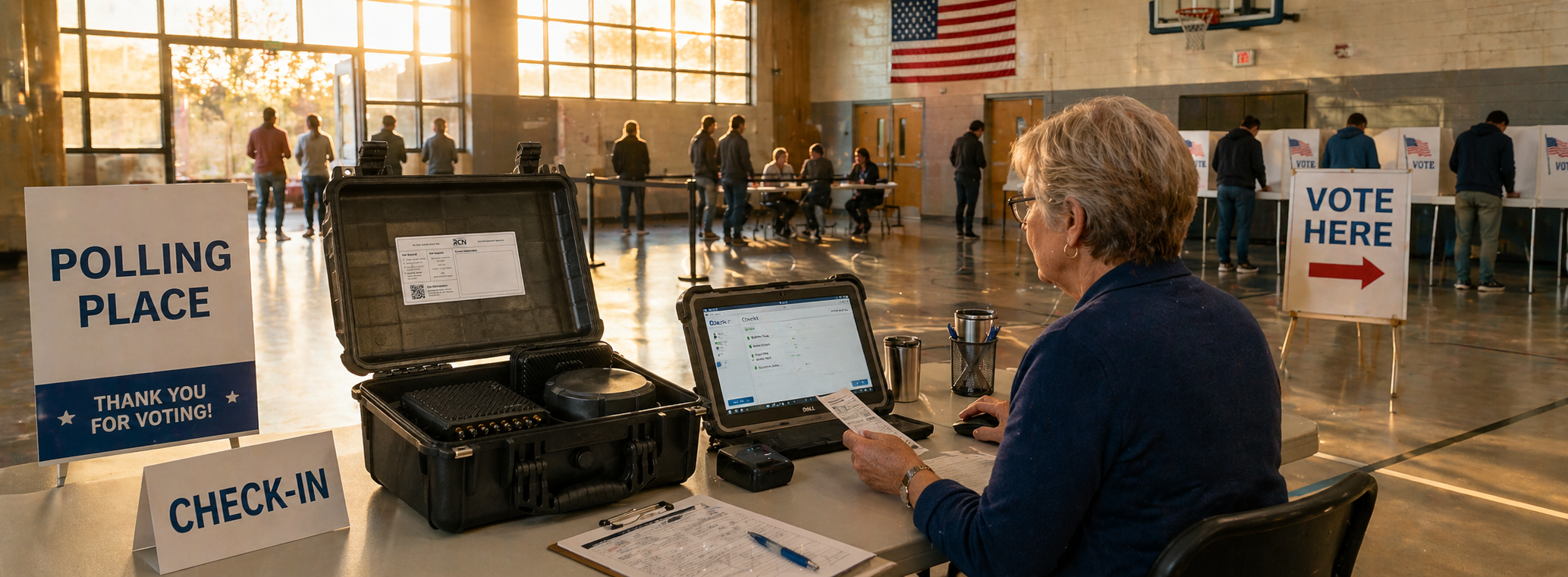
What is the Cradlepoint R1900?
The Ericsson Cradlepoint R1900 is a powerful ruggedized 5G router in Cradlepoint’s lineup, built for agencies that need to support multiple simultaneous users across demanding environments without compromising uptime. Inside the RCN Pop-Up Network Kit (PNK), the R1900 broadcasts a portable Wi-Fi 6 network up to 300 feet from an internal high-gain Panorama 5G MIMO antenna, supports up to 100 simultaneous connected devices, and operates from -30ºC to 75ºC (-22ºF to 167ºF). The kit ships with the router, antenna, battery indicator, wall charger, vehicle charger, and a weatherproof case as a single sealed unit.
For full R1900 specifications, see the Cradlepoint R1900 product page. The rest of this article covers how the R1900 PNK turns that hardware into a polling place network any precinct judge can deploy.
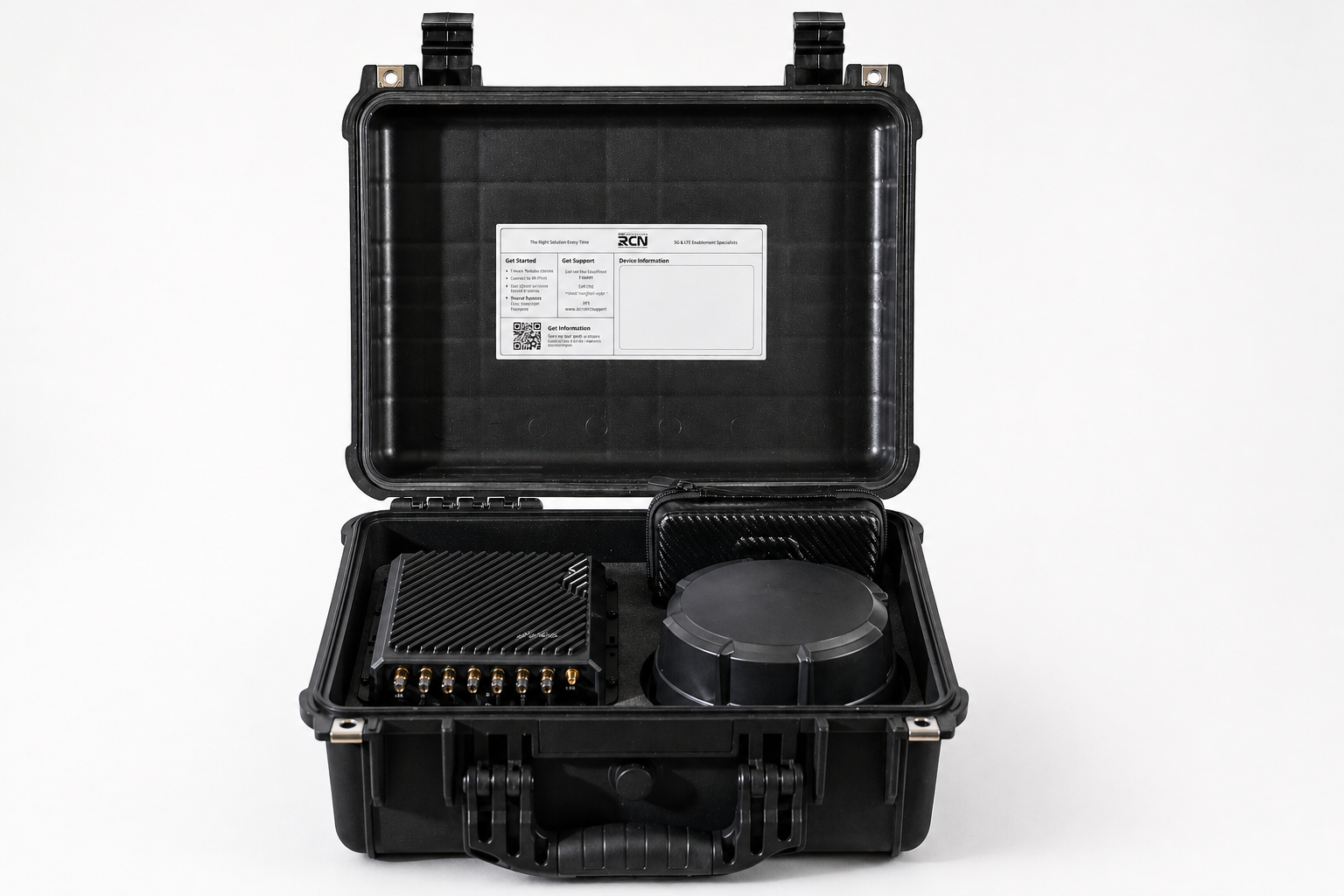
Why a Deployable 5G Network Requires More Than a Router on Election Day
A Cradlepoint R1900 out of the box is still an IT project. It needs SIMs provisioned across two carriers, a site-to-site VPN tunnel established to the elections office core, VLANs mapped to the data classication policy, antenna tuning, NetCloud Manager enrollment, and firmware baselined to the county’s standard image. Election officials cannot run an IT project at 6:45 AM on election morning. The network either works when the doors open or the precinct opens late.
A true deployable 5G network, like the RCN Pop-Up Network Kit (PNK), handles all of that before the case ever ships to the county warehouse:
- R1900 pre-configured to the county’s network policy
- Compatibility with Verizon, AT&T, and T-Mobile with SIMs pre-provisioned, with dual-SIMs and dual-modems optional. On dual-modem configurations using the RX30-MC accessory, both carriers run active-active for real time connection-level redundancy
- Site-to-site VPN tunnel established and tested against the elections office core
- VLANs configured separately for poll book traffic, election worker traffic, and observer or guest Wi-Fi
- Internal high-gain Panorama 5G MIMO antenna tuned and mounted (signal holds strong even with the lid closed)
- NetCloud Manager enrollment complete
- Ruggedized weatherproof case, internal battery, and chargers included
The precinct volunteers never touches any of it.
How the R1900 PNK Works for
Poll Workers
The people setting up the network on election morning are volunteer poll workers and county roving teams. The R1900 PNK is built for exactly that team.
Setup is a single button press. No SIM swap, no antenna alignment, no firmware check, no carrier selection, no VPN initiation. The case arrive turnkey. The poll worker sets it face up, presses the external power button, and the network broadcasts the pre-configured SSID. Poll books and worker devices connect using stored credentials.
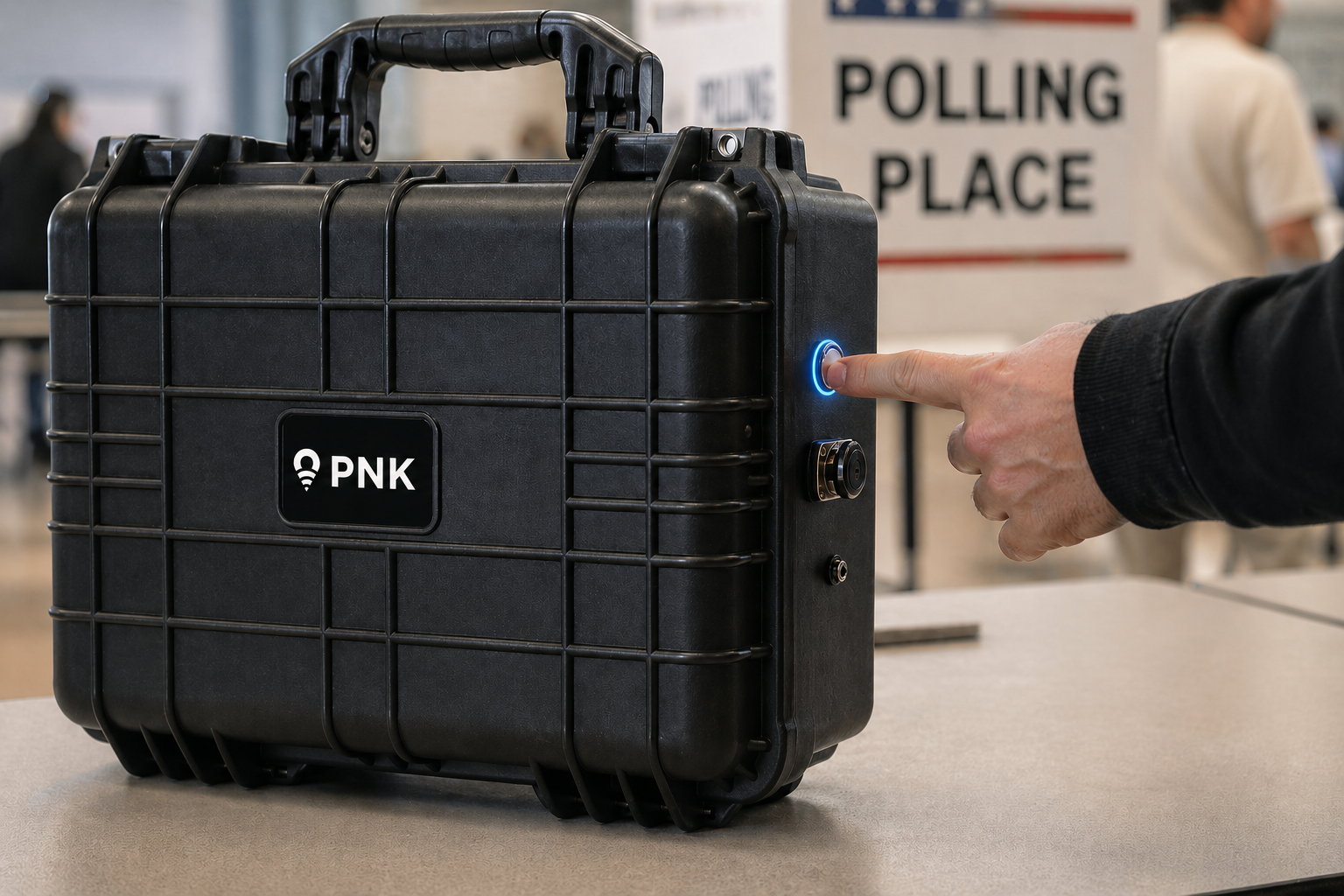
One important distinction. The R1900 PNK is the network for poll book check-in, election worker communication, and the secure tunnel back to the elections office. It is not the network for voting machines themselves. Voting systems operate on their own air-gapped or vendor-managed infrastructure, and they should. The PNK closes the connectivity gap on the public-facing side of the polling place, where poll workers and voters interact, and leaves the voting system untouched.
When something does go wrong, the polling place does not call the county IT helpdesk. They call RCN’s 24/7 NOC, which can remote into the unit, see live carrier signal, swap the active modem or SIM, or push a configuration fix without anyone touching the device on site.
Paper backup still exists. Every elections office has a downtime protocol: paper poll books, provisional ballots, manual reconciliation. The PNK does not replace those protocols. It reduces the likelihood of needing them. The point of a reliable polling place network is not to eliminate the backup plan. It is to make sure the backup plan stays a backup.
What this means operationally: election morning setup measured in the time it takes to set up a check-in table. No precinct opens late waiting for connectivity. Poll book check-in stays online when one carrier degrades. The same kit redeploys for primaries, general elections, and post-election audits across the same biennial cycle, with no reconfiguration.
CISA Election Infrastructure Guidance and Polling Place Security Considerations
Election infrastructure was designed critical infrastructure by CISA in 2017. The connectivity layer at the polling place sits inside that designation. The R1900 PNK is built to support three security pillars election directors already enforce.
Data in transit and PII protection
Poll books contain voter personally identifying information. The R1900 PNK supports the technical safeguards that align with CISA election security guidance and state-specific election security rules: encryption in transit, segmented VLANs, access controls, and audit logging through NetCloud Manager. RCN can help configure the unit for state-level alignment and, where the deployment is funded by HAVA Election Security grants, for the NIST 800-53 and 800-171 handling requirements those funds carry.
Network segmentation
Poll book traffic, election worker traffic, and any observer or guest Wi-Fi run on separate VLANs. The configuration is set at the warehouse, not in the field, and the precinct staff have no path to misconfigure it.
Physical chain of custody
The PNK case includes external lock points that accept tamper-evident seals or padlocks. The elections office applies the seal at the warehouse. The precinct judge inspects it on arrival. If the seal is broken in transit, the precinct team knows before opening the case. The kit is designed to participate in the physical chain-of-custody protocols elections offices already apply to ballot containers and voting equipment, not stand outside them.
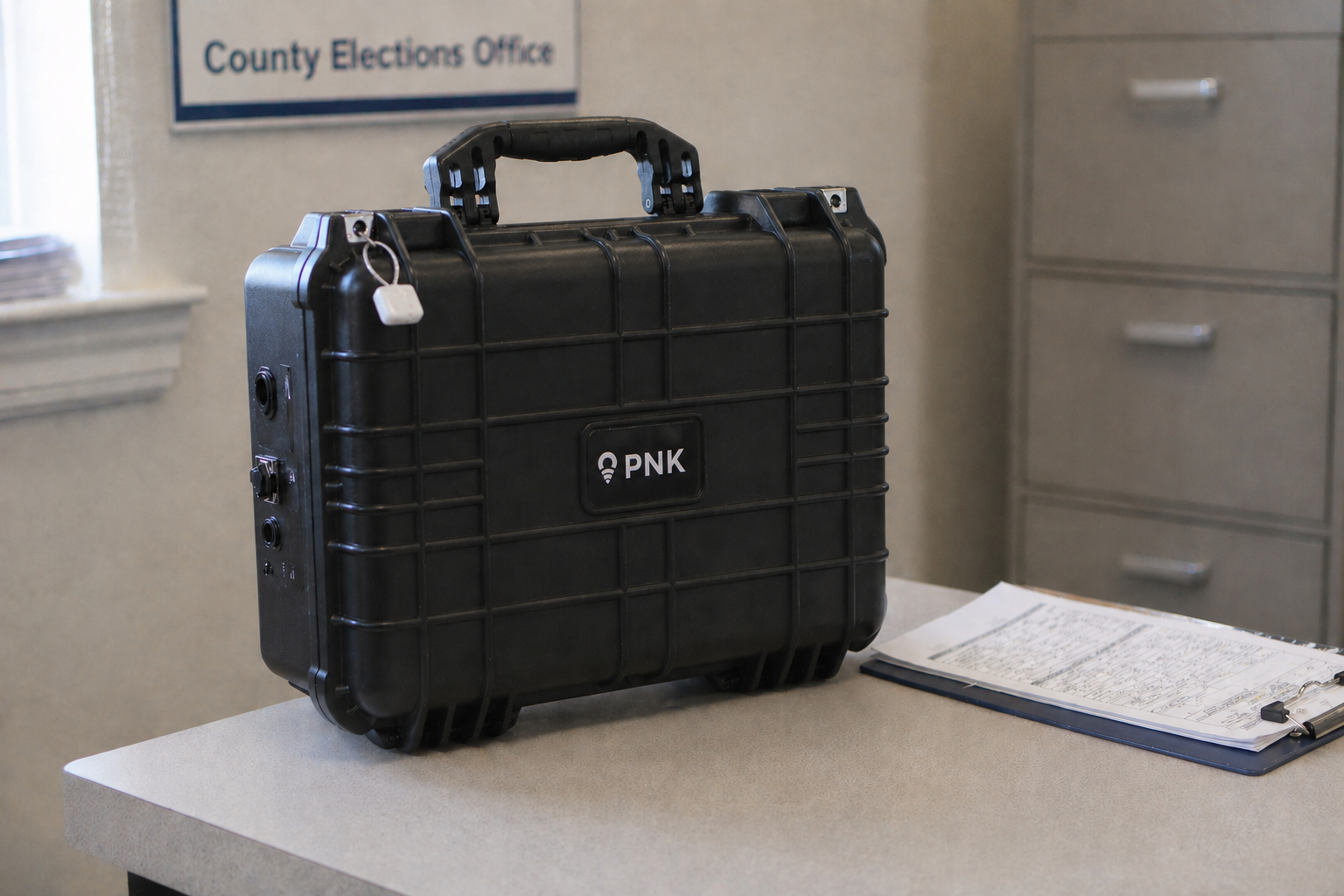
The R1900 PNK is not “certified” against HAVA, CISA guidance, or NIST. No connectivity product is. Deployments are configured against these frameworks, and RCN’s role is to help election authorities make that configuration repeatable across every polling place in the country.
Case Study – Harris County Elections
Harris county is the third-most populous county in the United States and runs elections at scale across the Houston metro region. They standardized on the R1900 PNK across a 130-unit fleet to deliver consistent connectivity at every polling place in the country.

The deployment is operationally repeatable. Same kit at every site. Same configuration. Same procedure for poll workers regardless of which polling place they are working. Same NOC support escalation path regardless of which precinct calls. The deployment scales horizontally without scaling the IT team behind it.
What the Harris County deployment proves is the case the rest of the country’s election directors are watching: a deployable election network can be standardized, repeated across hundreds of sites, and run by non-technical poll workers without compromising security of chain of custody. Counties use the kit to keep clerk’s offices online when lightning knocks out service on election day, and the same kit handles the hundreds of polling places running in paralel.
The same R1900 PNK configuration is deployed at the county and federal-district level by multiple different agencies. All of these deployments are available through GSA Schedule, NASPO ValuePoint, Sourcewell, OMNIA Partners, and Equalis Group cooperative contracts.
Frequently Asked Questions
What is a deployable 5G network for elections?
A deployable 5G network for elections is a self-contained, pre-configured cellular network the elections office stages at the warehouse and ships to each polling place in a sealed case. Poll workers do not configure it. They press a button, the network broadcasts, and electronic poll books and election worker devices connect using stored credentials. The kit returns to the warehouse after the cycle and redeploys for the next election.
How do poll workers set up the R1900 PNK on election morning?
The kit arrives ready to go. The poll worker opens the case, presses the external power button, and the pre-configured SSID broadcasts. There is no SIM swap, no antenna alignment, no carrier selection, and no VPN initiation. The standard procedure fits on a laminated card inside the case for first-time deployments.
What happens if a single carrier goes down at a polling place?
The R1900 PNK is able to ship with multi-carrier SIMs pre-provisioned. On dual-modem configurations using the RX30-MC accessory, both carriers run active-active for true hardware-level redundancy. If one carrier degrades or fails, the other is already passing traffic and the poll book stays online without operator intervention.
Is the R1900 PNK secure against physical tampering?
The case includes external lock points that accept tamper-evident seals or padlocks. Elections offices can apply a seal at the warehouse before deployment, and the precinct team inspects it on arrival. If the seal is broken in transit, the team knows before opening the case. The kit is designed to participate in the chain-of-custody protocols elections offices already apply to ballot containers and voting equipment.
Does the R1900 PNK support HAVA-aligned and CISA-aligned data handling?
The R1900 PNK supports the technical safeguards required for CISA election infrastructure security guidance and state-level election security rules: encryption in transit, segmented VLANs, access controls, and audit logging. For deployments funded by HAVA Election Security grants, RCN can help configure the unit for the NIST 800-53 and 800-171 handling requirements those funds carry.
Can the same kit be used for early voting, election day, and post-election audits?
Yes. The same kit, with the same configuration, redeploys across the full election cycle. Counties typically receive the kits, stage them for early voting, redeploy them for election day, and use them again for any post-election audit or recount activity. The annual cost stays predictable because the kit is a one-time purchase rather than a per-site rental.
What if the polling place has weak cellular coverage?
The R1900 PNK uses an internal high-gain Panorama 5G MIMO antenna that maintains signal strength even with the lid closed. For sites in marginal cellular zones, this antenna makes the difference, often receiving signal where jetpacks/hotspots/MiFis failed. RCN can also configure a Starlink-ready PNK that pairs satellite with cellular for full resilience.
You May Also Be Interested In…

Hurricane Season 2026: Emergency Connectivity Before the Storm Hits
Speak with a Connectivity ExpertReady to deploy one-button connectivity for your mobile blood drives? Want to Learn More? Request a custom quote.
Satellite vs. 5G: Which Wins for Remote and Temporary Sites?
Speak with a Connectivity ExpertReady to deploy one-button connectivity for your mobile blood drives? Want to Learn More? Request a custom quote.
Starlink for NPS Search and Rescue: A Command Network for the Trailhead
Mark Indelicato | Manager, Growth & Analytics at RCN TechnologiesMark leads digital growth strategy and marketing analytics, helping organizations navigate the transition from legacy connectivity to modern wireless and 5G solutions.The call comes in mid-afternoon....
Speak with a Connectivity Expert
Ready to deploy one-button connectivity for your mobile blood drives?


Want to Learn More?
Request a custom quote.