

Wireless Insights
AT&T FirstNet for Fire and EMS: A Command Network You Own
FirstNet priority on the fireground without requesting a shared deployable. The FirstNet-compatible Pop-Up Network Kit rides on the apparatus and is live in five minutes.
Talk to a PNK SpecialistWhen a structure fire escalates to a second alarm, the incident commander's tablet, the accountability board, and the EMS crew's patient care reporting all need bandwidth at an address nobody chose for its cell coverage. FirstNet, the nationwide public safety broadband network operated by AT&T under contract with the FirstNet Authority, was built for exactly this moment. The question most fire and EMS agencies have not answered is what hardware puts FirstNet to work on the fireground. A deployable 5G network that rides on the apparatus, powers on with one button, and runs FirstNet alongside a second carrier answers it.
The short answerFirstNet gives your agency priority on AT&T's network. The Pop-Up Network Kit turns that priority into an incident network you own: one button, five minutes, two carriers, no IT on scene.
What FirstNet Gives Fire and EMS Teams
FirstNet gives subscribed agencies priority and preemption on AT&T's network: when commercial traffic saturates a tower during an incident, first responder traffic goes to the front of the line. For fire and EMS, that means mutual aid coordination, ePCR uploads, and command software keep moving while the public's livestreams wait.
FirstNet also operates a fleet of deployable assets, including the Compact Rapid Deployable (CRD), a portable cell site that subscribed agencies can request for planned events and major incidents. CRDs are a real strength of the program. They are also shared assets: an agency requests one, and availability depends on what else is happening in the region.
For a hurricane or a multi-day wildland campaign, that model works. For the Tuesday afternoon structure fire, the highway MCI, or the training burn at the edge of the district, no agency is requesting a portable cell tower. Those incidents need equipment the department already owns.
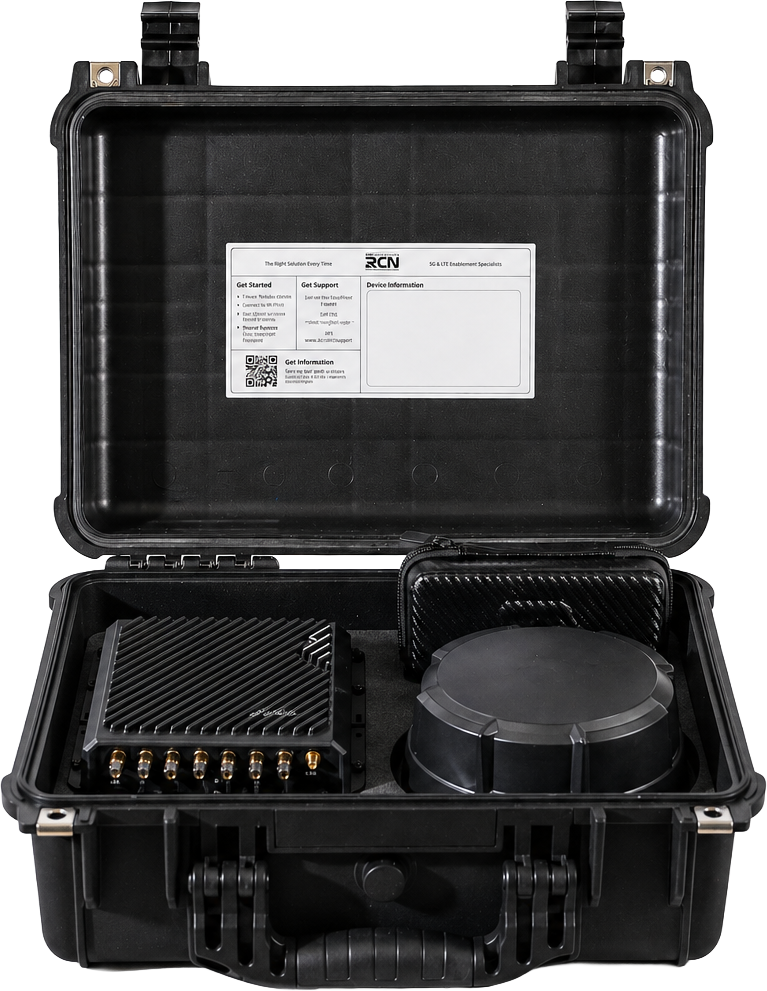
That is the gap RCN Technologies built the Pop-Up Network Kit (PNK) to close. The PNK is a ruggedized, pre-configured network kit built on Ericsson Cradlepoint routers that works on FirstNet via AT&T SIMs and runs a second carrier at the same time. It lives on the apparatus, deploys in minutes, and turns FirstNet subscription benefits into working fireground connectivity without an IT technician on scene.
Why a Deployable 5G Network Belongs on the Apparatus
A deployable 5G network is a self-contained cellular and Wi-Fi system that an agency owns, carries, and activates wherever the incident is, something a consumer hotspot was never built to be. For fire and EMS, owning the network instead of requesting one changes three things.
Response time
Operational within about five minutes of arriving on scene. Open the case, press the external power button, and the pre-configured network broadcasts to up to 100 devices. There is nothing to request.
Carrier resilience
FirstNet via AT&T SIMs, plus Verizon or T-Mobile on the second SIM. If one tower is damaged or saturated, traffic moves to the other carrier. The dual-modem build runs both at once, with no failover gap.
The people problem
Every PNK ships pre-provisioned: SIMs installed, VPN tunnels built, VLANs separated, antenna tuned. If something goes wrong, RCN's 24/7 U.S.-based NOC fixes most issues remotely while the crew works the incident.
How Fire and EMS Teams Use the PNK
Fire departments, county fire marshals, and EMS agencies across the country run PNK deployments today, from municipal departments in the Southwest to paramedic services in the Mountain West. The operational patterns repeat across districts of every size.
Fireground incident command
The command vehicle parks, the PNK powers on, and the incident commander has a private network for accountability software, preplans, and hydrant maps. VLAN segmentation keeps command traffic separate from everything else on scene.
Wildland staging and base camps
Extended attack operations set up where coverage is thinnest. The high-gain Panorama antenna pulls workable signal from marginal coverage, and the Starlink-Ready configuration adds satellite backhaul where there is none to find.
Mass casualty incidents
Patient tracking and ePCR systems cannot queue behind a saturated tower. FirstNet priority plus a second carrier gives triage and transport officers two independent paths for patient data.
Mobile command vehicles
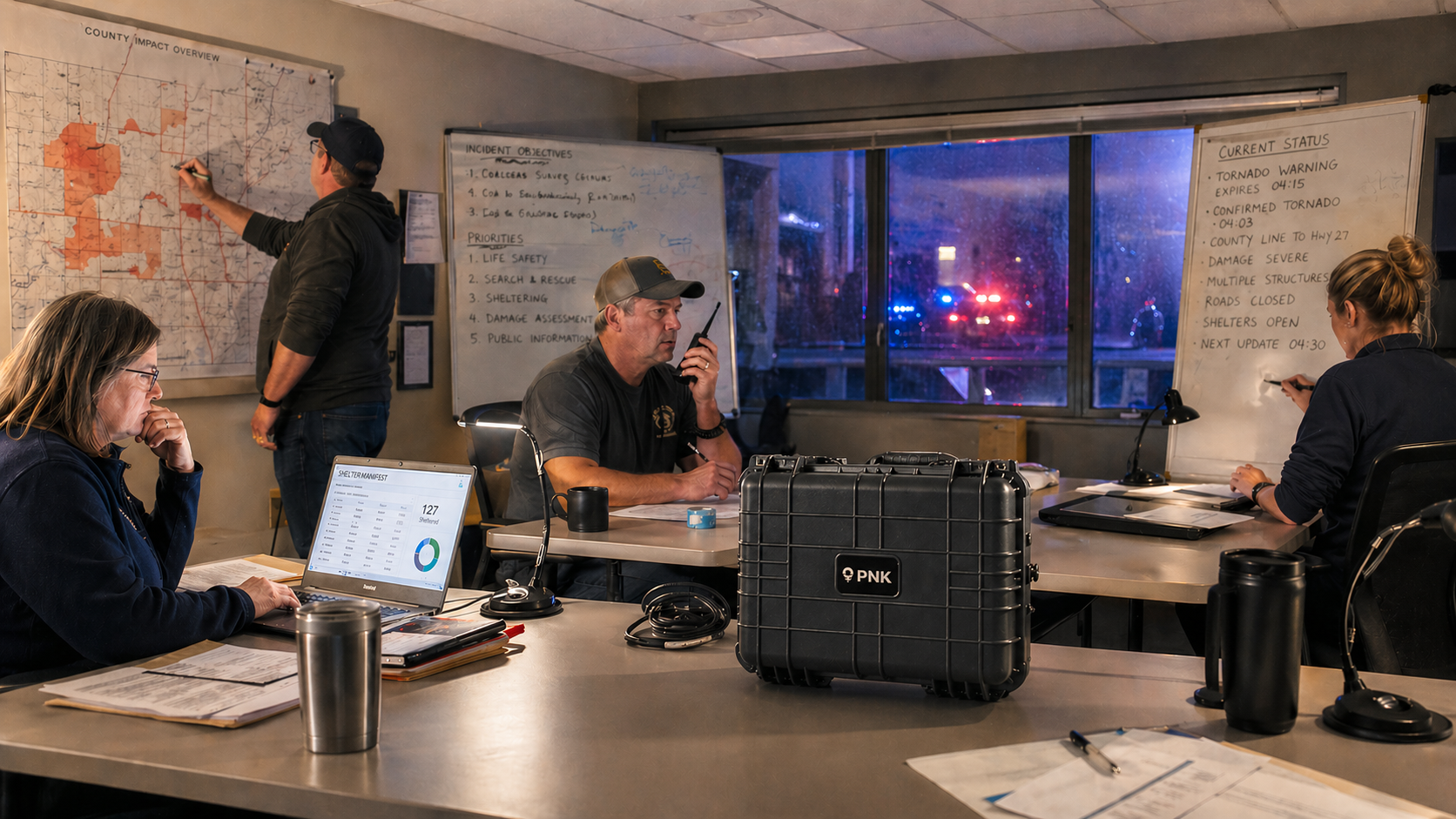
Many agencies spec the PNK as the connectivity core of a command trailer or MCV. It is the same platform agencies deploy for storm recovery operations when fixed infrastructure goes down.
The platform also carries proof from adjacent public sector deployments. Harris County Elections deployed 130 R1900 PNKs in 2025 to connect polling operations across the third-largest county in the country, the kind of scale and scrutiny that fire and EMS buyers can read as a reference test of the platform.
Choosing the Right PNK Configuration
| Configuration | Built on | Best fit for fire and EMS |
|---|---|---|
| R980 PNK | Ericsson Cradlepoint R980 | Lighter kits: rehab units, EMS supervisors, inspections, training sites |
| R1900 PNK | Ericsson Cradlepoint R1900 | Fireground command, mobile command vehicles, high device counts, vehicle mounting |
| R1900 Dual PNK | Two R1900 routers, two carriers | Active incident command where any interruption is unacceptable. Active-active redundancy, no failover gap |
| Starlink-Ready PNK | R1900 + Starlink | Wildland operations and rural districts beyond reliable cellular coverage |
Every configuration ships in an IP64-rated case, supports up to 100 devices, and includes pre-provisioned multi-carrier SIMs, the Panorama Mako antenna, NetCloud Manager enrollment, and RCN NOC support.
Compatibility and Setup
Public safety network compatibility
The PNK is FirstNet-compatible: it works on FirstNet via AT&T SIMs in standard configurations, so a subscribed agency's priority and preemption benefits apply to PNK traffic. The same kit is Verizon Frontline-compatible and T-Mobile public safety-compatible, which matters for mutual aid responses where neighboring agencies run different carriers.
Patient data and HIPAA
For EMS agencies, the PNK supports the technical safeguards required under HIPAA: encrypted transport over IPsec VPN, WPA3 wireless, VLAN separation between patient care and operational traffic, and audit logging through NetCloud Manager. RCN can help configure the deployment to align with your agency's compliance requirements before it ships.
Procurement Paths for Fire and EMS Agencies
Fire districts and EMS agencies rarely have appetite for a competitive bid on a connectivity kit. The PNK is available through pre-competed cooperative contracts, and most agencies can buy through a vehicle their purchasing office already uses:
- GSA Schedule for federal and eligible state and local buyers
- Sourcewell for local government, education, and nonprofit agencies
- NASPO ValuePoint for state-level cooperative purchasing
- OMNIA Partners and Equalis Group for additional cooperative coverage
- Carahsoft supporting federal procurement
Talk to a PNK Specialist
One conversation covers your district's coverage realities, the right configuration, and the procurement path your purchasing office already has.
Talk to a PNK SpecialistRCN Technologies is an Ericsson Cradlepoint Elite Partner and 2024 Cradlepoint Partner of the Year.
Frequently Asked Questions
What is a deployable 5G network for fire and EMS?
A deployable 5G network is a self-contained cellular and Wi-Fi system that a fire or EMS agency owns and activates at the incident scene. RCN's Pop-Up Network Kit is a deployable 5G network that works on FirstNet via AT&T SIMs, aggregates a second carrier for redundancy, and is operational within about five minutes with no IT staff on scene.
Does the PNK work on FirstNet?
Yes. The PNK is FirstNet-compatible and works on FirstNet via AT&T SIMs in standard configurations. Subscribed agencies keep their FirstNet priority and preemption benefits on PNK traffic.
How is the PNK different from a FirstNet Compact Rapid Deployable (CRD)?
A CRD is a portable cell site from FirstNet's shared deployable fleet that agencies request for major incidents and planned events. The PNK is equipment your agency owns and carries on the apparatus, sized for everyday incidents: structure fires, MCIs, staging areas, and command vehicles. Many agencies use both, with the PNK covering the incidents nobody would request a portable cell tower for.
What happens if the AT&T tower near an incident is down?
The PNK aggregates multiple carriers. If FirstNet service via AT&T is unavailable at a scene, traffic moves to the second carrier SIM, typically Verizon or T-Mobile. The R1900 Dual configuration runs two carriers in active-active operation simultaneously, so there is no switchover gap at all.
How many devices can one PNK support?
Up to 100 devices on a standard PNK, with full VLAN segmentation to separate command, EMS, and support traffic. Consumer hotspots typically support 10 to 15 devices.
Can the PNK handle patient data in the field?
Yes, when configured correctly. The PNK supports the technical safeguards required under HIPAA, including encryption in transit, WPA3 wireless, and VLAN separation. RCN can help configure the deployment to align with your agency's compliance requirements.
What if our district has areas with no cellular coverage at all?
The Starlink-Ready PNK adds satellite backhaul to the same kit, which covers wildland operations and rural response areas beyond any carrier's footprint. The high-gain Panorama antenna also recovers workable signal in marginal-coverage areas where handheld devices show no bars.
Can we buy the PNK without a competitive bid?
In most cases, yes. The PNK is available on GSA Schedule, Sourcewell, NASPO ValuePoint, OMNIA Partners, and Equalis Group cooperative contracts, and through Carahsoft for federal buyers. Your purchasing office can typically use a contract it already holds.
Speak with a Connectivity Expert
Ready to deploy one-button connectivity for your mobile blood drives?


Want to Learn More?
Request a custom quote.