

POTS Link vs. Inseego BPC100: Which POTS Replacement Is Right for You?
A buyer's decision guide comparing a single-line cellular voice adapter against a fully managed wireless WAN service for life-safety POTS replacement.
Request a POTS Link Assessment Jump to comparison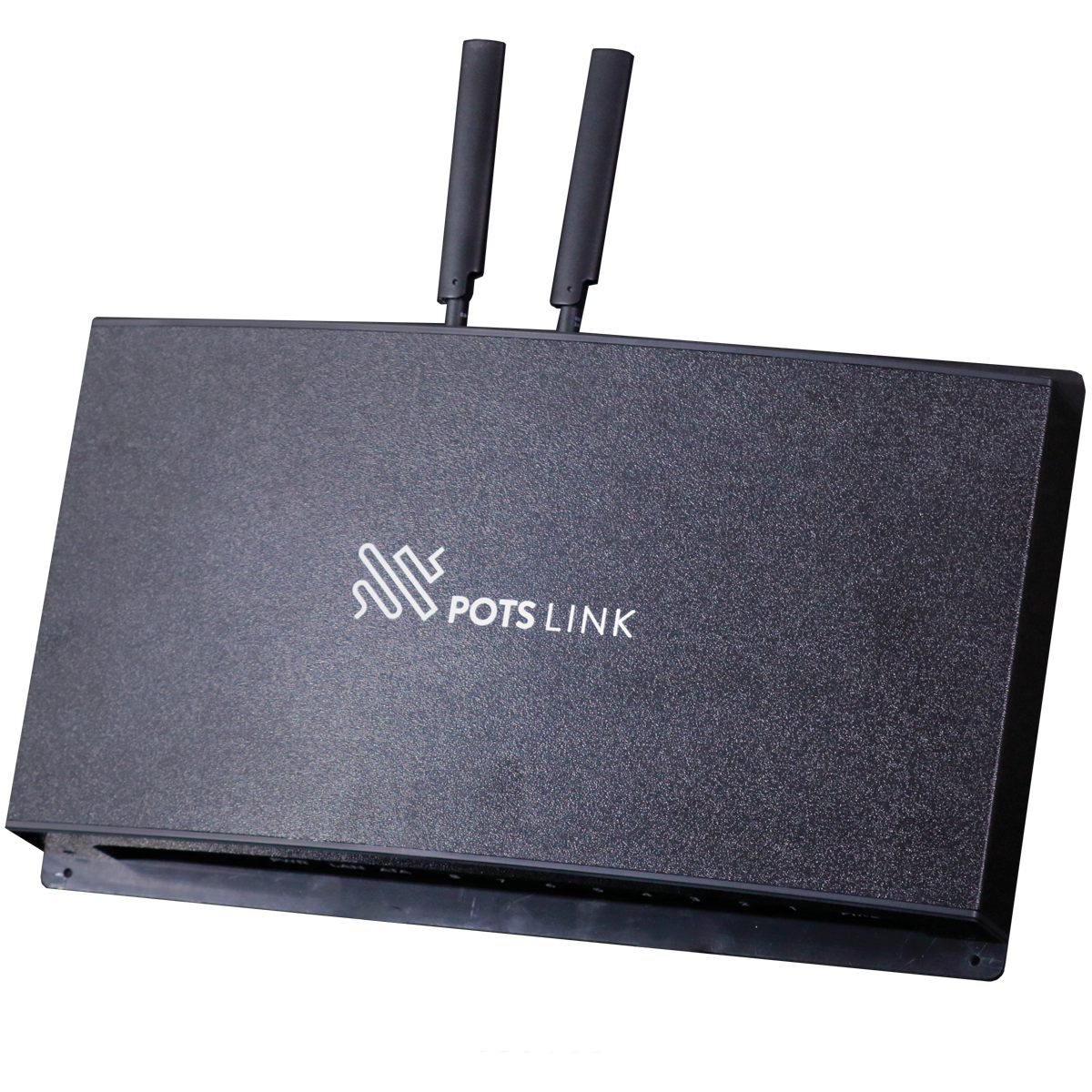
If you're evaluating cellular POTS replacements and the Inseego BPC100 has come across your desk, this page will help you understand what you're actually comparing. The BPC100 is a single-line Cat 4 LTE voice adapter, a product designed to replace one analog line in a relatively simple deployment. POTS Link is a fully managed wireless WAN service built on carrier-grade infrastructure and engineered specifically for the environments where analog failure is not acceptable: fire alarm panels, elevator emergency phones, gate access systems, and multi-device facilities that need a managed provider rather than a hardware box. For buyers researching an Inseego BPC100 alternative, that difference is the whole comparison.
That distinction, between a standalone device and a managed service built on wireless WAN expertise, is the core of what this comparison covers. Both products will replace a copper POTS line. The question is what happens at the boundaries: multi-line density, battery backup duration under life-safety code, carrier redundancy, compliance documentation, and what your organization is responsible for when something goes wrong.
What Is the Inseego BPC100?
The Inseego BPC100 is a cellular voice adapter from Inseego Corp., a San Diego-based manufacturer of fixed wireless access and mobile connectivity hardware. It supports HD Voice over LTE on a Cat 4 LTE chipset (Qualcomm MDM9207-LTE), with a single RJ11 port for voice or fax, a single RJ31 port for security systems, and a single RJ45 port for light data.
The BPC100 is a device purchase, not a service. Inseego sells it through authorized channel partners, and management is handled through a web UI on the device itself. Battery backup is three AA batteries: up to 23 hours of standby and up to 3 hours of talk time.
It is positioned as a voice and light-data cellular adapter, not an enterprise-grade POTS replacement platform. Its customer references skew to fast food chains, retail brands, and logistics companies replacing individual analog lines, not multi-device life-safety infrastructure.
What Is POTS Link?
POTS Link is RCN Technologies' fully managed cellular POTS replacement service. Unlike a hardware purchase, it is a service relationship: RCN provides and manages the gateway, provisions the SIM, manages carrier connectivity, and owns the ongoing health of your lines. The gateway is included in the monthly cost.
RCN is an Ericsson Technical Excellence Partner and a Cradlepoint-certified integrator with over 13 years of wireless WAN deployment experience across enterprise, government, and public safety, plus direct POTS replacement deployments on fire alarm panels, elevator phones, gate systems, and multi-device facilities.
That dual background matters. Wireless WAN depth handles the RF environment; POTS deployment experience handles the life-safety signaling and compliance behavior of the analog devices being replaced. POTS Link is built on both, and carries direct government contract vehicles across GSA, OMNIA Partners, Sourcewell, NASPO ValuePoint, and the State contracts for GA, NY, and PA.
How POTS Link and the Inseego BPC100 Compare
Carrier Redundancy: Single-Carrier vs. Wireless-First Dual-SIM +
The BPC100 operates on a single Cat 4 LTE connection. There is no multi-carrier fallback, no SD-WAN path management, and no dual-SIM capability described anywhere in Inseego's public product documentation. The device connects to whatever carrier SIM is installed. If that carrier has a coverage gap, a tower outage, or network congestion at the moment a fire alarm needs to transmit, there is no automatic path to an alternative carrier.
POTS Link is built on a wireless-first, dual-SIM architecture. SIM slot 2 is always occupied by RCN's multi-carrier SIM, a single physical SIM with tri-carrier redundancy that dynamically routes to the strongest available carrier at the network core. SIM slot 1 gives the customer a choice: bring your own preferred single-carrier SIM, or let RCN deploy the site's strongest available carrier based on the RF environment at that location. SD-WAN technology selects the optimal path across both SIM slots in real time, and a wired Ethernet WAN can be added to the mix when available.
POTS Link is also compatible with all three major public safety and priority networks: FirstNet-compatible via AT&T, Verizon Frontline-compatible, and T-Mobile public safety network-compatible. That priority access matters most when the surrounding infrastructure is under the most stress, during a declared emergency, when both network demand and the likelihood of a life-safety signal spike at once. The BPC100 has no stated compatibility with any priority or public safety network. The technology generation gap compounds this: Cat 4 LTE caps at 150 Mbps and was introduced in 2012, while POTS Link runs on current-generation 4G/5G.
Line Density: Single Line vs. 8 to 32 Lines per Gateway +
The BPC100 replaces one analog line. Its RJ31 port serves one security or fire alarm system. Its RJ11 port serves one voice or fax device. For a facility with multiple POTS-dependent devices, a fire alarm panel, an elevator phone, a gate intercom, and a fax line in the same building, the BPC100 requires one unit per line. Hardware costs, device management overhead, and physical installation complexity scale linearly with line count.
POTS Link supports 8 lines natively per service gateway, with extended architecture supporting 24 to 32 lines per rack-mount unit. For multi-device facilities, government campuses, healthcare facilities, commercial buildings, and any site managing more than a handful of POTS-dependent devices, the density difference has direct and material cost and logistics implications.
Battery Backup: Talk Time vs. Standby Time, and Why It Matters for NFPA 72 +
The BPC100's battery specification deserves careful reading: 3 AA batteries, rated for up to 3 hours of talk time and up to 23 hours of standby. Standby means the device is powered and waiting. It does not mean the device is transmitting an active fire alarm signal. Under a fire alarm scenario, where the communicator is actively transmitting alarm data to a monitoring center, the BPC100's relevant runtime is 3 hours, not 23.
NFPA 72, the National Fire Alarm and Signaling Code, requires that fire alarm communicators maintain 24 hours of standby power, followed by 5 minutes of alarm operation. The BPC100's rated 3-hour talk time does not meet that standard on its face. Buyers installing a BPC100 behind a fire alarm panel need to carefully evaluate whether the device, with or without supplemental power, satisfies the NFPA 72 backup requirement for their AHJ. That evaluation is not trivial, and getting it wrong creates a compliance gap in a life-safety system. POTS Link delivers 24-hour native battery backup with no add-ons required, aligned to the NFPA 72 standby power threshold by design.
Compliance Certifications +
POTS Link is built and tested against the applicable standards governing the devices it serves: NFPA 72 (fire alarm communications), ASME A17.1 (elevator emergency communications), and applicable UL listing standards for life-safety signaling equipment. POTS Link is also compliant with Federal Enhanced E911 requirements, Kari's Law, and the RAY BAUM'S Act.
Kari's Law requires that multi-line telephone systems permit direct 911 dialing without a prefix. The RAY BAUM'S Act extends that requirement to include dispatchable location data, ensuring emergency responders can identify not just which building a call originated from, but which floor or room. For any facility operating a multi-line system, which describes virtually every meaningful POTS replacement deployment, these are legal requirements.
The BPC100 cannot reliably satisfy the RAY BAUM'S Act's dispatchable location requirement, and that gap has a structural cause. The BPC100 is a cellular voice adapter, a VoIP-over-LTE device that routes calls over a carrier's mobile network. When that device places a 911 call, the location data delivered to the Public Safety Answering Point (PSAP) is derived from the cellular network's knowledge of where the device is: cell tower triangulation, carrier-reported coordinates, or similar network-level estimation. That is not dispatchable location, which means a verified, addressable location including the unit, floor, or room from which the call originates, the specific information a first responder needs to find a person in a multi-story building or multi-unit campus.
A cellular voice adapter with no provisioned location database, no MLTS integration, and no mechanism to pass floor or room data to a PSAP cannot deliver dispatchable location by design. This is not a configuration gap that a firmware update closes. It is a function of what the product is: a device that makes cellular voice calls, not a compliant MLTS communicator. Inseego's public documentation for the BPC100 does not address NFPA 72, ASME A17.1, Kari's Law, the RAY BAUM'S Act, or Federal Enhanced E911 compliance. Buyers with formal compliance review requirements, particularly those in government, healthcare, or any facility with fire alarm or elevator phone infrastructure, should request Inseego's certification documentation directly before procurement.
Installation Model: Self-Managed Device vs. Fully Managed Service +
The BPC100 is a self-installed, self-managed device. Configuration is handled through a web UI. Ongoing monitoring, troubleshooting, and carrier management are the customer's responsibility. Inseego provides product documentation and a help center, but there is no managed service layer, no provider monitoring your lines, no one who calls you when a connection drops at 2 a.m.
POTS Link is a fully managed service. Professional installation is the standard model; self-installation is only available by specialist approval. RCN monitors line health continuously and manages carrier connectivity on the customer's behalf. When something goes wrong with a managed service, the service provider resolves it. For life-safety infrastructure like fire alarms and elevator phones, that accountability distinction is consequential, not a preference. And because installing a cellular voice replacement correctly in an RF-severe environment requires someone who understands signal propagation and antenna placement, RCN's 13 years of wireless WAN deployment experience means site assessment and RF optimization are built into the install, not left to the customer's internal team.
Government and Cooperative Contract Access +
Inseego does not publish direct government cooperative contract vehicles for the BPC100 on their product page. Buyers interested in placing the BPC100 through GSA, Sourcewell, OMNIA Partners, or state contract vehicles would need to verify current availability through Inseego's sales channel or a reseller partner.
POTS Link carries direct contract vehicles across GSA Schedule, OMNIA Partners, Sourcewell, NASPO ValuePoint, State of Georgia, State of New York, and State of Pennsylvania. RCN holds these contracts directly, so procurement is not intermediated through a third-party aggregator. For agencies with existing GSA or Sourcewell relationships, or those in GA, NY, or PA, POTS Link can be placed without involving a separate channel partner.
Comparison at a Glance
| Inseego BPC100 | POTS Link | |
|---|---|---|
| Network architecture | Single-carrier Cat 4 LTE; no multi-carrier fallback; no SD-WAN | Wireless-first; dual-SIM (customer carrier in SIM 1 plus RCN multi-carrier SIM in SIM 2); SD-WAN path selection; wired Ethernet optional |
| LTE generation | Cat 4 LTE (up to 150 Mbps) | Current-generation 4G/5G |
| Public safety networks | None stated | FirstNet-compatible, Verizon Frontline-compatible, T-Mobile public safety network-compatible |
| Lines per device | 1 | 8 native; 24–32 extended |
| Battery backup | 3 hours talk time / 23 hours standby (3 AA batteries) | 24-hour native, NFPA 72 aligned |
| Hardware cost | Purchased per unit | Included in monthly service |
| Installation | DIY self-install; web UI management | Fully managed professional standard; self-install by specialist approval only |
| Service model | Customer self-managed | RCN fully managed |
| NFPA 72 / ASME A17.1 / UL | Not stated in public documentation | Compliant |
| E911 / Kari's Law / RAY BAUM'S Act | Cannot reliably provide dispatchable location; cellular voice architecture delivers carrier-derived coordinates, not verified floor/room data; Federal Enhanced E911 compliance not stated | Compliant |
| Gov contract vehicles | Not published | GSA, OMNIA, Sourcewell, NASPO, State of GA, NY, PA (direct) |
| Provider background | Mobile connectivity hardware manufacturer | Wireless WAN integrator with 13 years of both RF/cellular deployment experience and direct POTS replacement deployments across life-safety infrastructure |
Which Solution Fits Which Buyer?
The Inseego BPC100 is a reasonable fit if
Your organization needs to replace a single analog voice line in a low-complexity commercial setting, your procurement is through a standard reseller channel, and you have internal technical staff to self-manage the device and validate compliance requirements independently.
POTS Link is the stronger fit if
- Your facilities require 24-hour native battery backup for NFPA 72 compliance without battery add-on calculations.
- You need tri-carrier wireless redundancy with SD-WAN path optimization.
- You need priority access to FirstNet-compatible, Verizon Frontline-compatible, or T-Mobile public safety networks.
- You're managing 8 or more lines per location, or multi-device facilities with fire alarm panels, elevator phones, gate systems, and fax lines on a single service.
- You need documented compliance with Kari's Law and the RAY BAUM'S Act.
- You need a managed service partner with professional installation and ongoing line ownership, not a device to manage yourself.
- Your procurement runs through GSA, Sourcewell, or a state contract in GA, NY, or PA.
Frequently Asked Questions
What is an Inseego BPC100 alternative for government agencies?
Does the Inseego BPC100 meet NFPA 72 battery backup requirements?
How many lines does the Inseego BPC100 support?
What LTE generation does the Inseego BPC100 use?
Is POTS Link compliant with Kari's Law and the RAY BAUM'S Act?
What is tri-carrier redundancy in a POTS replacement?
Is POTS Link available on cooperative contract vehicles?
How does POTS Link compare to Ooma AirDial or MarketSpark?
Why does wireless WAN experience matter for a POTS replacement?
Request a POTS Link Assessment
RCN Technologies provides no-cost POTS line assessments for government agencies, enterprise facilities, and nonprofits evaluating POTS replacement options.
Request a POTS Link Assessment