

POTS Link vs. Ooma AirDial: Which POTS Replacement Is Right for You?
A direct comparison on network architecture, battery backup, compliance, installation, and government procurement, so you can make the right call for your facility
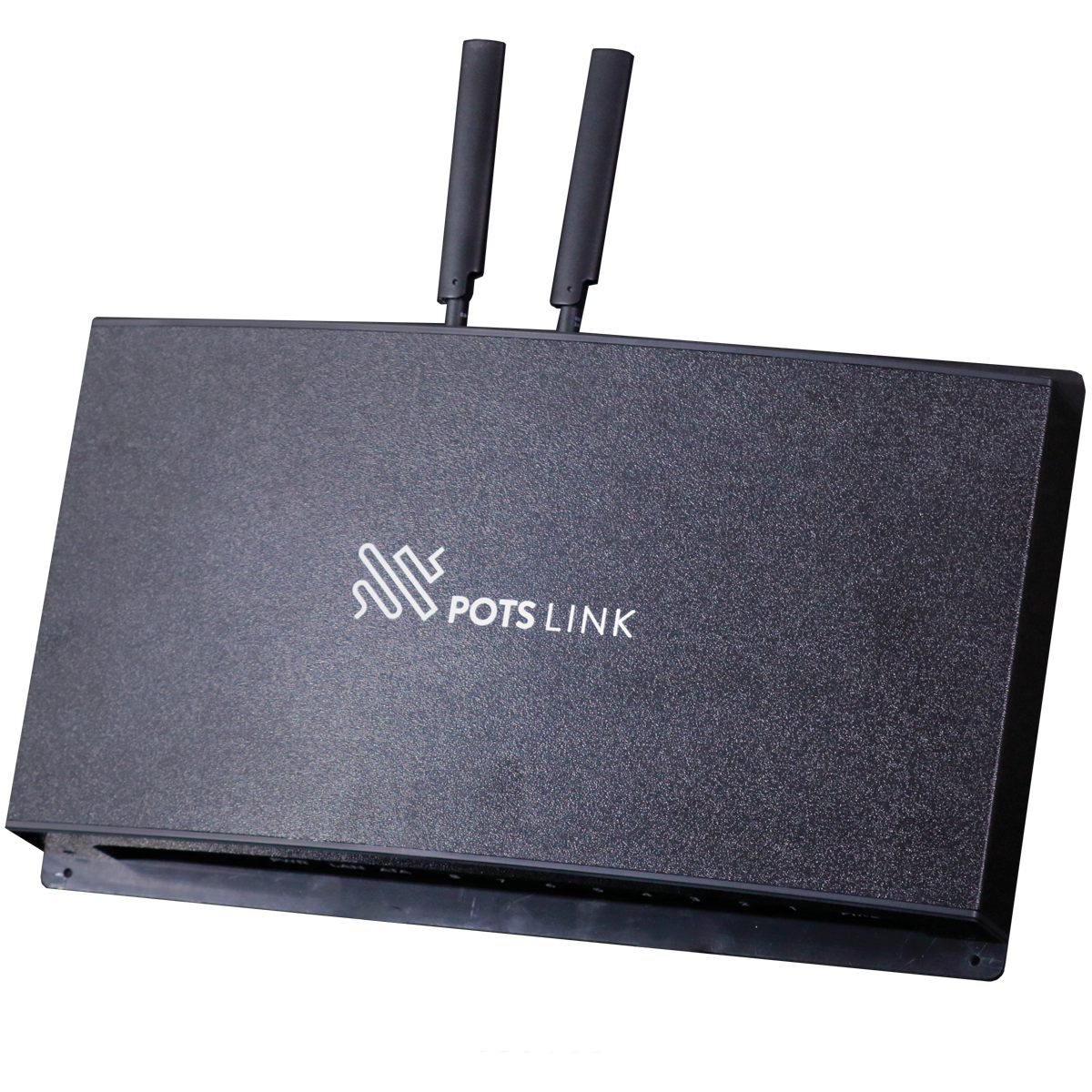
If you’re evaluating cellular POTS replacements, Ooma AirDial is likely on your shortlist, and for good reason. It’s a well-marketed, broadly distributed product with real enterprise deployments behind it. This page isn’t written to dismiss it. It’s written to help you understand where the two solutions genuinely differ, so you can make the right call for your organization.
What that evaluation requires is understanding the difference between a communications software company that added wireless connectivity to a VoIP product, and a wireless WAN integrator with 13 years of experience deploying carrier-grade cellular infrastructure in RF-severe environments. POTS Link is built on the latter foundation. For a wireless-first POTS replacement, which is what the copper sunset actually demands, that pedigree matters more than most buyers realize until something goes wrong in the field.
What is OOMA Airdial?
Ooma AirDial is a turnkey POTS replacement product combining a hardware base station, LTE connectivity via MultiPath technology, and a web-based remote device management (RDM) portal, sourced entirely from Ooma. It operates on T-Mobile, AT&T, and U.S. Cellular networks and supports common analog devices including fire alarm panels, elevator phones, building entry systems, and fax lines.
Ooma is a publicly traded communications company (NYSE: OOMA) with broad market distribution, including availability through Carahsoft on several cooperative contract vehicles. For organizations that want a self-managed solution from a single vendor, AirDial is a credible option.
What is POTS Link?
POTS Link is RCN Technologies’ fully managed cellular POTS replacement service. Unlike a product sale, POTS Link is a service relationship. RCN manages the hardware, the carrier connectivity, and the ongoing health of your lines. The service gateway is included in the monthly cost, and RCN’s team of wireless WAN specialists handles configuration, installation, monitoring, and support.
RCN is an Ericsson Technical Excellence Partner and a Cradlepoint-certified integrator with over 13 years of experience deploying wireless WAN solutions in enterprise, government, and public safety environments. That depth of RF and cellular engineering expertise is the technical foundation POTS Link is built on. RCN also holds direct government contract vehicles across GSA, OMNIA Partners, Sourcewell, NASPO ValuePoint, and the State contracts for Georgia, New York, and Pennsylvania.
How POTS Link and Ooma AirDial Compare
Network Architecture: How the Wireless Connection Is Built
This is the most technically significant difference between the two solutions, and the one most buyers don’t ask about until they’ve experienced a coverage failure.
Ooma AirDial uses MultiPath technology, routing traffic simultaneously over LTE and wired Ethernet. That’s a meaningful redundancy feature for sites that have a reliable wired connection to lean on. The LTE component operates on a single carrier at any given time, selected at the device level.
POTS Link is built on a wireless-first, dual-SIM architecture. SIM slot 2 is always occupied by RCN’s multi-carrier SIM, a single physical SIM with tri-carrier redundancy that dynamically routes to the strongest available carrier at the network core. SIM slot 1 gives the customer a choice: bring your own preferred single-carrier SIM, or let RCN deploy the site’s strongest available carrier based on the RF environment at that location. SD-WAN technology selects the optimal path across both SIM slots in real time, without manual intervention. A customer’s wired Ethernet WAN can also be incorporated into the path mix when available, providing an additional layer of connectivity.
Critically, POTS Link is compatible with all three major public safety and priority networks (FirstNet-compatible via AT&T, Verizon Frontline-compatible, and T-Mobile’s public safety network-compatible), providing priority access to network resources during declared emergencies. For government facilities, public safety campuses, and any site where a fire alarm or emergency phone must work precisely when the surrounding infrastructure is most stressed, that priority network access is not a minor footnote.
RCN’s 13 years of wireless WAN deployment experience, built through Ericsson and Cradlepoint partnerships across RF-severe environments, is what makes this architecture reliable in practice, not just on paper. Most POTS replacement vendors come from a wired VoIP background and treat wireless as a failover layer. RCN’s engineers start with wireless as the primary path and design around it.
Line Density
Ooma AirDial supports up to 4 analog lines per AirDial base unit. For facilities with more than 4 POTS-dependent devices, that means multiple units, and multiple hardware purchases.
POTS Link supports 8 lines natively per service gateway, with extended architecture supporting 24 to 32 lines per rack-mount unit. For multi-device facilities (large commercial buildings, government campuses, healthcare facilities with elevator phones, fire panels, and gate systems on a single floor), this density difference has direct cost and logistics implications.
Battery Backup: 8 Hours vs. 24 Hours
Ooma AirDial’s base unit provides 8 hours of battery backup. The unit can be expanded with additional battery hardware to extend uptime, but that expansion requires additional equipment and cost.
POTS Link delivers 24-hour native battery backup. No add-ons required.
This matters for a specific reason: NFPA 72, the National Fire Alarm and Signaling Code, requires that fire alarm communicators maintain 24 hours of standby power. If your POTS replacement is serving fire alarm panels (which it almost certainly is), the backup duration isn’t a preference. It’s a code requirement. A solution that requires an add-on to meet that threshold introduces deployment complexity and a potential compliance gap between initial installation and full configuration.
Compliance Certifications
POTS Link is built and tested against the applicable standards governing the devices it serves: NFPA 72 (fire alarm communications), ASME A17.1 (elevator emergency communications), and applicable UL listing standards for life-safety signaling equipment.
Ooma AirDial also references NFPA 72, ASME A17.1B, and UL on its product page. However, Ooma’s specific certification status for each standard is not detailed in their public-facing documentation. Buyers with formal compliance review requirements (particularly those in government, healthcare, or high-rise facilities management) should request Ooma’s certification documentation directly before making a procurement decision.
Additionally, POTS Link is compliant with Federal Enhanced E911 requirements, Kari’s Law, and the RAY BAUM’S Act. Kari’s Law requires that multi-line telephone systems permit direct 911 dialing without a prefix. The RAY BAUM’S Act extends that requirement to include dispatchable location data, ensuring emergency responders can identify not just which building a call originated from, but which floor or room. For any facility operating a multi-line system (which describes virtually every POTS replacement deployment), these are legal requirements. Ooma’s public documentation does not address Kari’s Law or RAY BAUM’S Act compliance specifically.
Installation Model
Ooma AirDial offers DIY self-installation as its standard model, with optional professional installation available for organizations that prefer it.
POTS Link leads with fully managed professional installation as the primary model. RCN’s POTS specialists handle site assessment, hardware configuration, carrier activation, and cutover. In select cases, where site conditions are straightforward and the customer’s team is technically qualified, RCN’s POTS specialists can approve a self-installation. It is the exception, not the default.
For enterprise and government buyers managing deployments across dozens or hundreds of locations, the difference between handing a box to a facilities coordinator and having a certified wireless WAN engineer commission each site is operationally significant. For life-safety systems where a misconfigured line has real-world consequences, professional commissioning is not overhead. It’s insurance.
Service Model: Self-Managed vs. Fully Managed
Ooma AirDial is a customer self-managed solution. The RDM portal gives your team visibility into device status, battery levels, and outage alerts across all locations. That’s a well-designed portal, but it assumes you have the internal staff and processes to act on what it shows you.
POTS Link is a fully managed service. RCN owns the monitoring, the troubleshooting, and the carrier coordination on an ongoing basis. For organizations without a dedicated telecom operations team (common in government agencies, school districts, and mid-market enterprises), that distinction determines whether a line issue becomes a resolved ticket or an undetected outage.
There’s also an accountability dimension. When something goes wrong with a self-managed product, you contact the vendor’s support line. When something goes wrong with a managed service, your service provider resolves it. For life-safety infrastructure like fire alarms and elevator phones, many buyers place significant value on that distinction.
Government and Cooperative Contract Access
Ooma AirDial is available to public sector buyers through their partnership with Carahsoft Technology Corp. Ooma advertises access via OMNIA Partners, NASPO ValuePoint, ITES, and SEWP contracts, routed through Carahsoft as the intermediary.
POTS Link carries a broader set of direct contract vehicles: GSA Schedule, OMNIA Partners, Sourcewell, NASPO ValuePoint, State of Georgia, State of New York, and State of Pennsylvania. RCN holds these contracts directly. Procurement is not intermediated through a third-party aggregator. For agencies with existing GSA or Sourcewell relationships, or those in GA, NY, or PA, POTS Link can be placed without involving a separate channel partner.
Comparison at a Glance
| Ooma AirDial | POTS Link | |
|---|---|---|
| Network architecture | LTE + wired Ethernet (MultiPath); single-carrier LTE | Wireless-first; dual-SIM (customer carrier in SIM 1 + RCN multi-carrier SIM in SIM 2); SD-WAN path selection; wired Ethernet optional |
| Public safety networks | T-Mobile, AT&T, U.S. Cellular | FirstNet-compatible, Verizon Frontline-compatible, T-Mobile public safety network-compatible |
| Lines per device | 4 | 8 native; 24 to 32 extended |
| Battery backup | 8 hours native (expandable with add-on) | 24 hours native, NFPA 72 aligned |
| Hardware cost | Purchased per unit | Included in monthly service |
| Installation | DIY standard; professional optional | Fully managed professional standard; self-install by specialist approval only |
| Service model | Customer self-managed (RDM portal) | RCN fully managed |
| NFPA 72 / ASME A17.1 / UL | Referenced; certification detail not publicly stated | Certified |
| E911 / Kari's Law / RAY BAUM'S Act | Not addressed in public documentation | Compliant |
| Gov contract vehicles | OMNIA, NASPO, ITES, SEWP (via Carahsoft) | GSA, OMNIA, Sourcewell, NASPO, State of GA, NY, PA (direct) |
| Provider background | Communications software / VoIP platform | Wireless WAN integrator; 13 years RF and cellular deployment experience |
Which Solution Fits Which Buyer?
Ooma AirDial is a reasonable fit if:
Your organization has internal telecom or IT staff who want direct portal access and control over device management, you have a small number of lines at manageable locations, and your procurement path runs cleanly through Carahsoft's existing contract vehicles.
POTS Link is the stronger fit if:
- Your facilities require 24-hour native battery backup for NFPA 72 compliance without add-ons
- You need tri-carrier wireless redundancy with SD-WAN path optimization
- You operate on or need priority access to FirstNet-compatible, Verizon Frontline-compatible, or T-Mobile public safety networks
- You're managing 8+ lines per location or running multi-device facilities
- You need documented compliance with Kari's Law and the RAY BAUM'S Act
- You need a managed service partner with professional installation and ongoing line ownership, not a portal to monitor lines yourself
- Your procurement runs through GSA, Sourcewell, or a state contract in GA, NY, or PA
Frequently Asked Questions
Get answers to some of the most common questions about the Pop-Up Network Kit
What is an Ooma AirDial alternative for government agencies?
POTS Link by RCN Technologies is a fully managed cellular POTS replacement available directly on GSA Schedule, OMNIA Partners, Sourcewell, and NASPO ValuePoint, with state contract coverage in Georgia, New York, and Pennsylvania. It operates on a wireless-first, tri-carrier architecture compatible with FirstNet, Verizon Frontline, and T-Mobile public safety networks.
Does Ooma AirDial meet NFPA 72 battery backup requirements?
Ooma AirDial’s base unit provides 8 hours of native battery backup. NFPA 72 requires 24 hours of standby power for fire alarm communicators. Ooma offers optional extended battery hardware to reach 24 hours. POTS Link provides 24-hour native backup without add-ons.
What is tri-carrier redundancy in a POTS replacement?
POTS Link uses a dual-SIM architecture. SIM slot 2 always carries RCN’s multi-carrier SIM, a single physical SIM that dynamically routes across all three major national carriers (AT&T, Verizon, and T-Mobile) at the network core based on signal strength and availability. SIM slot 1 gives the customer a choice: use their own preferred carrier, or have RCN deploy the strongest available carrier for that specific site. SD-WAN technology manages path selection across both slots in real time. Ooma AirDial connects via a fixed LTE configuration with wired Ethernet as the secondary path.
Is POTS Link compliant with Kari's Law and the RAY BAUM'S Act?
Yes. POTS Link is compliant with Federal Enhanced E911 requirements, Kari’s Law, and the RAY BAUM’S Act. Ooma AirDial’s public documentation does not address these compliance requirements. Buyers should request written compliance documentation from any POTS replacement vendor before committing to a multi-line facility deployment.
How many lines does Ooma AirDial support per unit?
Ooma AirDial supports up to 4 analog lines per base unit. POTS Link supports 8 lines per gateway natively and up to 24 to 32 lines per rack-mount unit in extended configurations.
What is a managed POTS replacement service?
A managed POTS replacement service means the provider, not the customer, is responsible for site installation, ongoing line monitoring, hardware management, and carrier coordination. POTS Link by RCN is a fully managed service with professional installation as the standard model. Ooma AirDial is a customer self-managed product with DIY installation and an online monitoring portal.
Is POTS Link available on cooperative contract vehicles?
Yes. POTS Link is available directly on GSA Schedule, OMNIA Partners, Sourcewell, NASPO ValuePoint, State of Georgia, State of New York, and State of Pennsylvania contract vehicles, without routing through a third-party distributor.
Why does wireless WAN experience matter for POTS replacement?
Most POTS replacement solutions come from a wired VoIP background, treating cellular as a failover layer bolted onto a fundamentally wired architecture. POTS Link is built by a team with 13 years of wireless WAN deployment experience in RF-severe environments, complex sites where signal variability, building attenuation, and carrier coverage gaps are real operational conditions. That engineering background shapes how deployments are designed, commissioned, and maintained. When a fire alarm panel or elevator phone needs to work in a basement mechanical room with marginal signal, the difference between a VoIP company with an LTE add-on and a wireless WAN integrator with a decade of RF experience is not abstract.
Get a no-cost POTS Link assessment for your facility.
RCN Technologies provides no-cost POTS line assessments for government agencies, enterprise facilities, and nonprofits evaluating POTS replacement options. A wireless WAN specialist will scope your site and walk you through what a managed cutover looks like.
Call RCN directly: 865-315-7373
Speak with a Connectivity Expert
Fill out the interest form to request that one of our 5G & LTE experts contact you to discuss how we can best support your organization’s connectivity needs.