

POTS Link vs. ATEL V810V and V810VD: Which POTS Replacement Is Right for You?
A buyer's decision guide comparing network architecture, life-safety compliance, RAY BAUM'S Act readiness, line density, and service model.
Request a POTS Link AssessmentJump to comparison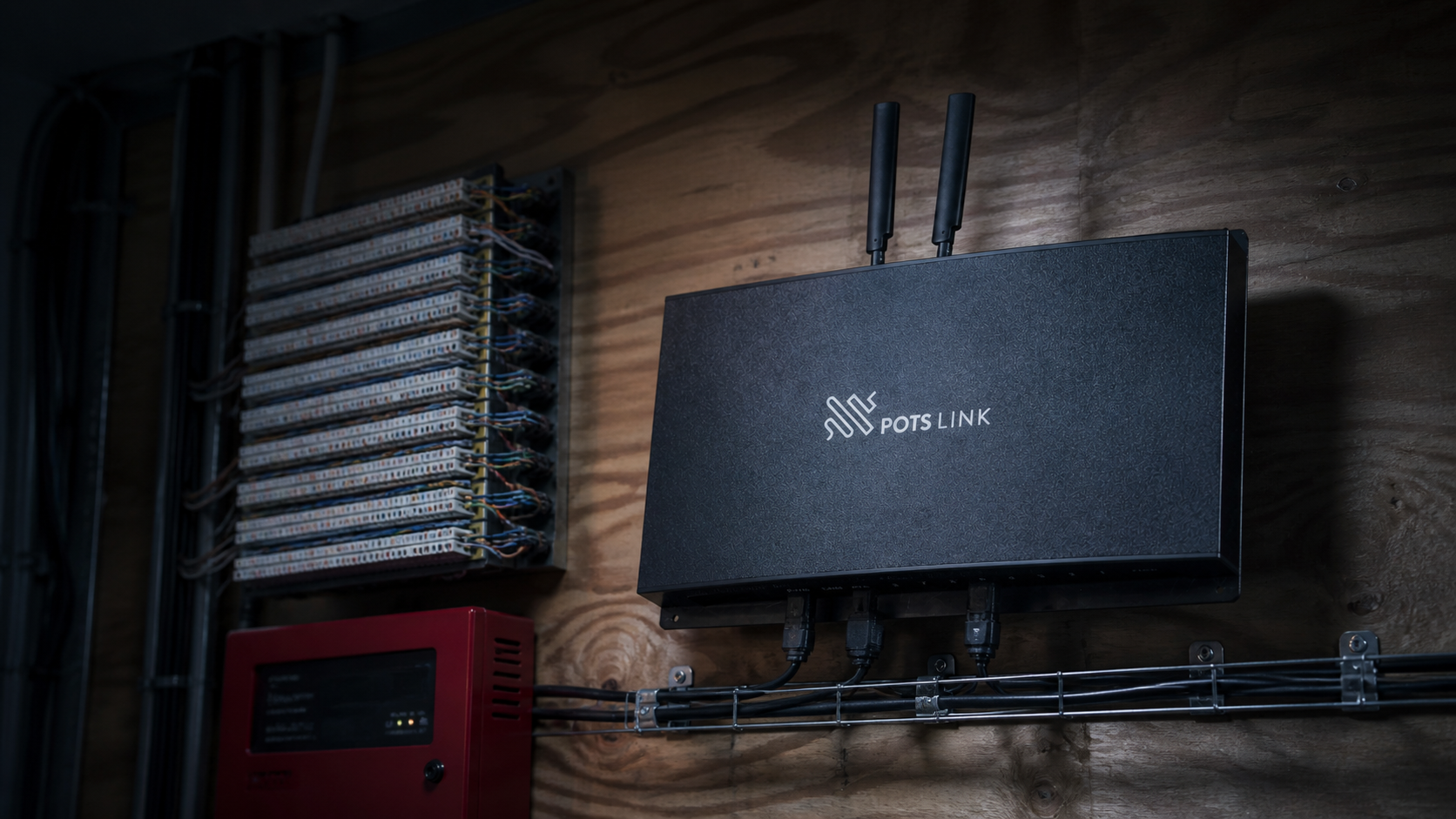
If ATEL's V810V or V810VD is on your POTS replacement shortlist, this page will help you understand what separates the two solutions and where the differences actually matter. ATEL sells hardware. RCN's POTS Link is a managed service built on 13 years of direct POTS replacement deployments and 13 years of wireless WAN engineering in RF-severe environments. Those two credentials are distinct, and both are load-bearing when analog devices attached to life-safety infrastructure need to be replaced reliably and compliantly.
ATEL is a Newport Beach based device manufacturer with a portfolio of LTE hardware including hotspots, indoor and outdoor routers, and the V810 series of home phone connect devices. The V810V and V810VD are its two POTS replacement SKUs, competent hardware products positioned at the consumer and SMB self-install market. POTS Link is built on a different foundation: the same wireless WAN engineering capability RCN has deployed across enterprise, government, and public safety environments since 2012, applied specifically to POTS replacement at facilities where analog failure is not acceptable.
What Is the ATEL V810 Series?
ATEL's POTS replacement line consists of two products. The V810V is a voice-only device providing LTE Cat-4 connectivity across two RJ11 ports, supporting HD voice via VoLTE and conference calling for up to six callers. It runs on AA backup batteries with approximately 30 hours of standby time.
The V810VD adds a data layer: an RJ45 Ethernet port, 802.11 b/g/n/ac Wi-Fi across 2.4GHz and 5GHz bands, and fixed wireless access at up to 150Mbps downlink. Both units carry a 1.77-inch LCD display, two internal LTE antennas, GNSS support, and Verizon ODI and Security Level 1 certification.
ATEL's go-to-market model is a hardware sale. Buyers purchase the device, supply their own SIM, and manage configuration and monitoring through the device's web GUI or cloud management platform. ATEL also offers private-label and co-brand programs and sells through authorized resellers and distributors.
What Is POTS Link?
POTS Link is RCN Technologies' fully managed cellular POTS replacement service. The service gateway is included in the monthly cost. RCN manages the hardware, the carrier connectivity, and the ongoing operational health of every line. Configuration, installation, monitoring, and support are handled by RCN's wireless WAN engineering team.
RCN is an Ericsson Technical Excellence Partner and a Cradlepoint-certified integrator. Over 13 years, RCN has built wireless WAN solutions in RF-severe environments, complex sites where signal variability, building attenuation, and carrier coverage gaps are real operational conditions rather than edge cases. That same track record includes direct POTS replacement deployments across fire alarm panels, elevator emergency phones, gate access systems, and multi-device facilities.
RCN also holds direct government contract vehicles on GSA Schedule, OMNIA Partners, Sourcewell, NASPO ValuePoint, and State contracts for Georgia, New York, and Pennsylvania.
How POTS Link and the ATEL V810 Series Compare
Network Architecture
The ATEL V810V and V810VD are LTE Cat-4 devices that accept a single SIM, tying the connection to whichever carrier that SIM is provisioned on. If that carrier experiences congestion, a coverage gap, or a tower outage at the moment a fire alarm needs to transmit, there is no automatic failover. The V810VD includes an RJ45 port that can incorporate a wired Ethernet path as a secondary connection, but that requires the buyer to supply and configure it. Neither device includes a second SIM slot or built-in carrier redundancy of any kind.
POTS Link is built on a wireless-first, dual-SIM architecture. SIM slot 2 always carries RCN's multi-carrier SIM, a single physical SIM that dynamically routes across all three major national carriers at the network core based on real-time signal strength and availability. SIM slot 1 gives the customer a choice: use a preferred carrier, or let RCN deploy the strongest available carrier for that specific site based on RF assessment. SD-WAN technology manages path selection across both slots in real time, and a customer's wired Ethernet WAN can be incorporated into the path mix when available.
POTS Link is also compatible with all three major public safety and priority networks: FirstNet-compatible via AT&T, Verizon Frontline-compatible, and T-Mobile public safety network-compatible. Priority network access matters most precisely when the surrounding infrastructure is under the most stress, during a declared emergency, when both network demand and the probability of a life-safety signal spike at the same time. The ATEL V810 series has no stated compatibility with any priority or public safety network.
Life-Safety Compliance: NFPA 72, ASME A17.1, and the RAY BAUM'S Act
NFPA 72 and life-safety device suitability. POTS Link is certified against NFPA 72 (fire alarm communications), ASME A17.1 (elevator emergency communications), and applicable UL listing standards for life-safety signaling equipment. ATEL's own published FAQ for the V810VD states directly that, while the device holds NFPA certification, it should not be considered 100% reliable for fire alarm or security panels. ATEL attributes this to the nature of VoLTE signaling and the reporting protocols used by fire alarm and security panels, specifically Contact ID (CID) and DMP formats. For any facility where a fire alarm panel, elevator phone, or security communicator is on the line, that disclosure is not a minor footnote. It is a documented reliability gap in a life-safety application.
Battery backup and NFPA 72 standby requirements. NFPA 72 requires that fire alarm communicators maintain 24 hours of standby power followed by 5 minutes of alarm operation. ATEL claims approximately 30 hours of standby on the V810V and 27 hours on the V810VD under voice-only operation, but in practice those figures are unverifiable. ATEL publishes no current-draw or power-consumption specifications for the V810 series, so a facilities manager, AHJ inspector, or life-safety engineer cannot perform an independent NFPA 72 backup-power calculation. The standby figures are almost certainly derived at room temperature and full signal strength, while an LTE modem in a basement mechanical room at marginal signal drives the RF power amplifier to maximum output and compresses real-world runtime. And the AA backup cells are never recharged by the device: there is no inline charging circuit, so the batteries self-discharge in the bay from the day of installation until the first power outage.
Kari's Law, the RAY BAUM'S Act, and Federal Enhanced E911. The ATEL V810V and V810VD are cellular voice adapters. When one places a 911 call, the location data delivered to the PSAP is derived from the cellular network: cell tower triangulation or carrier-reported coordinates. That is not dispatchable location as defined by the RAY BAUM'S Act, which requires the specific floor, unit, or room. A device with no provisioned location database, no MLTS integration, and no mechanism to pass floor or room data to a PSAP cannot deliver dispatchable location by design, and this is not a configuration gap a firmware update resolves. POTS Link is engineered as a managed, provisioned service precisely because location-data integrity requires a service architecture, not just a connected radio. Request written compliance documentation from any POTS replacement vendor before committing to a facility-wide deployment.
Line Density
Both the ATEL V810V and V810VD provide two RJ11 ports, supporting two analog lines per device. For facilities with more than two POTS-dependent devices, multiple units are required, and hardware, management overhead, and installation complexity scale linearly with line count.
POTS Link supports 8 lines natively per service gateway, with extended architecture supporting 24 to 32 lines per rack-mount unit. A 16-line facility requires 8 ATEL units versus 2 POTS Link gateways. For multi-device facilities such as government campuses, healthcare facilities, and commercial buildings with elevator phones, fire panels, and gate systems on the same floor, the density difference carries direct and material cost and logistics implications.
Installation Model and Service Accountability
ATEL's standard model is customer self-managed. The buyer purchases hardware, provisions a SIM, and handles configuration, monitoring, and troubleshooting through the web GUI or cloud management platform. There is no managed service layer, no provider monitoring lines, and no accountability for uptime beyond the device warranty.
POTS Link is a fully managed service with professional installation as the standard model. RCN's team handles site survey, RF assessment, installation, configuration, and ongoing monitoring. Antenna placement in a concrete building, carrier selection for a basement mechanical room, and multi-path optimization across dual SIMs are engineering decisions, not setup-wizard choices. With a self-managed hardware product, the customer owns the outcome of every configuration decision. With a managed service, RCN owns the ongoing operational performance of every line.
Government and Cooperative Contract Access
ATEL does not publish government contract vehicle information. Its distribution model routes through resellers and distributors oriented toward wholesale and private-label buyers, not government procurement.
POTS Link carries direct contract vehicles: GSA Schedule, OMNIA Partners, Sourcewell, NASPO ValuePoint, State of Georgia, State of New York, and State of Pennsylvania. RCN holds these contracts directly, with no intermediary required. For agencies with existing GSA or Sourcewell relationships, or those in GA, NY, or PA, POTS Link can be placed without involving a separate channel partner.
Comparison at a Glance
| Factor | ATEL V810V / V810VD | POTS Link |
|---|---|---|
| Cellular generation | 4G LTE Cat-4 | 4G LTE / 5G capable |
| SIM architecture | Single SIM; customer-provisioned; no carrier redundancy | Dual-SIM (customer carrier + RCN multi-carrier SIM); SD-WAN path selection |
| Public safety networks | None stated | FirstNet-compatible, Verizon Frontline-compatible, T-Mobile public safety-compatible |
| Lines per device | 2 | 8 native; 24 to 32 extended |
| Battery backup | 27 to 30 hr standby (AA, voice-only, lab conditions); no inline charging; no published current-draw specs | 24 hr native; NFPA 72 aligned; designed for sustained deployment |
| Fire alarm / life-safety suitability | NFPA certification held, but should not be considered 100% reliable for fire alarm or security panels (ATEL's own FAQ) | Certified; confirmed fit for fire alarm, elevator, and life-safety applications |
| Kari's Law / RAY BAUM'S Act / Federal E911 | Cannot deliver dispatchable location; carrier-network estimation, not provisioned floor/room data; compliance not stated in public documentation | Compliant |
| Installation model | Customer self-managed; web GUI and cloud portal | RCN fully managed; professional installation standard |
| Service model | Hardware purchase; customer-owned accountability | Managed service; RCN-owned accountability |
| Government contract vehicles | Not published | GSA, OMNIA, Sourcewell, NASPO, State of GA / NY / PA (direct) |
| Provider background | Consumer device manufacturer | Wireless WAN integrator; Ericsson Technical Excellence Partner; 13 years RF/cellular and POTS replacement deployment |
Which Solution Fits Which Buyer?
When the ATEL V810 Series Fits
The ATEL V810V or V810VD is a reasonable fit for a straightforward voice line replacement at a small business or home office with no life-safety devices on the line. It suits teams with internal IT or telecom staff comfortable provisioning SIMs and managing device configuration independently, buyers who want to own hardware outright and self-manage it, and procurement that does not require cooperative contract vehicles or formal compliance documentation.
When POTS Link Is the Stronger Fit
- Your facility has fire alarm panels, elevator phones, access control, or other life-safety devices that require a confirmed-reliable POTS replacement
- You need dual-SIM wireless redundancy with SD-WAN path optimization rather than a single-carrier LTE connection
- You need documented compliance with Kari's Law, the RAY BAUM'S Act, and Federal Enhanced E911, including dispatchable location
- You need priority access to FirstNet-compatible, Verizon Frontline-compatible, or T-Mobile public safety networks
- You are managing more than two lines per location
- You require a fully managed service with professional installation and ongoing line ownership
- Your procurement runs through GSA, Sourcewell, or a state contract in Georgia, New York, or Pennsylvania
Frequently Asked Questions
What is an ATEL V810V or V810VD alternative for enterprise or government buyers?
POTS Link by RCN Technologies is a fully managed cellular POTS replacement available directly on GSA Schedule, OMNIA Partners, Sourcewell, and NASPO ValuePoint, with state contract coverage in Georgia, New York, and Pennsylvania. It operates on a wireless-first, dual-SIM architecture compatible with FirstNet, Verizon Frontline, and T-Mobile public safety networks, is certified for NFPA 72 and ASME A17.1, and is compliant with Kari's Law, the RAY BAUM'S Act, and Federal Enhanced E911 requirements. For other adapter-class comparisons, see POTS Link vs. the Peplink POTS Adapter and POTS Link vs. Ooma AirDial.
Can the ATEL V810VD be used with fire alarm panels?
ATEL's own published FAQ states that, while the V810VD holds NFPA certification, it should not be considered 100% reliable for fire alarm or security panels due to VoLTE signaling limitations with Contact ID (CID) and DMP reporting protocols. ATEL's guidance is to consult its team directly before critical-application deployments. POTS Link, by contrast, is confirmed fit for fire alarm and life-safety applications.
Does the ATEL V810 series satisfy the RAY BAUM'S Act?
No cellular voice adapter architecture can reliably satisfy the RAY BAUM'S Act's dispatchable-location requirement, and the ATEL V810 series is no exception. The Act requires that a 911 call deliver a verified address including floor and room to the PSAP. The V810V and V810VD route calls over a carrier's mobile network, so the location data they deliver is carrier-derived: cell tower coordinates or network-level estimation, not dispatchable location. These devices have no provisioned location database, no MLTS integration, and no mechanism to pass floor or room data to a PSAP. Any facility deploying the V810 series in a multi-line system and expecting to satisfy RAY BAUM'S Act obligations should request written dispatchable-location compliance documentation from ATEL before proceeding. POTS Link is compliant with the RAY BAUM'S Act and Federal Enhanced E911 requirements.
Does the ATEL V810 series meet NFPA 72 standby requirements?
That question cannot be answered definitively from ATEL's published documentation, which is itself the problem. ATEL publishes no current-draw or power-consumption specifications for the V810 series, so no one can independently verify whether the claimed 27 to 30 hour standby figure holds under the real conditions of a fire alarm deployment: basement-level signal, elevated temperature, and multi-year installed life. The AA backup cells are also never recharged by the device, self-discharging from the day of installation until the first power outage. POTS Link provides 24-hour native backup in a gateway with a charging architecture designed for sustained deployment, with compliance documentation that supports AHJ review.
Does POTS Link provide carrier redundancy that ATEL does not?
Yes. The ATEL V810 series operates on a single SIM with no automatic carrier failover. POTS Link uses a dual-SIM architecture: SIM slot 2 always carries RCN's multi-carrier SIM with dynamic routing across all three major national carriers at the network core, and SIM slot 1 adds an additional carrier path. SD-WAN technology manages real-time path selection across both slots. The V810VD can incorporate a wired Ethernet connection via its RJ45 port, but the customer is responsible for provisioning and managing that path.
Is POTS Link compliant with Kari's Law and the RAY BAUM'S Act?
Yes. POTS Link is compliant with Federal Enhanced E911 requirements, Kari's Law, and the RAY BAUM'S Act. ATEL's public documentation does not address these requirements. For any organization operating a multi-line telephone system, these are federal legal requirements, so request written compliance documentation from any POTS replacement vendor, specifically covering dispatchable-location delivery and not just call completion, before committing to a facility-wide deployment.
How many lines does the ATEL V810 support per device?
Both the V810V and V810VD provide two RJ11 ports, supporting two analog lines per unit. A 16-line facility requires 8 ATEL units versus 2 POTS Link gateways. POTS Link supports 8 lines per gateway natively and up to 24 to 32 lines per rack-mount unit in extended configurations.
Why does 13 years of wireless WAN experience matter for a POTS replacement?
Most POTS replacement hardware, including consumer-grade cellular adapters like the ATEL V810 series, treats cellular connectivity as a device feature rather than an engineering discipline. RCN has spent 13 years building wireless WAN solutions in RF-severe environments: basements, concrete structures, multi-tenant campuses, and facilities where carrier coverage gaps and signal attenuation are real operational conditions. That same track record includes direct POTS replacement deployments across fire alarm panels, elevator emergency phones, gate access systems, and multi-device life-safety infrastructure. When a fire alarm panel in a basement mechanical room needs to reach a monitoring center reliably and deliver dispatchable location to a PSAP, the difference between a plug-in consumer adapter and a managed service built on both credentials is not abstract.
Is POTS Link available on cooperative contract vehicles?
Yes. POTS Link is available directly on GSA Schedule, OMNIA Partners, Sourcewell, NASPO ValuePoint, State of Georgia, State of New York, and State of Pennsylvania contracts, without routing through a third-party distributor. ATEL does not publish government contract vehicle availability.
Request a POTS Link Assessment
RCN Technologies provides no-cost POTS line assessments for government agencies, enterprise facilities, and nonprofits evaluating POTS replacement options.
Request a POTS Link Assessment