

POTS Replacement Comparison
POTS Link vs. Peplink POTS Adapter: Which POTS Replacement Is Right for You?
A direct comparison on E911 compliance, network architecture, battery backup, line density, installation, service model, and government contract access, so you can make the right call for your facility.
Request a POTS Link Assessment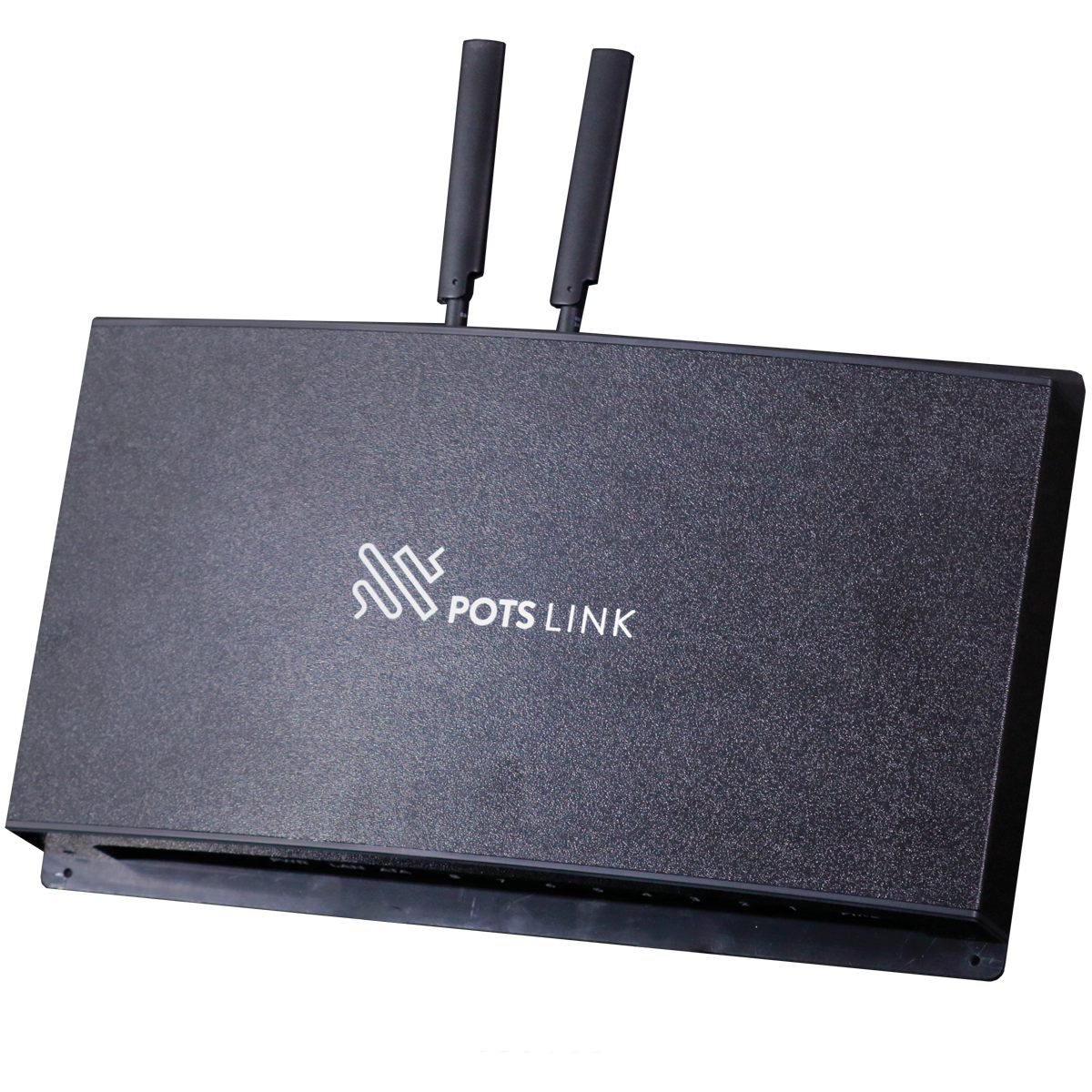
If you're evaluating cellular POTS replacements, the Peplink POTS Adapter may have crossed your radar, particularly if you already operate Peplink routers or work with a Peplink-aligned integrator. It's a compact, lightweight device from a respected networking hardware company, and for certain narrow use cases, it works as advertised. This page isn't written to dismiss it. It's written to help you understand where the two solutions genuinely differ, so you can make the right call for your organization.
What that evaluation requires is understanding the difference between a networking hardware company that added a VoLTE adapter to its product catalog, and a wireless WAN integrator with 13 years of experience deploying carrier-grade cellular infrastructure in RF-severe environments and a separate 13-year track record in POTS replacement and telephony infrastructure. POTS Link is built on both of those foundations. For facilities where fire alarms, elevator emergency phones, and regulated communications infrastructure are what's actually being migrated off copper, that dual depth of expertise matters more than most buyers realize before they've read the fine print.
What Is the Peplink POTS Adapter?
The Peplink POTS Adapter is a single-line cellular adapter that converts one analog POTS connection to a VoLTE cellular connection. It is sold as a standalone hardware product, available through Peplink's authorized reseller and eTailer network, and is managed through Peplink's InControl2 cloud platform.
The device supports a range of analog applications including alarm systems, elevator phones, door and gate intercoms, fax machines, and roadside call boxes. It carries FCC, RoHS, and UL certifications, supports LTE Bands B2, B4, B5, B12, B13, B14, B66, and B71, and is carrier-certified for Verizon, AT&T, T-Mobile, and FirstNet in North America.
Peplink is a networking hardware manufacturer based in Hong Kong, with a strong presence in the SD-WAN, mobile router, and enterprise connectivity markets. The POTS Adapter is a product line extension, a purpose-built adapter designed to leverage the company's existing cellular modem expertise and InControl management platform.
There is one item in the Peplink documentation that merits immediate attention from any buyer evaluating the device for a life-safety application. Peplink states directly on the product page and in the datasheet: "The Peplink POTS Adapter DOES NOT support 911 or E911 emergency calling services." The implications of that statement are addressed in detail below.
What Is POTS Link?
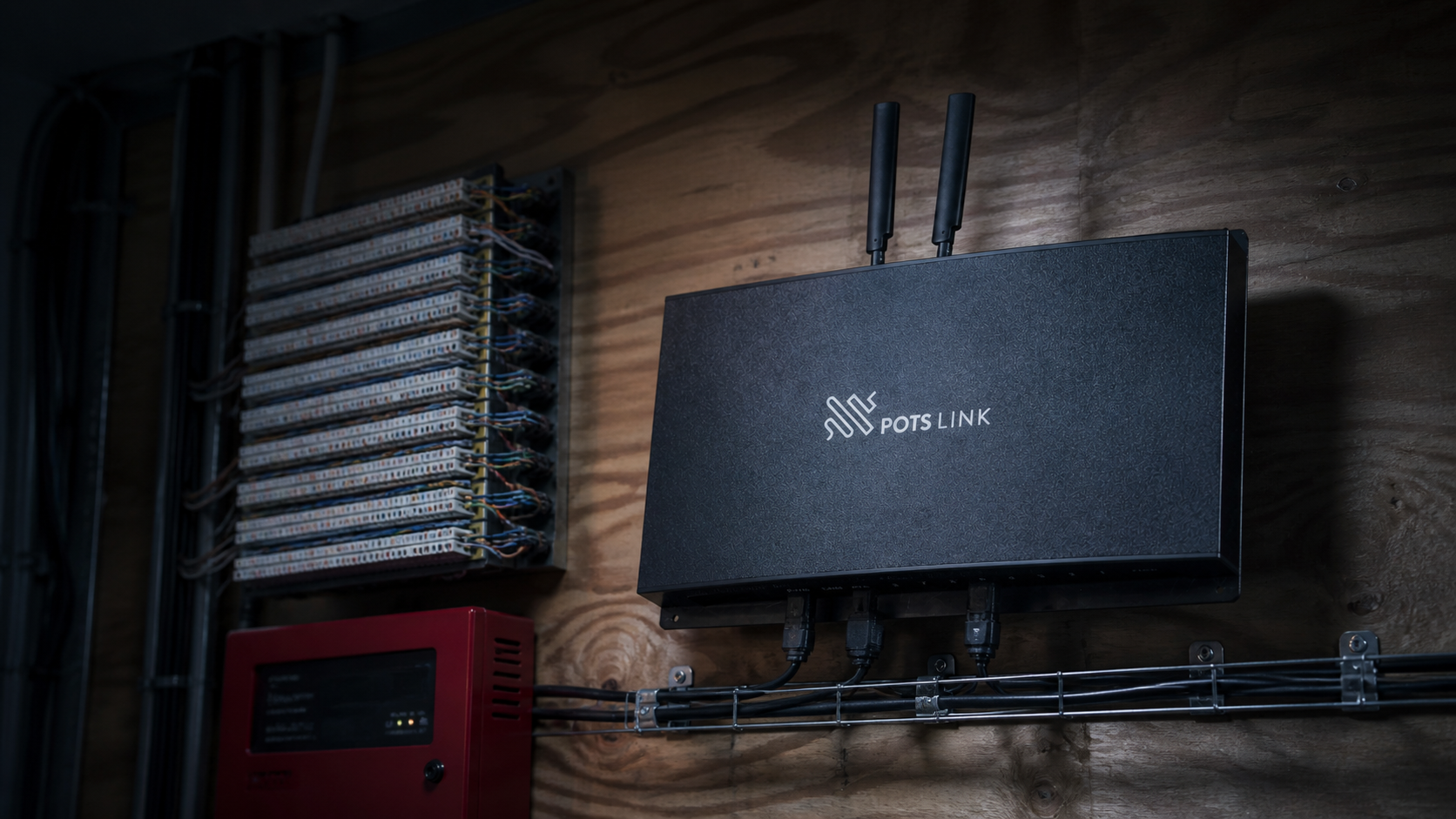
POTS Link is RCN Technologies' fully managed cellular POTS replacement service. Unlike a product sale, POTS Link is a service relationship. RCN manages the hardware, the carrier connectivity, and the ongoing health of your lines. The service gateway is included in the monthly cost, and RCN's team of wireless WAN specialists handles configuration, installation, monitoring, and support.
RCN is an Ericsson Technical Excellence Partner and a Cradlepoint-certified integrator with over 13 years of experience deploying wireless WAN solutions in enterprise, government, and public safety environments. RCN brings a separate and equally deep 13-year track record in POTS replacement and telephony infrastructure, the operational experience of migrating analog lines off copper at scale, across the full range of life-safety and regulated communications devices, before and during the copper sunset. Those two credentials together are the technical foundation POTS Link is built on. RCN also holds direct government contract vehicles across GSA, OMNIA Partners, Sourcewell, NASPO ValuePoint, and the State contracts for Georgia, New York, and Pennsylvania.
How POTS Link and the Peplink POTS Adapter Compare
E911 Compliance: The Threshold Issue
This is the most consequential difference between the two solutions, and it is not a nuance. It is a documented limitation published by Peplink itself.
The Peplink POTS Adapter does not support 911 or E911 emergency calling services. Peplink discloses this prominently in both the product page and the official datasheet. For deployments where the POTS line being replaced does not touch emergency calling infrastructure (isolated fax machines, gate intercoms in controlled access facilities, standalone autodial systems), that limitation may be acceptable in context.
For the vast majority of facilities evaluating POTS replacement, it is not acceptable.
POTS Link is compliant with Federal Enhanced E911 requirements, Kari's Law, and the RAY BAUM'S Act. Kari's Law requires that multi-line telephone systems permit direct 911 dialing without a prefix, with no "9 to get out." The RAY BAUM'S Act extends that requirement to include dispatchable location data, ensuring emergency responders can identify not just which building a call originated from, but which floor or room. For any facility operating a multi-line system, which describes virtually every commercial, government, and institutional POTS replacement deployment, both are legal requirements. The Peplink POTS Adapter, by the manufacturer's own disclosure, cannot satisfy them.
Buyers should document this due diligence in any procurement that involves fire alarm panels, elevator emergency phones, security monitoring lines, or any device that could reasonably be expected to reach emergency services. A POTS replacement device that cannot complete a 911 call is not an appropriate substitute for a copper line serving a fire panel.
Network Architecture: How the Wireless Connection Is Built
The Peplink POTS Adapter uses a single embedded LTE modem with one SIM slot. Connectivity routes over a single LTE carrier at a time. The device supports external antenna connections via two SMA ports, which is meaningful for installations in low-signal or structurally attenuated environments. Management and monitoring are handled through Peplink's InControl2 cloud platform. There is no built-in path redundancy across carriers. If the active carrier experiences an outage or coverage degradation at that location, the line goes down.
POTS Link is built on a wireless-first, dual-SIM architecture. SIM slot 2 is always occupied by RCN's multi-carrier SIM, a single physical SIM with tri-carrier redundancy that dynamically routes to the strongest available carrier at the network core. SIM slot 1 gives the customer a choice: bring your own preferred single-carrier SIM, or have RCN deploy the strongest available carrier based on the RF environment at that specific location. SD-WAN technology selects the optimal path across both SIM slots in real time, without manual intervention. A customer's wired Ethernet WAN can also be incorporated into the path mix when available, providing an additional layer of connectivity.
POTS Link is also compatible with all three major public safety and priority networks: FirstNet-compatible via AT&T, Verizon Frontline-compatible, and T-Mobile's public safety network-compatible, providing priority access to network resources during declared emergencies. For government facilities, public safety campuses, and any site where a fire alarm or emergency phone must work precisely when surrounding infrastructure is most stressed, that priority network access is not a footnote.
The Peplink POTS Adapter is carrier-certified for Verizon, AT&T, T-Mobile, and FirstNet. Carrier certification means the device has been approved to operate on those networks. It does not mean the device has public safety priority access provisioned, and it does not address the E911 limitation described above.
Line Density
The Peplink POTS Adapter supports one analog line per device. One port, one SIM, one line. For facilities with multiple POTS-dependent devices (and the typical commercial building has them: fire panels, elevator phones, fax lines, gate systems, intrusion monitoring), each additional line requires an additional device, an additional SIM activation, an additional power source, and an additional management relationship.
POTS Link supports 8 lines natively per service gateway, with extended architecture supporting 24 to 32 lines per rack-mount unit. For multi-device facilities, this density difference has direct cost and logistics implications. Eight Peplink POTS Adapters, their associated SIM plans, power supplies, and antenna kits represent a meaningfully different cost structure and installation footprint than a single POTS Link gateway serving the same line count.
Battery Backup: Built-In UPS vs. NFPA 72 Requirements
The Peplink POTS Adapter includes a built-in 3,000 mAh UPS that provides 24 hours of standby usage or 4 hours under active line usage. The 24-hour standby figure aligns with the NFPA 72 standby power requirement on its face, but the critical qualifier is "standby." NFPA 72 Section 10.6.7 requires 24 hours of standby power followed by 5 minutes of alarm operation. The 4-hour "under line usage" rating on the Peplink adapter suggests that under active load, which is when fire alarm panels are most likely communicating, the runtime is significantly shorter than what the NFPA 72 framework envisions.
POTS Link delivers 24-hour native battery backup with ratings designed to support the life-safety signaling context. Buyers with formal AHJ (Authority Having Jurisdiction) review processes should request written documentation from any POTS replacement vendor on standby power performance under active load conditions, not just standby conditions.
Compliance Certifications
POTS Link is built and tested against the applicable standards governing the devices it serves: NFPA 72 (fire alarm communications), ASME A17.1 (elevator emergency communications), and applicable UL listing standards for life-safety signaling equipment. POTS Link is also compliant with Federal Enhanced E911 requirements, Kari's Law, and the RAY BAUM'S Act.
The Peplink POTS Adapter carries FCC, RoHS, and UL certifications. Peplink does not reference NFPA 72 or ASME A17.1 compliance in its public documentation. The explicit disclaimer that the device does not support 911 or E911 services is directly relevant to the compliance posture of any facility deploying it in a life-safety role. Buyers with formal compliance review requirements (AHJ approvals, state fire marshal sign-offs, elevator inspector certifications, or government IT security reviews) should request Peplink's written documentation on each applicable standard before committing to deployment.
Installation Model
The Peplink POTS Adapter is positioned as a plug-and-play device requiring only a power source and cellular signal. Peplink's marketing emphasizes DIY simplicity: no additional network equipment required, standalone deployment out of the box. For straightforward low-stakes applications, that simplicity is genuine.
For installations serving fire panels, elevator emergency phones, or any life-safety signaling device, plug-and-play installation by non-specialists introduces meaningful risk. The compliance posture of a fire alarm communicator is established at the time of installation and is the responsibility of the installing party. A misconfigured analog line serving a fire panel that fails during an alarm event is not a configuration error. It is a liability event.
POTS Link leads with fully managed professional installation as the primary model. RCN's POTS specialists handle site assessment, hardware configuration, carrier activation, and cutover. In select cases, where site conditions are straightforward and the customer's team is technically qualified, self-installation can be approved. It is the exception, not the default.
For enterprise and government buyers managing deployments across dozens or hundreds of locations, the difference between handing a device to a facilities coordinator and having a certified wireless WAN engineer commission each site is operationally significant. For life-safety infrastructure, professional commissioning is not overhead. It is insurance.
Service Model: Self-Managed vs. Fully Managed
The Peplink POTS Adapter is a customer self-managed product. InControl2 provides visibility into device status, connection health, and email alerting when a device goes offline or power supply changes are detected. That is a well-designed management platform for an organization with internal telecom or IT staff who can act on what it reports.
POTS Link is a fully managed service. RCN owns the monitoring, the troubleshooting, and the carrier coordination on an ongoing basis. For organizations without a dedicated telecom operations team, common in government agencies, school districts, healthcare facilities, and mid-market enterprises, that distinction determines whether a line issue becomes a resolved ticket or an undetected outage.
There is also an accountability dimension that matters specifically in the life-safety context. When something goes wrong with a self-managed product, you contact the vendor's support line and manage resolution internally. When something goes wrong with a managed service, your provider resolves it. For fire alarms and elevator phones, many buyers place significant value on that accountability structure. The question to ask is not whether your team can manage the portal. It is whether your team should be the last line of defense on a life-safety communications line.
Government and Cooperative Contract Access
The Peplink POTS Adapter is available through Peplink's certified reseller and eTailer channel. Peplink does not appear to hold direct cooperative contract vehicles for government buyers. Procurement would route through a Peplink-authorized partner or through a reseller with its own contract vehicle.
POTS Link carries a broader set of direct contract vehicles: GSA Schedule, OMNIA Partners, Sourcewell, NASPO ValuePoint, State of Georgia, State of New York, and State of Pennsylvania. RCN holds these contracts directly. Procurement is not intermediated through a third-party aggregator. For agencies with existing GSA or Sourcewell relationships, or those in GA, NY, or PA, POTS Link can be placed without involving a separate channel partner.
Comparison at a Glance
| Factor | Peplink POTS Adapter | POTS Link |
|---|---|---|
| E911 support | Explicitly NOT supported (Peplink documentation) | Compliant: Federal Enhanced E911, Kari's Law, RAY BAUM'S Act |
| Network architecture | Single LTE modem, single SIM, single carrier | Wireless-first; dual-SIM (customer carrier in SIM 1 plus RCN multi-carrier SIM in SIM 2); SD-WAN path selection; wired Ethernet optional |
| Public safety networks | Carrier-certified for Verizon, AT&T, T-Mobile, FirstNet | FirstNet-compatible, Verizon Frontline-compatible, T-Mobile public safety network-compatible |
| Lines per device | 1 | 8 native; 24 to 32 extended |
| Battery backup | 24HR standby / 4HR under active load | 24HR native, NFPA 72 aligned |
| Hardware cost | Purchased per unit, per line | Included in monthly service |
| Installation | DIY plug-and-play | Fully managed professional standard; self-install by specialist approval only |
| Service model | Customer self-managed (InControl2 portal) | RCN fully managed |
| NFPA 72 / ASME A17.1 / UL | Not referenced; FCC, RoHS, UL only | Certified |
| Gov contract vehicles | Through Peplink reseller channel (no direct cooperative contracts confirmed) | GSA, OMNIA, Sourcewell, NASPO, State of GA, NY, PA (direct) |
| Provider background | Networking hardware manufacturer | Wireless WAN integrator; 13 years RF and cellular deployment experience; 13 years POTS replacement and telephony experience |
Which Solution Fits Which Buyer?
The Peplink POTS Adapter is a reasonable fit if
Your organization needs to migrate a specific set of non-emergency analog lines (isolated fax machines, gate intercoms, autodial systems with no life-safety function) and you have internal IT staff to manage deployment and monitoring. You operate in a Peplink-centric environment and want a device that integrates cleanly into your existing InControl2 infrastructure. Your procurement can run through a Peplink reseller without a cooperative contract requirement. And critically: the lines you're migrating have no 911 or E911 requirement.
POTS Link is the stronger fit if
- Any of your POTS lines serve fire alarm panels, elevator emergency phones, security monitoring, or any device that may need to reach 911.
- You need documented E911, Kari's Law, and RAY BAUM'S Act compliance for your facility or your AHJ.
- You need tri-carrier wireless redundancy with SD-WAN path optimization across dual SIM slots.
- You're managing 8 or more lines per location, or running multi-device facilities where per-line hardware cost compounds.
- You need a managed service partner with professional installation and ongoing line ownership, not a portal to monitor lines yourself.
- Your procurement runs through GSA, Sourcewell, or a state contract in GA, NY, or PA.
Frequently Asked Questions
What is a Peplink POTS Adapter alternative for government agencies?
POTS Link by RCN Technologies is a fully managed cellular POTS replacement available directly on GSA Schedule, OMNIA Partners, Sourcewell, and NASPO ValuePoint, with state contract coverage in Georgia, New York, and Pennsylvania. Unlike the Peplink POTS Adapter, POTS Link supports E911, Kari's Law, and the RAY BAUM'S Act, and operates on a wireless-first, tri-carrier dual-SIM architecture compatible with FirstNet, Verizon Frontline, and T-Mobile public safety networks.
Does the Peplink POTS Adapter support 911 calling?
No. Peplink states directly on the product page and in the datasheet that the POTS Adapter does not support 911 or E911 emergency calling services. Buyers evaluating the device for any life-safety application (fire alarm panels, elevator emergency phones, security monitoring lines) should treat this as a disqualifying limitation and evaluate alternatives that carry documented E911 compliance.
What is the difference between VoLTE and a fully managed POTS replacement service?
VoLTE (Voice over LTE) is the underlying technology used to carry analog voice calls over a cellular network. The Peplink POTS Adapter is a hardware device that converts a POTS line to VoLTE: the customer buys the hardware, activates a SIM, and manages the deployment. POTS Link is a fully managed service built on cellular infrastructure: RCN supplies the hardware, manages the carrier connectivity, handles professional installation, and provides ongoing monitoring and support as part of the monthly service cost.
Does the Peplink POTS Adapter meet NFPA 72 battery backup requirements?
The Peplink POTS Adapter includes a built-in 3,000 mAh UPS rated for 24 hours of standby usage but only 4 hours under active line usage. NFPA 72 requires 24 hours of standby power for fire alarm communicators. The device's 4-hour active load runtime is a meaningful qualifier that buyers with AHJ oversight should evaluate carefully. POTS Link provides 24-hour native backup designed to support life-safety signaling contexts.
How many lines does the Peplink POTS Adapter support per device?
One. The Peplink POTS Adapter supports a single analog line per unit. POTS Link supports 8 lines per service gateway natively and up to 24 to 32 lines per rack-mount unit in extended configurations. For multi-device facilities, the per-line hardware, SIM, and management cost of single-line adapters compounds quickly.
What is a managed POTS replacement service?
A managed POTS replacement service means the provider, not the customer, is responsible for site installation, ongoing line monitoring, hardware management, and carrier coordination. POTS Link by RCN is a fully managed service with professional installation as the standard model. The Peplink POTS Adapter is a customer self-managed product with DIY installation and cloud-based device monitoring through the InControl2 portal.
Is POTS Link available on cooperative contract vehicles?
Yes. POTS Link is available directly on GSA Schedule, OMNIA Partners, Sourcewell, NASPO ValuePoint, State of Georgia, State of New York, and State of Pennsylvania contract vehicles, without routing through a third-party reseller. The Peplink POTS Adapter does not appear to carry equivalent direct cooperative contract access.
Why does the E911 limitation on the Peplink POTS Adapter matter for my facility?
Most facilities replacing POTS lines have at least one line serving a life-safety device: a fire alarm communicator, an elevator emergency phone, a security panel. Federal law and local codes require that these devices can reach emergency services. The Peplink POTS Adapter's explicit disclaimer that it does not support 911 or E911 means it cannot legally or operationally substitute for a POTS line serving those devices. Before deploying any POTS replacement, buyers should audit every line being migrated for emergency calling dependency, and verify in writing that the replacement solution satisfies E911 requirements at that line.
Request a POTS Link Assessment
RCN Technologies provides no-cost POTS line assessments for government agencies, enterprise facilities, and nonprofits evaluating POTS replacement options. We will audit every line being migrated for emergency calling dependency and map the right path off copper for your facility.
Request a POTS Link AssessmentSpeak with a Connectivity Expert
Tell us about your facility and the lines you need to migrate. An RCN wireless WAN specialist will follow up with a tailored POTS Link assessment.