
Verizon POTS Replacement: Understanding Your Options
Verizon offers several POTS replacement paths through its business channel. Here’s what those cover, where they fall short, and how POTS Link by RCN gives Verizon customers a better-engineered alternative on the same network.
If you’re a Verizon business customer looking at POTS replacement, the carrier gives you a few paths through its channel. Some are straightforward device swaps. Others are fully managed services built for complex, life-safety environments. All of them run on Verizon’s network, which is worth understanding before you commit.
This page is written for buyers who want to understand what those paths actually cover and what they don’t before committing. It also introduces a fourth option most Verizon customers don’t know exists: POTS Link by RCN Technologies, a fully managed POTS replacement service that works on Verizon’s network while giving you capabilities Verizon’s own catalog doesn’t offer.
What Verizon Offers: A Three-Tier Portfolio
Verizon’s POTS replacement portfolio breaks into three tiers, ranging from plug-and-play device swaps to fully managed life-safety services. For most life-safety and complex multi-line buyers, the managed partners are the relevant tier, so they get the detailed treatment below. The simpler tiers are summarized first for context.
For simple analog lines like phones, fax machines, and credit card readers, Verizon offers plug-and-play Analog Telephone Adapters through its Business Phone Connect product: the Inseego BPC100, ATEL V810V, and ATEL V810VD. These are single-carrier LTE devices. Self-managed. Not rated for life-safety applications.
For phone system replacement, Verizon offers One Talk, a hosted, feature-rich voice platform. This is a PBX replacement, not a POTS replacement in the technical sense. It doesn’t bridge legacy analog devices to cellular. It’s listed separately from Verizon’s POTS solutions for a reason.
For life-safety and complex POTS environments like fire alarm panels, elevator phones, access control, and multi-line facilities, Verizon routes buyers to two managed partners:
CSG POTSolve
A Verizon-exclusive managed POTS replacement service, with hardware OEM-built specifically for the Verizon channel. POTSolve supports up to 16 lines per enclosure and delivers 24-hour battery backup as a native specification. It's a capable managed service with real deployments. Because it's a Verizon-exclusive offering, the service is single-carrier by architecture, transacted through Verizon's channel, and procurement flows through Verizon's billing relationship rather than standalone.
MarketSpark
An enterprise-scale migration platform with a strong deployment track record (2,000 lines across 490 hospitals; 8,000 lines across 2,250 grocery stores). MarketSpark's standard hardware publishes 8+ hours of battery backup, which falls below the 24-hour threshold NFPA 72 requires for fire alarm communicators without an add-on. Like POTSolve, MarketSpark in the Verizon channel is transacted inside Verizon's billing relationship.
Both managed partners are legitimate solutions. Both are actively deployed. Both are sold through Verizon’s channel. The question worth asking is whether the Verizon network relationship and the POTS replacement service have to come from the same vendor.
What Verizon’s Catalog Doesn’t Make Obvious
When a Verizon business customer is presented with POTSolve or MarketSpark through Verizon’s channel, the natural inference is that the POTS replacement architecture is a Verizon-network solution. That’s true. What’s less visible is the architectural ceiling that comes with it. Buying either managed partner through Verizon’s channel means single-carrier service, transacted through Verizon’s billing relationship, with no independent managed backup path baked into the architecture.
For commercial facilities with straightforward requirements, single-carrier service is often adequate. For government agencies, healthcare campuses, public safety facilities, and any site where a fire alarm or elevator phone has to work during a declared emergency, when commercial LTE capacity is most congested, single-carrier service is a meaningful risk. The Verizon network is reliable. It is not infallible during storms, regional outages, or declared emergencies. When it falls back, a single-carrier POTS replacement falls with it.
There’s also the procurement question. POTSolve and MarketSpark sold through Verizon’s channel can be procured via Verizon’s NASPO MA152 umbrella vehicle. They are not, as standalone POTS services, available on GSA, OMNIA Partners, Sourcewell, NASPO directly, or state cooperative contracts. For state and local government, school districts, municipalities, and nonprofits with existing cooperative contract relationships outside of Verizon’s vehicle, that matters.
POTS Link on Verizon's Network
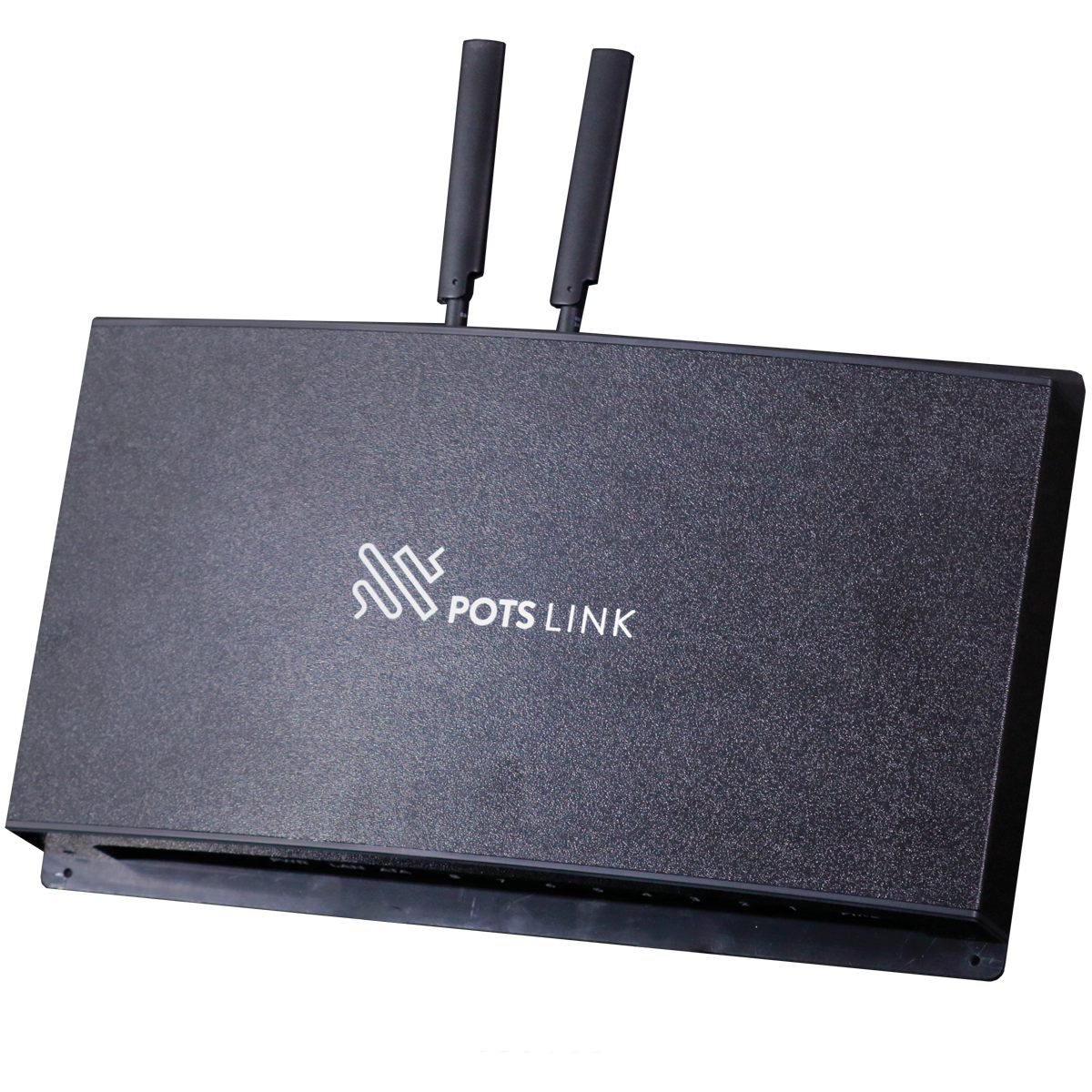
RCN Technologies is an Ericsson Technical Excellence Partner with 13 years of wireless WAN deployment experience. POTS Link, RCN's fully managed cellular POTS replacement service, supports Verizon SIMs, including Verizon Frontline for eligible public safety organizations, as the primary carrier in its dual-SIM architecture.
That creates a service model Verizon's own catalog doesn't offer: a customer can bring their Verizon SIM as the primary connection in POTS Link's SIM slot 1, maintaining the Verizon network relationship they already have, while RCN manages the backup layer independently. SIM slot 2 is always occupied by RCN's tri-carrier SIM, a single physical SIM that dynamically routes across AT&T, Verizon, and T-Mobile at the network core based on live signal conditions. SD-WAN manages path selection across both slots in real time, without manual intervention.
The result: you keep Verizon as your primary carrier for POTS replacement, and you gain a fully managed backup layer that doesn't depend on Verizon being available.
How POTS Link Differs from Verizon’s Managed Partners
Carrier Redundancy and SD-WAN Path Intelligence
POTSolve and MarketSpark, when sold through Verizon’s channel, are single-carrier services by architecture. Verizon is the network. There is no independent secondary carrier integrated into the managed service.
POTS Link takes a different architectural position from the start. SIM slot 1 can carry your Verizon SIM, including Verizon Frontline. SIM slot 2 carries RCN’s tri-carrier multi-carrier SIM, a single physical SIM that dynamically routes to the strongest available carrier across AT&T, Verizon, and T-Mobile at the network core. SD-WAN technology manages path selection across both slots in real time. If Verizon is congested or degraded at your site (during a storm, a declared emergency, a local outage), your POTS lines stay up on a different carrier without a service call, without manual cutover, and without the customer ever needing to touch the device.
Public Safety Network Compatibility
POTS Link is Verizon Frontline-compatible, FirstNet-compatible via AT&T, and T-Mobile public safety network-compatible. Each of those networks provides priority access to spectrum and routing during declared emergencies. None of Verizon’s listed POTS replacement solutions reference priority network access in their published documentation. For fire/EMS facilities, law enforcement, emergency management, and public safety answering points, that matters as much as the connection itself.
Battery Backup and NFPA 72
NFPA 72 requires 24 hours of standby power for fire alarm communicators. POTS Link delivers 24-hour native battery backup as a standard feature, no add-ons, no upgraded tier. POTSolve also publishes 24-hour battery backup as a native specification, which is real parity at the hardware level. MarketSpark’s standard hardware publishes 8+ hours, which requires an add-on to reach the NFPA 72 threshold for fire alarm applications.
Line Density
Both Verizon managed partners top out at 16 lines per device. POTS Link supports 8 lines per gateway natively and up to 24–32 lines in its extended rack-mount configuration. For facilities with fire panels, elevator phones, access control, gate systems, and voice lines running simultaneously, that density consolidates a deployment that would otherwise require multiple POTSolve or MarketSpark enclosures.
Documented Compliance
POTS Link is certified against NFPA 72 (fire alarm communications), ASME A17.1 (elevator emergency communications), and applicable UL listing standards for life-safety signaling equipment. It is also compliant with Federal Enhanced E911, Kari’s Law, and the RAY BAUM’S Act. Kari’s Law requires that multi-line telephone systems permit direct 911 dialing without a prefix. The RAY BAUM’S Act requires that 911 calls include dispatchable location data. Both apply to any multi-line facility deploying a POTS replacement. Neither Verizon managed partner addresses Kari’s Law or RAY BAUM’S Act compliance in their published documentation. Buyers should request written compliance documentation from any vendor before executing a service agreement.
Direct Government Contract Access
POTS Link is available directly on GSA Schedule, OMNIA Partners, Sourcewell, NASPO ValuePoint, and state contracts in Georgia, New York, and Pennsylvania. No carrier vehicle required, no Verizon billing relationship required to procure. Verizon’s managed POTS partners are accessible through Verizon’s NASPO MA152 vehicle, but procurement flows through Verizon’s contract, not a standalone POTS service agreement. For agencies that want to procure their POTS replacement under their own existing cooperative contract relationship, that distinction is the procurement question.
Wireless WAN Engineering Pedigree
POTSolve and MarketSpark are managed services integrators. RCN is a wireless WAN integrator. That background shapes how POTS Link deployments are engineered at the site level: RF assessment, carrier selection by location, antenna selection where signal is marginal, SD-WAN path configuration, and ongoing NOC monitoring. For fire alarm panels in basement mechanical rooms, elevator phones in concrete shafts, or remote government facilities with marginal signal, the difference between a managed services integrator and a wireless WAN integrator is not abstract. It’s the difference between a generic install and an engineered deployment.
Verizon POTS Replacement Comparison at a Glance
| Business Phone Connect (ATAs) | CSG POTSolve (Verizon) | MarketSpark (Verizon) | POTS Link (RCN) | |
|---|---|---|---|---|
| Sold through Verizon | Yes (direct device sale) | Yes (managed partner) | Yes (managed partner) | RCN is independent; supports Verizon SIM in SIM slot 1 |
| Service model | Self-managed device | Fully managed | Fully managed | RCN fully managed |
| Carrier model | Single carrier (Verizon) | Single carrier (Verizon) | Single carrier (Verizon, in Verizon channel) | Customer Verizon SIM (SIM 1) + RCN multi-carrier SIM across AT&T / Verizon / T-Mobile (SIM 2) |
| Path intelligence | None (single LTE radio) | Single-carrier managed service | Single-carrier managed service in Verizon channel | SD-WAN: real-time path selection across both SIM slots; multi-carrier SIM in SIM slot 2 selects strongest carrier dynamically at network core |
| Public safety networks | Not addressed | Not addressed | Not addressed | Verizon Frontline-compatible, FirstNet-compatible, T-Mobile public safety-compatible |
| Lines per device | 1–2 analog ports per ATA | Up to 16 | Up to 16 | 8 native; 24–32 extended |
| Battery backup | Device-dependent; not life-safety rated | 24HR native | 8HR+ native (add-on required for NFPA 72) | 24HR native, NFPA 72 aligned |
| NFPA 72 / ASME A17.1 | Not life-safety rated | Referenced | Referenced | Certified |
| Kari's Law / RAY BAUM'S Act | Not addressed | Not addressed in published documentation | Not addressed in published documentation | Compliant |
| Gov contract vehicles | Verizon NASPO MA152 umbrella | Verizon NASPO MA152 umbrella | Verizon NASPO MA152 umbrella | GSA, OMNIA, Sourcewell, NASPO, State of GA, NY, PA (direct) |
| Procurement | Verizon billing | Verizon billing | Verizon billing | Standalone service agreement; independent of carrier billing |
| Provider background | OEM devices through Verizon | Managed services partner OEM-built for Verizon channel | Enterprise POTS migration platform | Wireless WAN integrator; Ericsson Technical Excellence Partner; 13 years RF and cellular deployment |
Which Solution Fits Which Buyer?
CSG POTSolve is a reasonable fit if:
Your facility is fully inside Verizon's coverage footprint with reliable signal, your procurement runs through Verizon's NASPO MA152 vehicle or direct Verizon billing, your line count is within 16 ports per location, and a single-carrier managed service meets your operational risk profile.
MarketSpark is a reasonable fit if:
Your primary challenge is migration velocity across hundreds of commercial locations inside Verizon's billing relationship, your AHJ has accepted an 8-hour backup position or you're willing to deploy a battery add-on for fire alarm sites, and your facilities are not subject to government cooperative procurement requirements outside Verizon's vehicle.
POTS Link is the stronger fit if:
- You want to keep your Verizon SIM, including Verizon Frontline, as the primary connection while having an independent managed backup layer that doesn't depend on Verizon's availability
- You need 24-hour native battery backup for NFPA 72 compliance without hardware add-ons
- You need priority access to Verizon Frontline, FirstNet-compatible, or T-Mobile public safety networks at the same site
- You require documented Kari's Law and RAY BAUM'S Act compliance
- You're managing more than 16 lines per location
- You're a government agency, municipality, school district, or nonprofit that needs to procure under GSA, Sourcewell, OMNIA, NASPO, or a state contract in GA, NY, or PA, independent of Verizon's billing relationship
- You need a wireless WAN integrator, not a carrier-channel managed services partner, engineering and managing your POTS replacement infrastructure
Frequently Asked Questions
Does POTS Link work on Verizon's network?
Yes. POTS Link supports Verizon SIMs, including Verizon Frontline for eligible public safety organizations, as the primary carrier in SIM slot 1. You keep your Verizon connection. RCN’s multi-carrier SIM in SIM slot 2 adds tri-carrier redundancy across AT&T, Verizon, and T-Mobile, managed dynamically in real time by SD-WAN. If Verizon is congested or degraded at your site, your POTS lines stay up on a different carrier without manual cutover.
How is POTS Link different from CSG POTSolve?
CSG POTSolve is a Verizon-exclusive managed service sold inside Verizon’s billing relationship, with hardware OEM-built for the Verizon channel. It’s single-carrier by architecture and tops out at 16 lines per enclosure. POTS Link operates independently of Verizon’s channel, supports your Verizon SIM in SIM slot 1, adds tri-carrier multi-carrier redundancy in SIM slot 2, supports up to 32 lines per gateway, and is available on GSA, OMNIA, Sourcewell, NASPO, and state contracts.
How is POTS Link different from MarketSpark?
MarketSpark is an enterprise-scale POTS migration platform, available through Verizon’s channel and transacted within Verizon’s billing relationship. Its standard hardware delivers 8+ hours of native battery backup, which requires an add-on to reach the 24-hour NFPA 72 threshold for fire alarm communicators. POTS Link delivers 24-hour native battery backup as standard, supports up to 32 lines per gateway, adds tri-carrier multi-carrier redundancy at the network core, and is available on GSA, OMNIA, Sourcewell, NASPO, and state contracts independent of Verizon billing. A full technical comparison is available on the POTS Link vs. MarketSpark page.
What is Verizon's role in POTS replacement?
Does POTS Link meet NFPA 72 battery backup requirements without hardware add-ons?
Yes. POTS Link delivers 24-hour native battery backup as a standard feature, meeting the NFPA 72 threshold for fire alarm communicators without add-ons or upgraded hardware. CSG POTSolve also publishes 24-hour battery backup as a native specification. MarketSpark’s standard hardware publishes 8+ hours, which requires an add-on to reach the same threshold. Buyers deploying POTS replacement on fire alarm panels should confirm that their chosen solution meets the 24-hour requirement in its standard configuration before deployment.
What government procurement vehicles does POTS Link support?
POTS Link is available directly on GSA Schedule, OMNIA Partners, Sourcewell, NASPO ValuePoint, and state contracts in Georgia, New York, and Pennsylvania, independent of any carrier billing relationship. Verizon’s managed POTS partners are accessible through Verizon’s NASPO MA152 vehicle, but procurement flows through Verizon’s contract, not a standalone POTS service agreement. For agencies that want to procure their POTS replacement under their own existing cooperative contract relationship outside of Verizon’s vehicle, POTS Link is the option that fits.
Is POTS Link compliant with Kari's Law and the RAY BAUM'S Act?
Yes. POTS Link is compliant with Federal Enhanced E911 requirements, Kari’s Law, and the RAY BAUM’S Act. Kari’s Law mandates direct 911 dialing without a prefix from multi-line systems. The RAY BAUM’S Act requires that emergency calls include dispatchable location data. Neither CSG POTSolve nor MarketSpark addresses these requirements in their published documentation. Any buyer deploying POTS replacement in a multi-line facility should request written compliance documentation from their vendor before executing a service agreement.
Why does wireless WAN experience matter for Verizon POTS replacement?
CSG POTSolve and MarketSpark are managed services integrators. RCN Technologies is an Ericsson Technical Excellence Partner and Cradlepoint-certified integrator with 13 years of wireless WAN deployment experience in RF-severe environments. That engineering background shapes how every POTS Link deployment is commissioned: RCN evaluates carrier signal at each site, provisions the strongest available carrier into SIM slot 1, deploys RCN’s multi-carrier SIM into SIM slot 2, and selects antennas where signal is marginal. For fire alarm panels in basement mechanical rooms, elevator phones in concrete shafts, or remote government facilities, that difference shows up at install and over the life of the service.
Get a no-cost POTS Link assessment for your facility.
RCN Technologies provides no-cost POTS line assessments for government agencies, enterprise facilities, and nonprofits evaluating POTS replacement options. A wireless WAN specialist will scope your site and walk you through what a managed cutover looks like on Verizon’s network.
Call RCN directly: 865-315-7373
Speak with a Connectivity Expert
Fill out the interest form to request that one of our 5G & LTE experts contact you to discuss how we can best support your organization’s connectivity needs.