

CASE STUDY
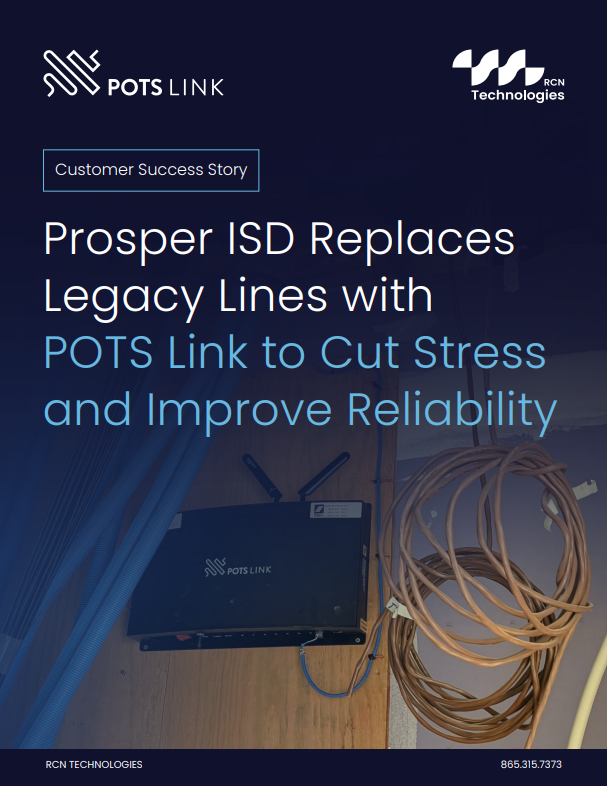
Prosper ISD Replaces Legacy Lines with POTS Link to Cut Stress and Improve Reliability
Details
Location: Prosper ISD, Texas
Deployment: ~30,000 students across 32 campuses
Use Case: Fire alarms, fax, and 9-1-1 backup communications
Previous Provider: Legacy POTS telecom
Challenge: Outages, disconnections, rising costs, unreliable service
Solution Selected: RCN Technologies’ POTS Link (cellular-based replacement)
Are Legacy Phone Lines Creating Risk Across Your School District?
Prosper Independent School District, one of the fastest-growing districts in Texas, relied on traditional POTS lines to support fire alarms, fax systems, and 9-1-1 backup communications across dozens of campuses. But as the district expanded to serve nearly 30,000 students, those legacy lines became increasingly unreliable—triggering outages, accidental mass disconnections, and constant operational stress for IT staff.
What began as a routine telecom dependency quickly turned into a daily reliability concern. Service disruptions created uncertainty around critical safety systems, while troubleshooting legacy infrastructure consumed valuable time and resources that should have been focused on supporting students, staff, and classroom technology.
At the same time, rising costs and limited visibility into line performance made long-term planning difficult. District leaders recognized that continuing to rely on aging copper-based communications introduced unnecessary operational and safety risks—especially as campuses continued to grow and technology demands increased.
Facing mounting pressure to ensure reliability, protect campus safety, and reduce ongoing telecom risk, the district began searching for a modern, more dependable alternative designed specifically for mission-critical school communications.
Advice for Other Schools & Educational Institutions
Schools still relying on legacy POTS lines face growing risks as providers phase out traditional landline services. Many districts unknowingly pay for inactive or unnecessary lines, while aging infrastructure drives unreliable emergency communications, rising costs, and limited campus visibility.
More Case Studies

When the POTS Lines Fail: Three Organizations That Made the Switch to POTS Link
Real case studies from organizations that replaced POTS lines before the deadline — without disruption. See how Wauwatosa School District, Prosper ISD, and KCDC made the switch with RCN’s POTS Link.

How the City of Round Rock Replaced Legacy POTS Lines with a Modern, Cellular-Based Solution
CASE STUDYHow the City of Round Rock Replaced Legacy POTS Lines with a Modern, Cellular-Based SolutionLocation: Round Rock, TexasDeployment: Over 200 POTS lines across 49 city facilitiesUse Case: Emergency communications, community pool emergency lines, municipal...

Annual Holiday Event Connects Hundreds of Boston Older Adults with Safety Training & Free Phone Calls
Strengthening security practicesAnnual Holiday Event Connects Hundreds of Boston Older Adults with Safety Training & Free Phone Calls John Emra President, AT&T Northeast Region February 3, 2026 Key InsightsHundreds of older adults visited Boston City Hall for...