

The NG911 Transition Isn’t Done — And Your POTS Lines Are the Weak Link
Legacy 911 centers still rely on POTS lines that carriers are actively retiring — and without a proactive replacement plan, PSAPs risk losing the very circuits that keep emergency communications alive.
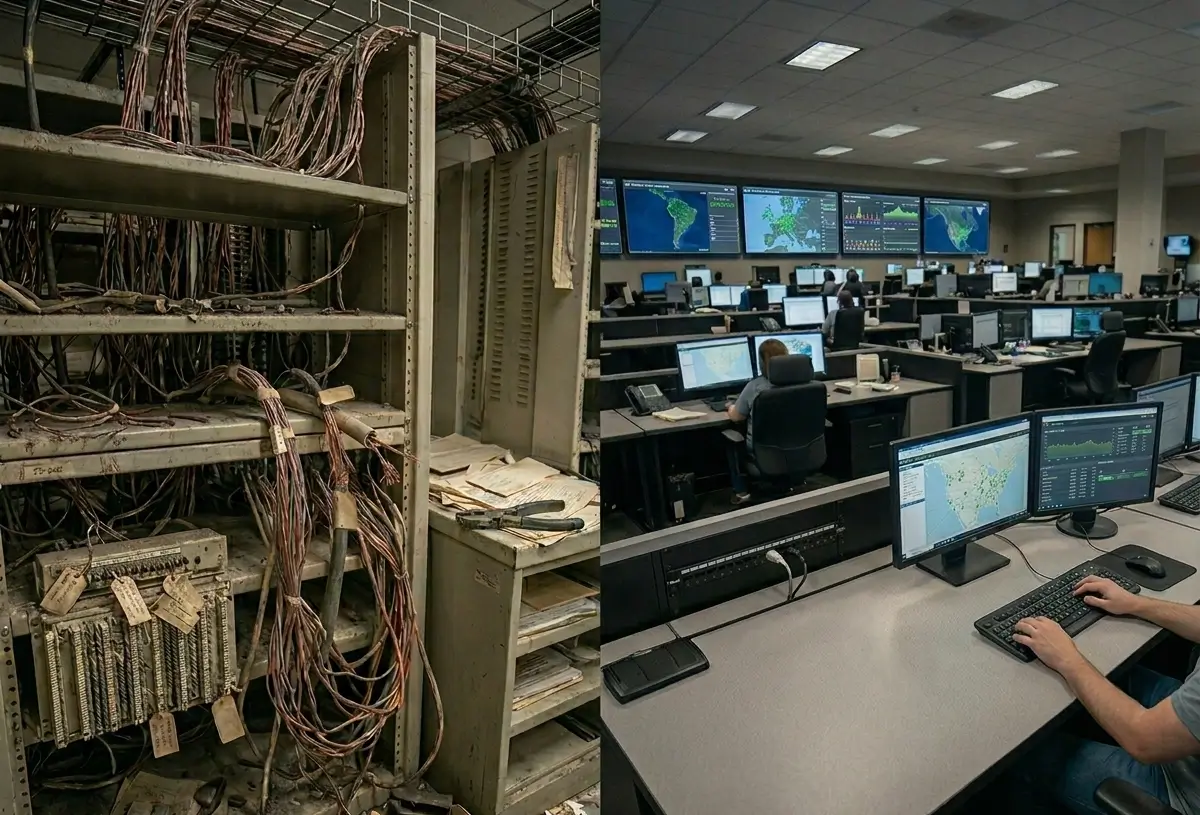
The headline in emergency communications is Next Generation 911. ESInet buildouts, IP-based call routing, GIS-driven location accuracy — the public safety community has invested years and billions of dollars modernizing how emergency calls flow. But beneath that modern stack, a quieter infrastructure crisis is unfolding: the copper phone lines that PSAPs and 911-adjacent systems still depend on are being cut off, one wire center at a time.
If you’re an emergency communications manager, government IT director, or PSAP administrator, this isn’t a future problem. It’s happening now.
Ready to Cut POTS Costs?
Let’s get you a custom quote.
What Is NG911 — And Why It Doesn’t Eliminate POTS (Yet)
Next Generation 911 (NG911) is the nationwide initiative to migrate 911 infrastructure from the legacy public switched telephone network (PSTN) to IP-based Emergency Services IP Networks (ESInets). Under NG911, voice calls, text messages, photos, and video can all be routed to PSAPs over broadband infrastructure — dramatically improving location accuracy and interoperability between jurisdictions.
The federal framework is in place. NENA’s i3 standard defines the architecture. PSAP modernization funding has flowed through FirstNet, FCC grants, and state 911 fee allocations. Progress is real.
But here’s the operational truth: full NG911 deployment is still years away for most jurisdictions. As of 2026, the majority of U.S. PSAPs remain in a hybrid state — running NG911-capable call handling systems on top of infrastructure that still touches POTS at critical points. Backup circuits. ALI/ANI feeds. Administrative lines. Backup-to-backup routing. Interagency tie lines. These aren’t artifacts of neglect — they’re deliberate redundancy, and for many PSAPs, they’re the last line of defense when IP systems fail.
The problem? Those POTS lines are being retired.
Why PSAPs Are Still Deeply Wired to Copper
Modern PSAP call handling platforms — including widely deployed systems like Motorola Solutions’ Viper and Zetron’s Acom (formerly marketed under the Entrado brand) — were engineered to operate in hybrid POTS/IP environments. That was the right design choice for a decade-long transition. But it means these platforms maintain physical analog line interfaces for:
- Backup call routing when ESInet connectivity degrades
- TTY/TDD lines for hearing-impaired callers (a legal obligation under the ADA)
- Administrative POTS lines for non-emergency coordination between agencies
- Logging recorder connections tied to analog loop-start circuits
- PSAP-to-PSAP transfer circuits in jurisdictions that haven’t fully migrated to SIP trunking
- Tower site remote monitoring and dispatch-to-radio-site backhaul on analog circuits
These aren’t legacy oversights. They’re mission-critical connections that 911 center managers deliberately kept in place as reliability backstops.
And now carriers are pulling the copper out from under them.
The Copper Sunset Is Not Waiting for NG911 to Finish
The FCC’s Order 19-72A1, combined with the March 2025 rule change cutting copper retirement notice periods from 180 days to 90 days, has unleashed the most aggressive phase of wireline copper retirement in U.S. history.
AT&T has announced grandfathering plans for 1,711 wire centers across 19 states — meaning existing POTS customers in those areas will receive copper service until AT&T decides otherwise, with only 90 days’ notice before termination. Other carriers are following the same playbook.
For a commercial business, 90 days is inconvenient. For a PSAP, 90 days is an emergency.
The administrative lead time alone for a government procurement action — even under cooperative contracts — can consume weeks. Add system integration testing, vendor coordination for Viper or similar platforms, and FCC-compliant circuit validation, and the window gets dangerously thin.
Several PSAPs across the country have already received copper retirement notices for administrative and backup lines without having a replacement plan in place. The scramble that follows is exactly what emergency communications infrastructure should never experience.
The Compliance Stakes: E911, Kari’s Law, and RAY BAUM’s Act
This isn’t just an operational resilience problem — it’s a regulatory one.
PSAP POTS replacement must meet the full compliance stack:
- Kari’s Law mandates direct 911 dialing (no prefix) and requires notification to a central point when a 911 call is placed from a multi-line telephone system
- RAY BAUM’s Act requires that a “dispatchable location” — floor, suite, building — be transmitted to the PSAP with every 911 call
- GSA EIS Section 5 governs POTS replacement procurement for federally-funded 911 systems and explicitly requires advanced E911 compliance
- NFPA 72 governs fire alarm signaling circuits that are often co-located with PSAP backup lines
Consumer VoLTE services — the “quick fix” some agencies are being pitched — do not meet these standards. They’re built for mobile consumer use, not fixed, address-registered, life-safety signaling. Deploying a generic VoLTE product on a PSAP backup circuit is a compliance liability, not a solution.
How POTS Link Protects PSAPs Through the Transition
RCN Technologies’ POTS Link is a fully managed, LTE/5G-powered replacement for legacy copper analog lines — purpose-built for exactly the use cases 911 centers depend on.
Unlike generic cellular voice adapters, POTS Link is:
Drop-in compatible. No rip-and-replace of existing analog equipment. Viper and Entrado consoles, logging recorders, TTY devices, and alarm panels connect to POTS Link exactly as they connected to the copper circuit — same RJ-11 interface, same signaling behavior.
E911-compliant by design. Each POTS Link unit is provisioned with a validated, static physical address registered to the correct PSAP service area. Kari’s Law notification and RAY BAUM’s Act dispatchable location requirements are built into the platform — not bolted on.
Hardened for mission-critical reliability. POTS Link units include 24+ hours of battery backup for power outage continuity, dual-carrier LTE failover (if one carrier’s signal degrades, the circuit stays live on the backup carrier), and 24/7 monitoring by RCN’s U.S.-based Network Operations Center.
Procurement-ready. POTS Link is available through GSA Schedule, OMNIA Partners, Sourcewell, Equalis Group, and NASPO ValuePoint — cooperative contract vehicles that let PSAPs and county emergency management agencies procure without a full RFP process.
Fast to deploy. RCN’s average deployment is 19 days from signed contract — critical when a copper retirement notice arrives with a 90-day clock.
Field Proven. POTS Link has been successfully deployed to PSAPs and interfaces seamlessly with Viper and Entrado systems.
What 911 Centers Should Do Right Now
The NG911 transition will eventually resolve the copper dependency problem — but “eventually” is not a risk management strategy when carrier retirement notices are landing in county IT inboxes today.
Immediate steps for PSAP administrators and government IT directors:
- Audit every POTS circuit connected to your PSAP or 911-adjacent infrastructure. Include backup lines, TTY circuits, admin lines, and any analog connections to dispatch consoles or logging systems.
- Identify your carrier and wire center. Check whether your serving wire center appears on AT&T’s grandfathered list or has already been flagged for retirement.
- Confirm compliance requirements for any replacement solution — E911, Kari’s Law, RAY BAUM’s Act, and applicable building codes.
- Request a POTS Link assessment from RCN before a retirement notice forces a reactive decision.
The copper sunset is not a future threat to NG911 — it is an active threat to the POTS infrastructure that holds PSAPs together right now. The time to plan is before the 90-day clock starts.
Suggested Resources
☎️ Ready to protect your 911 center from the copper sunset? Talk to a POTS Replacement Specialist or call (865) 293-0350
🏢 About RCN Technologies
RCN Technologies partners with 4,200 businesses & over 1,100 unique government agencies across local, state, education, and federal sectors. We specialize in delivering turnkey wireless connectivity where wired options fall short — and we have the procurement experience to help you find an approved purchasing path fast.

By: Reed Perryman — VP of Sales & Marketing, RCN Technologies
Reed Perryman is VP of Sales & Marketing at RCN Technologies with 10 years of experience in POTS line replacement for government agencies, K–12 school districts, and critical infrastructure. He specializes in POTS replacement strategy, GSA procurement, NFPA 72 compliance, and the FCC copper retirement framework.
Checklists & FAQs
NG911 & POTS Line Readiness Checklist
| NG911 & POTS Line Readiness Checklist | |
|---|---|
| Inventory all POTS lines | Identify every copper line in service — fire alarms, elevator phones, fax, gate systems |
| Confirm FCC copper retirement deadlines | Check your region’s copper retirement notices and sunset timelines from local carriers |
| Assess NG911 compatibility | Verify which lines connect to 911 infrastructure and confirm IP-based handoff requirements |
| Identify single points of failure | Flag lines with no redundancy — especially those tied to life safety systems |
| Request carrier migration timeline | Contact your copper carrier for written confirmation of service end dates |
| Evaluate cellular WAN alternatives | Assess 4G LTE and 5G WWAN coverage at each site for POTS replacement viability |
| Confirm line replacement compliance requirements | Review NFPA 72, local fire marshal rules, and FCC copper retirement framework requirements |
| Engage a managed POTS replacement provider | Request a no-cost POTS line audit from a certified managed service provider |
Frequently Asked Questions
What is the NG911 transition and why does it affect my POTS lines?
NG911 (Next Generation 911) is the nationwide migration from analog copper-based 911 systems to IP-based emergency communications infrastructure. Many legacy POTS lines — including those tied to fire alarms and elevator phones — were designed for the old analog network and must be replaced or upgraded to remain compatible with NG911-capable PSAPs (Public Safety Answering Points).
Has the FCC set a deadline for copper retirement?
The FCC has established a framework allowing carriers to retire legacy copper infrastructure with advance notice. Carriers like AT&T have already begun grandfathering TDM services in many regions. There is no single national cutoff date, but organizations should assume copper service will end within 2–5 years in most markets and plan accordingly.
What happens to fire alarm and elevator lines when copper is retired?
Fire alarm communicators and elevator emergency phones that rely on analog POTS lines will lose dial tone connectivity when copper is retired. This can cause alarm panel trouble conditions, failed central station communications, and potential safety and code violations. Replacement with POTS Link or another managed cellular solution resolves this before service ends.
How does POTS Link ensure NG911 compatibility?
POTS Link by RCN Technologies delivers a dial-tone-equivalent cellular signal over 4G LTE and 5G networks, maintaining compatibility with analog devices while routing over IP-capable carrier networks. This allows fire panels, elevator phones, and other life-safety equipment to operate through the NG911 transition without hardware replacement.
Speak with a POTS Replacement Specialist
ADDITIONAL POTS REPLACEMENT RESOURCES
Use these resources to deepen your understanding of POTS modernization.

POTS Link Risk Assessment
Uncover hidden costs, risks & inefficiencies in your POTS setup with our 3-min, 15-question VLE Score assessment.

Code Compliant Replacement Bible
Discover how to replace POTS lines without violations or downtime. Get code compliance tips for NFPA 72, ASME A17.1, ADA, and more — free guide.

GSA EIS Guide
Many public sector organizations continue to use POTS for life safety, compliance, and facility management functions—but without a migration strategy, thes…
You May Also Be Interested In…

Blue Light Emergency Phone POTS Line Replacement: Extend Your Campus Emergency Call Infrastructure Without Replacing the Hardware
By: Reed Perryman, VP of Sales & Marketing, RCN Technologies Reed Perryman is VP of Sales & Marketing at RCN Technologies with 10 years of experience in POTS line replacement for government agencies, K–12 school districts, and critical infrastructure. He...

What the FCC Copper Retirement Order Actually Says: A Line-by-Line Breakdown for Government POTS Users
By: Reed Perryman, VP of Sales & Marketing, RCN Technologies Reed Perryman is VP of Sales & Marketing at RCN Technologies with 10 years of experience in POTS line replacement for government agencies, K–12 school districts, and critical infrastructure. He...

The FCC Just Made It Easier to Shut Down Your POTS Lines. Here Is What Government Agencies Need to Do Now.
By: Reed Perryman, VP of Sales & Marketing, RCN Technologies Reed Perryman is VP of Sales & Marketing at RCN Technologies with 10 years of experience in POTS line replacement for government agencies, K–12 school districts, and critical infrastructure. He...
Speak with a Connectivity Expert
Fill out the interest form to request that one of our 5G & LTE experts contact you to discuss how we can best support your organization’s connectivity needs.


Ready to Cut POTS Costs?
Let’s get you a custom quote.