

Still Paying for POTS Lines? Here’s Where They’re Hiding on Your Telecom Bill
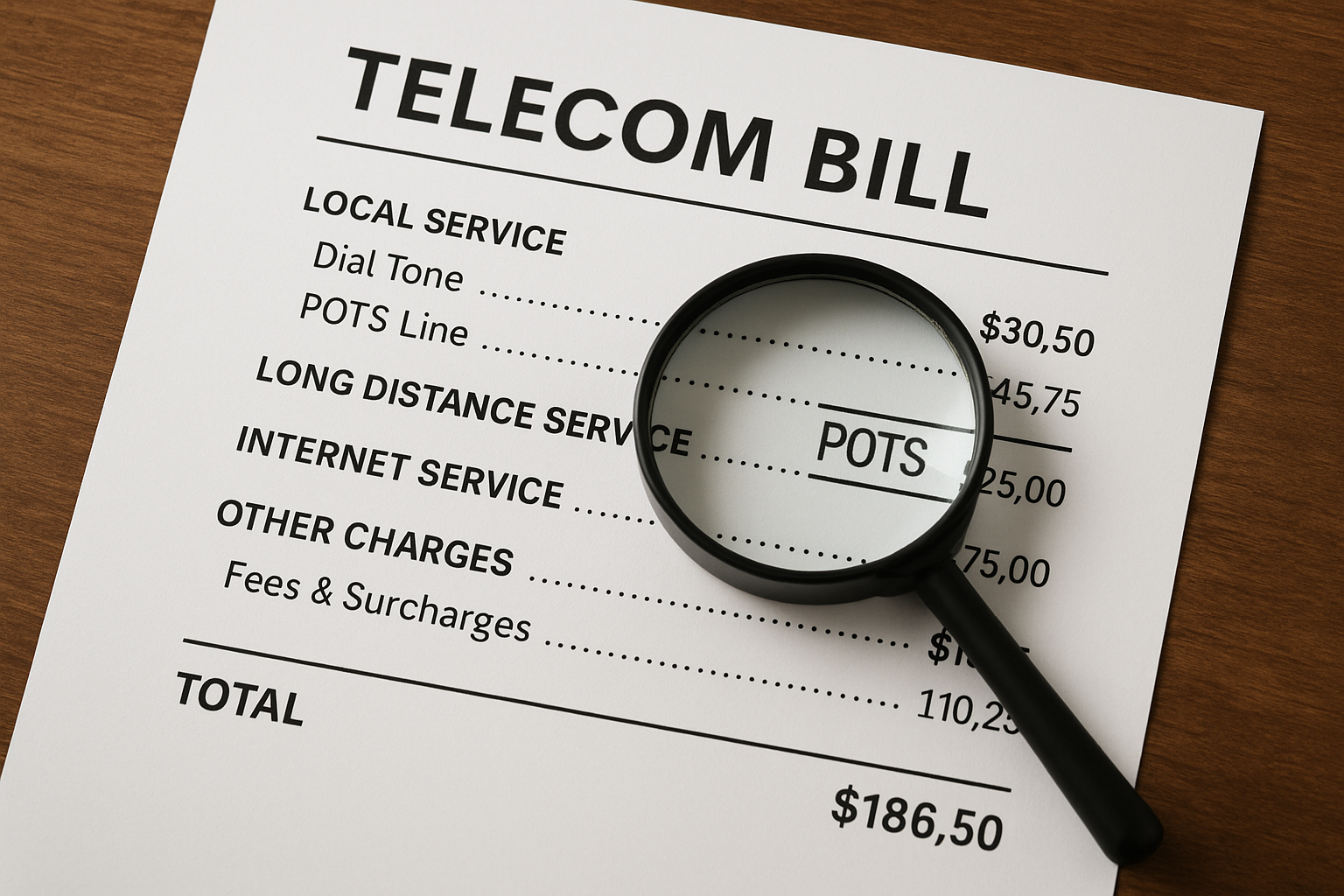
If your organization hasn’t audited its phone bills in the last 6–12 months, chances are you’re still paying for analog POTS lines — whether you realize it or not. With prices for legacy copper lines skyrocketing 400–700% in some regions, the cost of inaction is compounding fast.
Ready to Cut POTS Costs?
Let’s get you a custom quote.
Why You Need to Eliminate POTS Now
The national sunset of POTS lines is no longer a distant concern — it’s already here. The FCC’s 2022 Forbearance Order officially relieved telcos of their obligation to maintain copper-based phone infrastructure. As a result:
- Rates for analog lines have surged — often $70 to $300+ per line per month
- Repair times have increased as copper techs retire and inventory disappears
- New lines are no longer offered, meaning your new facilities are out of luck
- Life-safety code compliance is jeopardized when voice connectivity over analog fails
If your organization relies on fire alarms, elevators, security systems, gate access, fax lines, or blue light emergency phones — it’s time to migrate.
But first, you have to find them.
Where Are Your POTS Lines Hiding?
POTS lines are notoriously difficult to identify. They often appear on telecom invoices with vague, inconsistent, or misleading line items. Here are the most common descriptors to look for:
⚠️ Common Terms for POTS Lines on Telecom Bills
| Billing Term | What It Typically Refers To |
| Analog Line / Analog Voice | Standard copper phone line |
| Centrex Line | Legacy multi-line business phone service over POTS |
| Fire Alarm Line | Dedicated POTS line for alarm panel backhaul |
| Elevator Phone Line | Life-safety phone line in elevator cabs |
| Alarm Circuit / Security Line | POTS for intrusion systems, video systems, or access control |
| Fax Line / Fax DID | Direct inward dial (DID) used for fax over analog |
| Local Line or Business Line | Generic label for basic analog voice |
| 1MB / 1MBPS Circuit | Misleading label often tied to legacy copper data or voice |
| Ground Start Line | Specialty signaling type used in POTS applications |
| Coin Line | Old terminology — often still used for emergency phones |
| Off-Premise Extension (OPX) | Remote analog line extensions to other buildings |
| Line Charge / Voice Line | Non-specific analog voice line billing |
| Voice Grade Line | Technical term for analog voice — often used in enterprise accounts |
| Business Trunk Line | Can refer to analog trunks (vs PRI/SIP) |
| Loop Start Line | Similar to Ground Start — signaling type for analog lines |
| Standalone Voice | Usually an unbundled analog voice service |
| Legacy Voice / Traditional Voice | Indicates old tech — usually copper-based |
| Basic Telephone Service | Catch-all for a single line — often analog |
| Message Rate Service | Metered or usage-based analog billing model |
| Plain Old Telephone Service (POTS) | Occasionally spelled out, but surprisingly rare |
| Legacy Voice / Traditional Voice | Indicates old tech — usually copper-based |
| Basic Telephone Service | Catch-all for a single line — often analog |
| Message Rate Service | Metered or usage-based analog billing model |
| Local Measured Service | Legacy telco term — usage-based billing over analog |
| 1FL or 1FB | 1-Party Flat Business/Line — common code for analog line in AT&T/Verizon billing |
| Individual Line | Telecom-speak for a non-PBX analog line |
| Wire Center Line | Refers to connection directly from central office — likely POTS |
| Circuit ID / Special Circuit | POTS lines are sometimes listed as “circuits” with obscure IDs |
| Emergency Line | Generic label — often POTS for fire, elevator, or security |
| Direct Line / Dedicated Line | Non-IP, dedicated analog connection for a device |
| Rotary Line / Rotary Hunt Group | Outdated multi-line analog setup — still billed in some municipalities |
| DID Trunk (non-IP) | Direct Inward Dialing trunk using POTS (not SIP) |
| Facility Access Charge (FAC) | Often tied to physical copper line maintenance — red flag for analog |
| Analog Access | Straightforward term, rarely used today but appears on older accounts |
✅ What to Do Next
- Run a full line audit. Start by pulling the last 1–2 months of your telecom bills.
- Identify suspicious line items using the terms above.
- Validate physical use. If a line is still powering critical life-safety infrastructure, you can’t just disconnect it — you’ll need a compliant replacement.
Need Help Finding or Replacing POTS?
RCN’s POTS Link service is a fully managed, code-compliant POTS replacement designed for elevators, fire panels, security systems, and more. We’ve helped hundreds of organizations eliminate POTS lines safely and securely.
✅ NFPA 72 / ASME A17.1 Compliant
✅ Managed LTE with 24-hour battery backup
✅ Dual-path failover and e911 support
✅ GSA and state contract purchasing available
🔍 Free Bill Review: We’ll Find the POTS You’re Missing
Send us your last 2 months of telecom bills, and our team will identify hidden analog lines and give you a migration plan — no obligation.
🏢 About RCN Technologies
RCN Technologies partners with over 1,100 unique government agencies across local, state, education, and federal sectors. We specialize in delivering turnkey wireless connectivity where wired options fall short — and we have the public sector procurement experience to help you find an approved purchasing path fast.

By: Reed Perryman — VP of Sales & Marketing, RCN Technologies
Reed Perryman is VP of Sales & Marketing at RCN Technologies with 10 years of experience in POTS line replacement for government agencies, K–12 school districts, and critical infrastructure. He specializes in POTS replacement strategy, GSA procurement, NFPA 72 compliance, and the FCC copper retirement framework.
Checklists & FAQs
Telecom Bill Audit Checklist for POTS Lines
| Checklist Item | Status |
|---|---|
| Collect 3–12 months of carrier invoices for all POTS lines | ✅ |
| List every billed line number and associated monthly charge | ✅ |
| Identify lines with no corresponding internal record or physical device | ✅ |
| Flag recurring surcharges, taxes, and fees that may be incorrectly applied | ✅ |
| Request itemized usage reports for all billed lines from your carrier | ✅ |
| Compare billed rates against your original service agreement or contract | ✅ |
| Identify lines still under contract that are past their term and eligible for disconnect | ✅ |
| Summarize total monthly POTS spend and projected savings from cleanup | ✅ |
Frequently Asked Questions: Telecom Bill Audits & POTS Lines
Why are unused POTS lines so hard to spot on a telecom bill?
Carrier invoices for large organizations can contain hundreds of line items with cryptic identifiers and bundled charges. Unused lines are billed identically to active ones, making them invisible without a deliberate audit process that cross-references billing data against actual device records.
What should I look for first when auditing my POTS telecom bill?
Start with lines that have no associated extension, location, or device in your internal records. Then pull usage reports—any line with zero call activity for 60+ days is a strong candidate for disconnection. Also review for duplicate charges, expired promotional rates, and lines still billed under contracts that have lapsed.
How long does a POTS line audit typically take?
For a small organization with under 50 lines, a focused audit can be completed in a few days. Larger organizations with hundreds of billed lines may need 2–4 weeks to fully reconcile billing records against physical inventory. RCN Technologies can assist with this process as part of a POTS replacement engagement.
What happens after I identify unused lines on my telecom bill?
Contact your carrier in writing to request disconnection and stop billing on identified unused lines. Document the request and confirmation number. For lines under contract, negotiate an early termination or wait for contract expiry. The savings recovered often offset the cost of transitioning remaining lines to POTS Link.
Speak with a POTS Replacement Specialist
ADDITIONAL POTS REPLACEMENT RESOURCES
Use these resources to deepen your understanding of POTS modernization.

POTS Link Risk Assessment
Uncover hidden costs, risks & inefficiencies in your POTS setup with our 3-min, 15-question VLE Score assessment.

Code Compliant Replacement Bible
Discover how to replace POTS lines without violations or downtime. Get code compliance tips for NFPA 72, ASME A17.1, ADA, and more — free guide.

GSA EIS Guide
Many public sector organizations continue to use POTS for life safety, compliance, and facility management functions—but without a migration strategy, thes…
You May Also Be Interested In…

What the FCC Copper Retirement Order Actually Says: A Line-by-Line Breakdown for Government POTS Users
By: Reed Perryman, VP of Sales & Marketing, RCN Technologies Reed Perryman is VP of Sales & Marketing at RCN Technologies with 10 years of experience in POTS line replacement for government agencies, K–12 school districts, and critical infrastructure. He...

The FCC Just Made It Easier to Shut Down Your POTS Lines. Here Is What Government Agencies Need to Do Now.
By: Reed Perryman, VP of Sales & Marketing, RCN Technologies Reed Perryman is VP of Sales & Marketing at RCN Technologies with 10 years of experience in POTS line replacement for government agencies, K–12 school districts, and critical infrastructure. He...

T-Minus 6 Days: What the FCC’s March 26 Vote on Section 214 Means for Every Organization Still on POTS Lines
By: Reed Perryman, VP of Sales & Marketing, RCN Technologies Reed Perryman is VP of Sales & Marketing at RCN Technologies with 10 years of experience in POTS line replacement for government agencies, K–12 school districts, and critical infrastructure. He...