
POTS Link vs. Granite EPIK: Which POTS Replacement Is Right for You?
A side-by-side look at softswitch architecture, connectivity model, SIM redundancy, line density, compliance, and government contract vehicles, so you can match the right product to your facilities.
If you’re evaluating enterprise POTS replacements, Granite EPIK is likely on your shortlist, and if your organization is already a Granite Telecommunications customer, it may be presented as the obvious default. Granite is a $1.8 billion carrier managing 1.75 million lines across more than 650,000 locations, including customers at two-thirds of the Fortune 100. EPIK is a mature, enterprise-grade product backed by serious infrastructure. This page is not written to dismiss it.
What it is written to do is examine the architectural decisions that define each product, because those decisions determine where each solution works well and where it has hard constraints. Both POTS Link and Granite EPIK are built on Class 5 softswitch platforms. Both are NFPA 72 compliant. The parity is real. But the connectivity model beneath that voice engine is fundamentall different and for buyers with remote facilities, RF-severe environments, or multi-line deployments, that difference is the decision.
What is Granite EPIK?
Granite EPIK is a Managed Facilities-based Voice Network (MFVN) POTS replacement product built on a Class 5 softswitch that fully emulates a Central Office. It combines Ethernet, FXS, and 4G LTE in a single appliance, allowing analog devices to interface directly with the PSTN. EPIK supports fire alarm panels, elevator phones, SCADA systems, blue light boxes, fax, and the full range of legacy analog applications. It is listed and approved by the California State Fire Marshal as an MFVN device, and in Q1 2025 Granite published FCC Adequate Replacement Test results across more than 2.5 million observed calls, demonstrating performance exceeding FCC benchmarks for TDM replacement.
Granite’s marketing describes EPIK as providing “4G LTE connectivity and cellular backup if primary internet access is unavailable,” positioning LTE as the backup path. Granite’s own cooperative contract documentation includes a footnote noting that wireline connections “may be necessary to furnish service at some locations” and that some jurisdictions require wireline for Fire/Life Safety applications. The product supports up to 8 analog lines per device, with stacking supported for higher-density deployments. It is available on OMNIA Partners cooperative contract, and Granite’s NOC provides 24/7 out-of-band monitoring.
What is POTS Link?
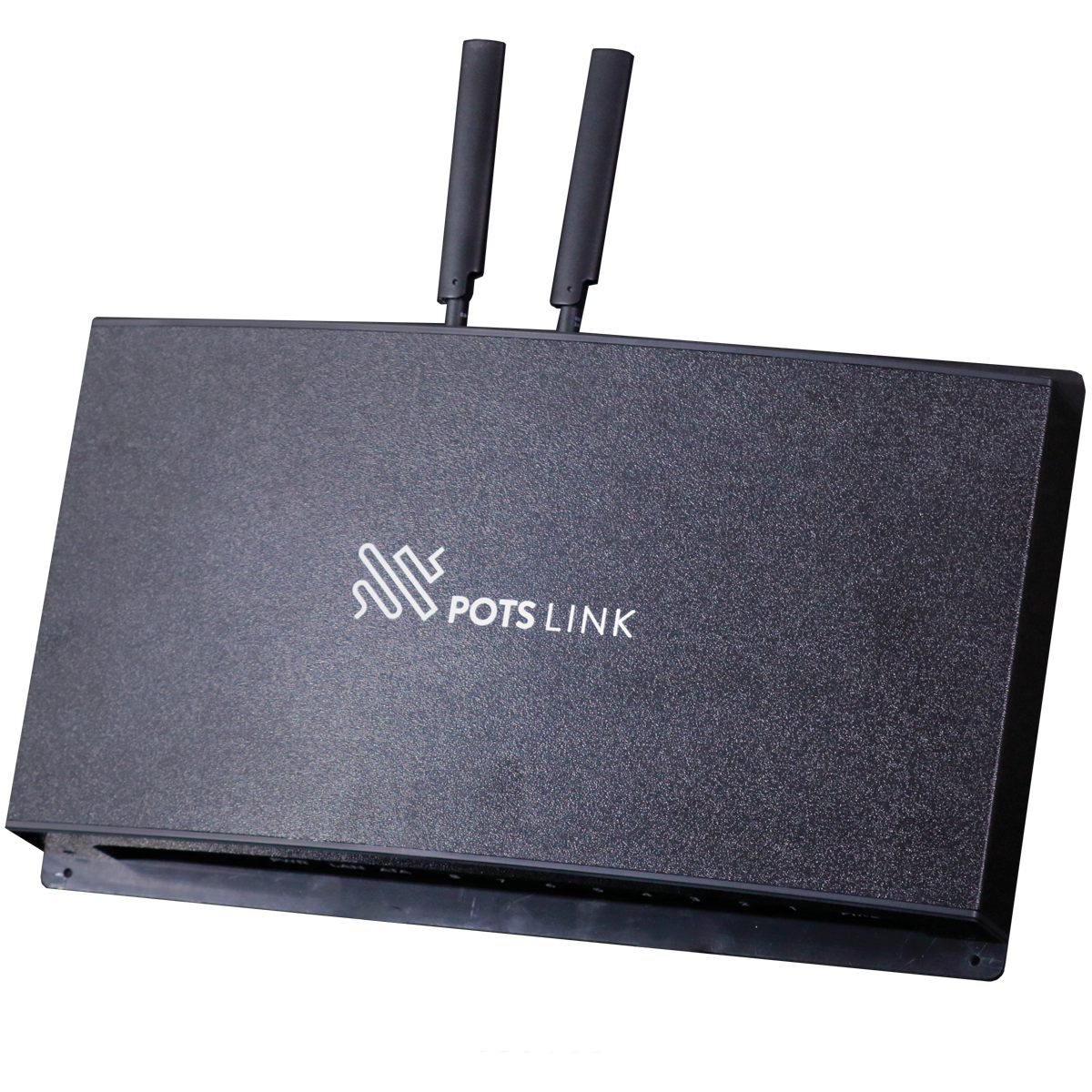
POTS Link is RCN Technologies’ fully managed cellular POTS replacement service. Like EPIK, it is built on a Class 5 softswitch platform. Unlike EPIK, POTS Link is wireless-first by design. Cellular is the primary connectivity path. Wired Ethernet is an available layer in the SD-WAN mix when present at a location, but it is never a prerequisite for deployment or operation.
RCN is an Ericsson Technical Excellence Partner and a Cradlepoint-certified integrator with over 13 years of experience deploying wireless WAN solutions in enterprise, government, and public safety environments. That wireless WAN pedigree, not a wired VoIP background with cellular bolted on, is the technical foundation POTS Link is built on. RCN also holds direct government contract vehicles across GSA Schedule, OMNIA Partners, Sourcewell, NASPO ValuePoint, and state contracts for Georgia, New York, and Pennsylvania.
How POTS Link and Granite EPIK Compare
Softswitch Architecture: Where the Products Start from the Same Place
This is important to state clearly, because most comparisons in this space skip it. Both POTS Link and Granite EPIK are built on Class 5 softswitch architecture that fully emulates a Central Office. Both deliver the TDM-quality signal fidelity required for fire alarm panels, elevator circuits, SCADA systems, high-volume fax, and other legacy analog applications that fail on standard SIP or VoIP solutions. Both support advanced voice features including hunt groups, ringdown, call forwarding, and voicemail, delivered through the same Class 5 mechanism. POTS Link provides these through RCN’s hosted PBX service, which runs on the same softswitch platform. On the voice engine and feature set, these products are architectural peers.
The divergence is entirely in how the call gets to that switch, and that is where the deployment-critical differences begin.
Network Architecture and Connectivity Model
Granite EPIK’s connectivity architecture treats wired internet as the primary path for service delivery. Granite’s own marketing describes LTE as “cellular backup if primary internet access is unavailable.” Granite’s cooperative contract documentation includes a footnote explicitly stating that “wireline connections may be necessary to furnish service at some locations” and that some jurisdictions require wireline specifically for Fire/Life Safety applications. For broadband-rich enterprise facilities, this architecture is workable. For locations without reliable wired internet, including remote government sites, rural facilities, temporary deployments, or any site where broadband infrastructure is absent or unreliable, buyers should verify serviceability directly with Granite before committing.
POTS Link is built on a wireless-first, dual-SIM architecture. SIM slot 2 is always occupied by RCN’s multi-carrier SIM: a single physical SIM with tri-carrier redundancy that dynamically routes to the strongest available carrier at the network core across AT&T, Verizon, and T-Mobile. SIM slot 1 gives the customer a choice: bring your own preferred single-carrier SIM, or let RCN deploy the site’s strongest available carrier based on the RF environment at that specific location. SD-WAN technology selects the optimal path across both SIM slots in real time, without manual intervention. A customer’s wired Ethernet WAN can also be incorporated into the path mix when available, providing an additional layer of connectivity, but it is never required.
Critically, POTS Link is compatible with all three major public safety and priority networks: FirstNet-compatible via AT&T, Verizon Frontline-compatible, and T-Mobile’s public safety network-compatible, providing priority access to network resources during declared emergencies. For government facilities, public safety campuses, and any site where a fire alarm or emergency phone must work precisely when surrounding infrastructure is most stressed, that priority access is not a footnote.
RCN’s 13 years of wireless WAN deployment experience, built through Ericsson and Cradlepoint partnerships across RF-severe environments, is what makes this architecture reliable in practice, not just on paper. Granite is a carrier that built a POTS replacement product. RCN is a wireless WAN integrator whose engineers start with cellular as the primary path and design around it.
Line Density
Granite EPIK supports up to 8 analog lines per device. For facilities requiring more than 8 lines, EPIK requires stacking multiple units or adding ATAs, each of which introduces additional hardware, cost, and failure points per location.
POTS Link supports 8 lines natively per service gateway, with extended architecture supporting 24 to 32 lines per rack-mount unit. For multi-device facilities such as government campuses, commercial buildings, and healthcare facilities with elevator phones, fire panels, access control, and SCADA systems, this density difference has direct cost and logistics implications. Count your lines per location before committing to a deployment architecture.
Battery Backup
Both POTS Link and Granite EPIK provide 24 hours of battery backup, meeting the NFPA 72 requirement for fire alarm communicators. Neither product requires an add-on to meet the NFPA 72 threshold.
Compliance Certifications
POTS Link is built and tested against the applicable standards governing the devices it serves: NFPA 72 (fire alarm communications), ASME A17.1 (elevator emergency communications), and applicable UL listing standards for life-safety signaling equipment.
Granite EPIK is NFPA 72 compliant and MFVN-qualified, and Granite’s documentation confirms it is approved for Life Safety applications including elevators and alarm systems. However, Granite’s published documentation does not cite ASME A17.1 or specific UL Standards by name or number. Buyers with formal compliance review requirements, particularly those subject to AHJ or insurance audits that require specific standard citations, should request Granite’s full certification documentation directly before committing.
Additionally, POTS Link is compliant with Federal Enhanced E911 requirements, Kari’s Law, and the RAY BAUM’S Act. Kari’s Law requires that multi-line telephone systems permit direct 911 dialing without a prefix. The RAY BAUM’S Act requires that 911 calls include dispatchable location data, ensuring emergency responders can identify not just the building, but the floor or room a call originated from. For any facility operating a multi-line system, which describes virtually every POTS replacement deployment, these are federal legal requirements. Granite EPIK’s public documentation does not address Kari’s Law or RAY BAUM’S Act compliance. Buyers should request written confirmation from any vendor before committing to a multi-line facility deployment.
Installation Model
Granite EPIK offers optional white-glove managed deployment nationwide, with devices typically deliverable within 30 days. The product can also be self-installed.
POTS Link’s standard installation model is fully managed professional deployment. Self-installation is available for non-standard cases, but only with approval from an RCN POTS specialist. For life-safety infrastructure, including fire alarms, elevator phones, and access control, most buyers place significant value on a managed installation model where the service provider owns the outcome, not just the product.
Government and Cooperative Contract Access
Granite EPIK is available to public sector buyers through OMNIA Partners cooperative contract.
POTS Link carries a broader set of direct contract vehicles: GSA Schedule, OMNIA Partners, Sourcewell, NASPO ValuePoint, State of Georgia, State of New York, and State of Pennsylvania. RCN holds these contracts directly. Procurement is not intermediated through a third-party aggregator. For agencies with existing GSA or Sourcewell relationships, or those in GA, NY, or PA, POTS Link can be placed without involving a separate channel partner.
Comparison at a Glance
Side-by-side, on the eight decisions that actually shape deployment outcomes.
| Granite EPIK | POTS Link | |
|---|---|---|
| Softswitch platform | Class 5, Central Office emulation (MFVN) | Class 5, Central Office emulation |
| Primary connectivity | Wired internet as primary path; LTE as cellular backup. Wireline "may be necessary" at some locations per Granite's own contract documentation. | Wireless-first; cellular primary, no broadband required. |
| Wired Ethernet | Serves as primary connection path | Optional third path in SD-WAN mix |
| SIM architecture | Optional dual-SIM on LTE backup path | Dual-SIM: RCN multi-carrier SIM (SIM 2) plus customer or RCN-selected carrier (SIM 1) |
| Carrier redundancy | Single ISP primary; optional dual-SIM on LTE failover | Tri-carrier (AT&T, Verizon, T-Mobile), SD-WAN managed |
| SD-WAN path selection | Intelligent failover (broadband to LTE) | Real-time path selection across all active connections |
| Public safety networks | Not documented | FirstNet-compatible, Verizon Frontline-compatible, T-Mobile public safety network-compatible |
| Lines per device | Up to 8; stacking required above 8 | 8 native; 24 to 32 extended |
| Battery backup | 24-hour battery backup | 24-hour native, NFPA 72 aligned |
| Hardware cost | Included in monthly subscription | Included in monthly service |
| Installation | Managed deployment available; self-install available | Fully managed professional standard; self-install by specialist approval only |
| Service model | EPIK portal plus Granite NOC monitoring | RCN fully managed |
| NFPA 72 | Compliant (MFVN-qualified) | Compliant |
| ASME A17.1 / UL Standards | Elevator and life safety device approval claimed; ASME A17.1 and UL Standards not cited by name in published documentation | Compliant, cited by standard name and number |
| E911 / Kari's Law / RAY BAUM'S Act | Not addressed in public documentation | Compliant |
| Gov contract vehicles | OMNIA Partners | GSA, OMNIA, Sourcewell, NASPO, State of GA, NY, PA (direct) |
| Provider background | $1.8B carrier; broadband and voice services | Wireless WAN integrator; 13 years RF and cellular deployment experience |
Which Solution Fits Which Buyer?
Granite EPIK is a reasonable fit if:
Your organization is already a Granite customer and broadband consolidation on a single invoice is a priority. All of your locations have reliable wired internet infrastructure. And you need fewer than 8 lines per location, or are comfortable with device stacking for higher-density sites.
POTS Link is the stronger fit if:
Any of your locations lack reliable wired broadband, or you need a solution that can deploy independently of customer-provided internet. You require tri-carrier wireless redundancy with SD-WAN path optimization and real-time failover. You operate on or need priority access to FirstNet-compatible, Verizon Frontline-compatible, or T-Mobile public safety networks. You're managing more than 8 lines per location, or need to avoid the cost and complexity of device stacking. You need documented compliance with ASME A17.1, UL Standards, Kari's Law, and the RAY BAUM'S Act. You need a managed service partner with professional installation and ongoing line ownership. Or your procurement runs through GSA, Sourcewell, or a state contract in GA, NY, or PA.
Frequently Asked Questions
Get answers to some of the most common questions about the Pop-Up Network Kit
What is a Granite EPIK alternative for government agencies?
POTS Link by RCN Technologies is a fully managed cellular POTS replacement available directly on GSA Schedule, OMNIA Partners, Sourcewell, and NASPO ValuePoint, with state contract coverage in Georgia, New York, and Pennsylvania. It operates on a wireless-first, tri-carrier architecture compatible with FirstNet, Verizon Frontline, and T-Mobile public safety networks, and does not require wired broadband at deployment locations.
Does Granite EPIK require a wired internet connection?
Granite’s own marketing describes LTE as “cellular backup if primary internet access is unavailable,” positioning wired internet as the primary path. Granite’s cooperative contract documentation goes further, noting that “wireline connections may be necessary to furnish service at some locations” and that some jurisdictions require wireline connections specifically for Fire/Life Safety applications. Organizations evaluating EPIK should verify serviceability, and the specific connectivity requirements, at every deployment location before committing, particularly at sites without reliable broadband. POTS Link does not require broadband at any location.
Do both POTS Link and Granite EPIK use a Class 5 softswitch?
Yes. Both products are built on Class 5 softswitch architecture that fully emulates a Central Office, supporting fire alarm panels, elevator circuits, SCADA, fax, and the full range of legacy analog applications. The architectural parity stops at the voice engine. POTS Link delivers that performance over a wireless-native, cellular-primary network. Granite EPIK delivers it over a broadband-primary connection with LTE as backup. The delivery model is the differentiator.
Is POTS Link compliant with Kari's Law and the RAY BAUM'S Act?
Yes. POTS Link is compliant with Federal Enhanced E911 requirements, Kari’s Law, and the RAY BAUM’S Act. Granite EPIK’s public documentation does not address these compliance requirements. Buyers should request written compliance documentation from any POTS replacement vendor before committing to a multi-line facility deployment.
What is tri-carrier redundancy in a POTS replacement?
POTS Link uses a dual-SIM architecture. SIM slot 2 always carries RCN’s multi-carrier SIM, a single physical SIM that dynamically routes across AT&T, Verizon, and T-Mobile at the network core based on signal strength and availability. SIM slot 1 gives the customer a choice: use their own preferred carrier, or have RCN deploy the strongest available carrier for that specific site. SD-WAN technology manages path selection across both slots in real time. Granite EPIK uses broadband as its primary connection, with optional dual-SIM on the LTE failover path.
How many lines does Granite EPIK support per device?
Granite EPIK supports up to 8 analog lines per device. Deployments requiring more lines must stack multiple EPIK units or add ATAs. POTS Link supports 8 lines per gateway natively and up to 24 to 32 lines per rack-mount unit in extended configurations.
What fire, elevator, and life safety standards does POTS Link meet?
POTS Link is certified against NFPA 72 (National Fire Alarm and Signaling Code), ASME A17.1 (Safety Code for Elevators and Escalators), and applicable UL Standards, cited by standard name and number. Granite EPIK is NFPA 72 compliant and MFVN-qualified, and claims elevator and life safety device approval in its documentation. However, Granite’s published materials do not cite ASME A17.1 or UL Standards by name. Buyers with AHJ compliance reviews or insurance audit requirements that specify standard citations should request Granite’s full certification package before committing.
Why does wireless WAN experience matter for POTS replacement?
Most POTS replacement solutions come from a wired VoIP background, treating cellular as a failover layer added to a fundamentally broadband architecture. POTS Link is built by a team with 13 years of wireless WAN deployment experience in RF-severe environments, complex sites where signal variability, building attenuation, and carrier coverage gaps are real operational conditions. Granite EPIK addresses this by requiring broadband as the primary path and using LTE as backup. POTS Link addresses it by engineering cellular to be the primary path and knowing how to make it work where broadband doesn’t reach.
Request a POTS Link Assessment
RCN Technologies provides no-cost POTS line assessments for government agencies, enterprise facilities, and nonprofits evaluating POTS replacement options.
Call RCN directly: 865-315-7373
Speak with a Connectivity Expert
Fill out the interest form to request that one of our 5G & LTE experts contact you to discuss how we can best support your organization’s connectivity needs.