

How POTS Replacement with POTS Link Works: A Plain-English Technical Explainer for Non-Technical Buyers
If you’ve received a notice from AT&T, Lumen, Verizon, Frontier or another carrier that your copper phone lines are being discontinued — you’re not alone. Tens of thousands of government agencies, school districts, hospitals, and businesses across the country are facing the same deadline. And most of the people responsible for fixing it aren’t network engineers. They’re procurement officers, facilities directors, city administrators, and executives who just need to know: what actually replaces a POTS line, and how does it work?
This article answers that question without the technical jargon.
Ready to Cut POTS Costs?
Let’s get you a custom quote.
What Is a POTS Line — and Why Is It Going Away?
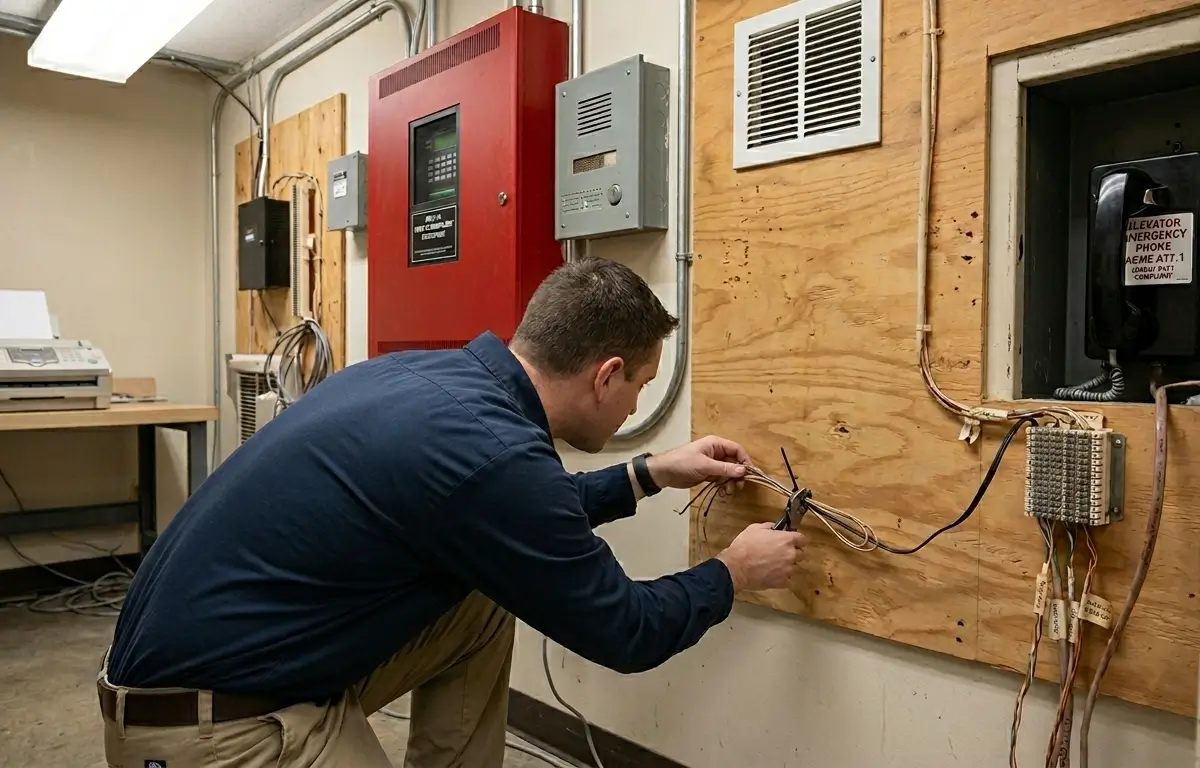
POTS stands for Plain Old Telephone Service. It’s the copper wire phone infrastructure that has connected buildings to the public telephone network for over a century. Your elevator emergency phone, fire alarm panel, building entry system, and fax machine all likely run on POTS lines.
Carriers are retiring copper infrastructure because maintaining aging physical networks is expensive and economically unsustainable. The FCC has allowed this transition, and carriers are actively issuing end-of-service notices. When a copper line is cut off, everything connected to it stops working — including life-safety systems like fire panels and elevator phones.
The bottom line: POTS lines aren’t being upgraded — they’re being eliminated. Every organization that has them needs a replacement plan.
How Does POTS Line Replacement Work?
Here’s the part most vendors overcomplicate. The answer is straightforward.
A POTS replacement device like our POTS Link Service gateway uses an ATA (Analog Telephone Adapter), and plugs directly into your existing analog equipment and connects to a cellular LTE or 5G network to deliver a working phone line.
That’s it. Your building’s phones, fire alarm panel, elevator emergency phone, and fax machine don’t change. The ATA acts as a translator between your old analog equipment and modern cellular networks. From the perspective of every device in your building, nothing has changed. They still get a dial tone. They still make and receive calls. They still do their jobs.
Step-by-Step: What POTS Line Replacement Looks Like
- Assessment — A specialist audits your existing POTS lines, identifies what equipment is connected to each line, and maps out replacement requirements.
- Device provisioning — A POTS Link service gateway is configured and matched to each line being replaced. No new wiring. No new phones. No new panels.
- On-site installation — A technician plugs the POTS Link service gateway into your existing analog port. The cellular connection is established upon boot up.
- Testing and verification — Each line is tested to confirm it functions correctly, including any life-safety systems.
- Go-live — The old carrier line is cancelled. Your systems continue operating normally.
With RCN Technologies’ POTS Link solution, this entire process averages 19 days from order to activation — including scheduling, shipping, and installation.
What Equipment Does POTS Link Work With?
This is the question that matters most to facilities managers and procurement officers: do we have to replace our existing equipment?
No. POTS Link is a drop-in replacement. The service gateway is designed to work with:
- Fire alarm panels — compliant with NFPA 72, the National Fire Alarm and Signaling Code, which governs how fire systems communicate
- Elevator emergency phones — compliant with ASME A17.1, the Safety Code for Elevators and Escalators, which requires two-way communication in elevator cabs
- Building entry systems and intercoms
- Fax machines
- Traditional desk phones and analog PBX systems
- Security and access control systems
If it currently runs on a copper POTS line, POTS Link can replace it — without touching the device itself.
How Does the Cellular Connection Work?
POTS Link can use your building’s internet connection, but the native connection relies on a built in cellular modem — similar to how a cell phone connects to the network, except it’s purpose-built for voice reliability.
POTS Link uses multi-carrier LTE/5G with automatic failover. That means the device isn’t locked to a single carrier. If one cellular network experiences an outage or weak signal in your area, the device automatically switches to another carrier — without interruption, and without anyone on your staff doing anything.
This matters for life-safety systems. An elevator emergency phone or fire alarm communicator can’t afford to go offline because one carrier has a tower issue. Multi-carrier failover is the protection against that scenario.
For customers that prefer to use their preferred carrier accounts, POTS Link can handle to SIM connections concurrently.
Is Cellular as Reliable as Copper?
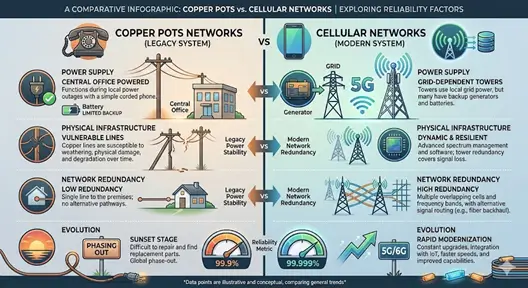
Modern cellular networks are highly redundant and have, in many regions, surpassed copper in reliability. LTE and 5G networks have geographic redundancy built in — multiple towers covering overlapping areas — whereas copper depends on a single physical line that can be cut, corroded, or simply retired.
Who Manages the System After Installation?
This is where many POTS replacement solutions fall short. They hand you a device and walk away. That leaves your IT team (or your lack of one) responsible for monitoring, troubleshooting, and managing the cellular connection.
POTS Link is a fully managed service. RCN Technologies operates a 24/7 U.S.-based Network Operations Center (NOC) that proactively monitors every deployed device. If a line goes offline or degrades, the NOC identifies it — often before you do — and initiates resolution.
For lean IT teams, small municipalities, school districts, and county agencies that don’t have dedicated telecom staff, this is the critical differentiator. You’re not buying a box. You’re buying a service with humans watching it around the clock.
Is POTS Link Available Through Government Contracts?
Yes — and this matters significantly for government buyers, school districts, and publicly funded organizations. Procurement through a cooperative contract eliminates the need for a full competitive bid process, saving months of procurement time.
POTS Link is available on the following cooperative and government contracts:
- GSA Multiple Award Schedule (compliant with GSA EIS Sections 5 and 6)
- NASPO ValuePoint
- Sourcewell
- OMNIA Partners
- Equalis Group
- COSTARS (Pennsylvania)
- Georgia Statewide Contract
- New York OGS
If your organization is required to purchase through a competitive contract vehicle, POTS Link is almost certainly already on it.
What Does Compliance Look Like for Life-Safety Systems?
Life-safety systems aren’t optional equipment — they’re legally mandated. Before replacing a POTS line connected to a fire panel or elevator phone, stakeholders need to know the replacement solution is compliant with applicable codes.
POTS Link is designed and tested for compliance with:
- NFPA 72 — The National Fire Alarm and Signaling Code specifies performance requirements for fire alarm communicators. POTS Link meets these requirements, ensuring fire panels can transmit alarm signals to monitoring centers.
- ASME A17.1 — The Safety Code for Elevators and Escalators requires a two-way voice communication system in elevator cabs. POTS Link supports this requirement without modification to the elevator system itself.
- GSA EIS Sections 5 and 6 — The General Services Administration’s Enterprise Infrastructure Solutions contract framework governs telecommunications services for federal agencies. POTS Link’s capabilities and architecture compliance aligns with these sections.
Before any installation on a life-safety circuit, RCN Technologies conducts system-specific testing to verify compliant operation. This is not a generic out-of-the-box deployment — it’s a verified, documented replacement.
How Much Does POTS Line Replacement Cost?
POTS line replacement with POTS Link is billed as a monthly recurring charge (MRC) per line — similar to how you currently pay your carrier for each POTS line. The difference is that the per-line cost of cellular replacement is typically lower than what carriers are charging for legacy copper, particularly as carriers raise rates ahead of line retirements to accelerate the transition.
Pricing varies based on line count, location, and contract vehicle. Organizations procuring through cooperative contracts often receive pre-negotiated pricing that further reduces cost.
Summary: What Replaces a POTS Line?
| Question | Answer |
| What replaces a POTS line? | An ATA (Analog Telephone Adapter) connected to a WAN source; POTS Link uses cellular |
| Does existing equipment need to change? | No — the service gateway plugs directly into existing analog devices |
| Is it compliant with fire and elevator codes? | Yes — NFPA 72 and ASME A17.1 compliant |
| How long does installation take? | Average 19 days from contract with POTS Link |
| Is it available on government contracts? | Yes — GSA, NASPO ValuePoint, Sourcewell, OMNIA, and more |
| Who manages the system? | RCN Technologies’ 24/7 U.S.-based NOC |
Ready to Replace Your POTS Lines?
The copper shutdown isn’t slowing down. Every month you wait is a month closer to a carrier termination notice — and a potential life-safety compliance gap.
Ready to replace your POTS lines? Talk to a POTS Replacement Specialist at RCN Technologies. Call (865) 293-0350 or visit rcntechnologies.com.
🏢 About RCN Technologies
RCN Technologies partners with 4,200 businesses & over 1,100 unique government agencies across local, state, education, and federal sectors. We specialize in delivering turnkey wireless connectivity where wired options fall short — and we have the procurement experience to help you find an approved purchasing path fast.
ADDITIONAL POTS REPLACEMENT RESOURCES
Use these resources to deepen your understanding of POTS modernization.

POTS Link Risk Assessment
Uncover hidden costs, risks & inefficiencies in your POTS setup with our 3-min, 15-question VLE Score assessment.

Code Compliant Replacement Bible
Discover how to replace POTS lines without violations or downtime. Get code compliance tips for NFPA 72, ASME A17.1, ADA, and more — free guide.

GSA EIS Guide
Many public sector organizations continue to use POTS for life safety, compliance, and facility management functions—but without a migration strategy, thes…
You May Also Be Interested In…

What the FCC Copper Retirement Order Actually Says: A Line-by-Line Breakdown for Government POTS Users
By: Reed Perryman, VP of Sales & Marketing, RCN Technologies Reed Perryman is VP of Sales & Marketing at RCN Technologies with 10 years of experience in POTS line replacement for government agencies, K–12 school districts, and critical infrastructure. He...

The FCC Just Made It Easier to Shut Down Your POTS Lines. Here Is What Government Agencies Need to Do Now.
By: Reed Perryman, VP of Sales & Marketing, RCN Technologies Reed Perryman is VP of Sales & Marketing at RCN Technologies with 10 years of experience in POTS line replacement for government agencies, K–12 school districts, and critical infrastructure. He...

T-Minus 6 Days: What the FCC’s March 26 Vote on Section 214 Means for Every Organization Still on POTS Lines
By: Reed Perryman, VP of Sales & Marketing, RCN Technologies Reed Perryman is VP of Sales & Marketing at RCN Technologies with 10 years of experience in POTS line replacement for government agencies, K–12 school districts, and critical infrastructure. He...
Speak with a Connectivity Expert
Fill out the interest form to request that one of our 5G & LTE experts contact you to discuss how we can best support your organization’s connectivity needs.


Ready to Cut POTS Costs?
Let’s get you a custom quote.