

Blue Light Emergency Phone POTS Line Replacement: Extend Your Campus Emergency Call Infrastructure Without Replacing the Hardware

By: Reed Perryman, VP of Sales & Marketing, RCN Technologies
Reed Perryman is VP of Sales & Marketing at RCN Technologies with 10 years of experience in POTS line replacement for government agencies, K–12 school districts, and critical infrastructure. He specializes in POTS replacement strategy, GSA procurement, NFPA 72 compliance, and the FCC copper retirement framework.
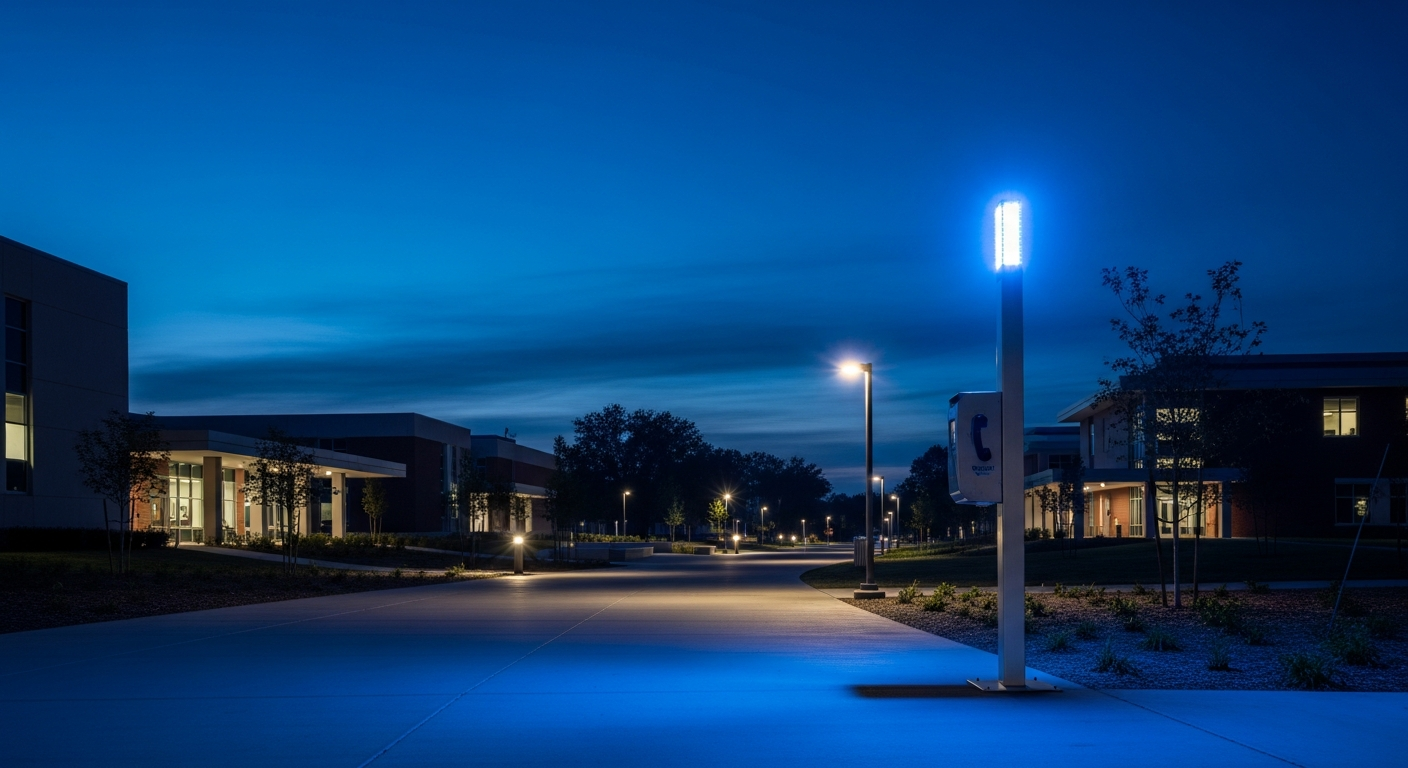
Campus blue light emergency phones represent some of the most visible safety infrastructure an institution can operate. The blue light tower standing at the edge of a parking structure, the wall-mounted emergency call box at the end of a residence hall corridor, the blue light kiosk on a remote campus pathway: these are not just hardware. They are the physical manifestation of a duty-of-care commitment to every student, staff member, and visitor on your grounds.
That commitment only holds if the phone works when someone needs it.
The single most common reason a blue light emergency phone fails to connect a call is not the phone itself. It is the POTS line supplying dial tone to it. Legacy copper infrastructure, much of it buried underground, some of it routed through aging MDFs, all of it subject to corrosion, moisture intrusion, and carrier divestment, is the weakest link in an otherwise durable system. The emergency call box on the wall or the blue light tower stanchion in the parking lot may have decades of service life remaining. The copper pair feeding it may not survive the next weather event.
POTS Link by RCN Technologies solves this at the network layer, not the hardware layer. You replace the POTS line. You keep the phone.
Why Blue Light Emergency Phone and Emergency Call Box POTS Lines Are Failing
A campus blue light emergency phone, whether a free-standing tower, a wall-mounted call station, a parking garage call box, or a pathway kiosk, operates like any other analog device on your network. It expects a standard POTS line: a copper pair carrying analog dial tone, powered by the carrier, with a direct path to the PSTN for 911 dispatch. The station itself is passive. It dials, it rings, it transmits voice. Everything else, the dial tone, the routing, the connection to first responders, depends entirely on that copper pair being intact.
Three structural problems are compressing the lifespan of those copper pairs simultaneously.
Carrier copper retirement. AT&T, Verizon, and most major ILECs have filed or are filing to retire copper wire centers across the country. AT&T’s copper network retirement, which accelerates through late 2026 and beyond, is not a gradual phase-down. In many markets it is a hard cutoff. The FCC’s 2019 forbearance order removed the obligation for carriers to maintain POTS service at regulated rates, and carriers have been raising prices on remaining analog lines by as much as 400 percent while reliability declines. If your blue light emergency phone POTS lines run through an affected wire center, you will receive a disconnect notice, not a migration offer.
Physical infrastructure degradation. Underground copper runs are particularly vulnerable. Buried conduit systems on campuses are often decades old. Water intrusion, ground shift, and oxidation degrade signal quality over time, producing intermittent call failures that are difficult to diagnose and expensive to remediate. A blue light tower or emergency call box that fails two out of ten calls is functionally unreliable, even if it works most of the time.
Rising replacement economics. When a buried copper run fails completely, the remediation cost is not a technician visit. It is excavation. When a carrier retires a wire center, the alternative they offer is rarely priced for a single analog line on a campus safety system. The economic pressure to simply replace the blue phones ignores the fact that the phones themselves are not the problem.
How POTS Link Replaces the Copper Line on Your Blue Light Emergency Phones and Emergency Call Boxes
POTS Link is a managed cellular-to-analog gateway service. It replaces the incoming POTS line with a managed cellular WAN connection and delivers a standard analog dial tone to the end device, your blue light emergency phone, emergency call box, or public emergency phone tower, exactly as if it were still connected to the copper network. The phone does not know the difference. Your dispatch center does not know the difference. The call behavior, the ring cadence, the two-way voice path: all of it is preserved.
RCN deploys POTS Link for blue light emergency phone systems using two configurations depending on the physical topology of your campus infrastructure.
MDF-Based Gateway Deployment
For blue phone stations that are wall-mounted or otherwise connected to a building’s internal wiring, POTS Link is deployed at the closest Main Distribution Frame. The POTS Link gateway sits at the MDF, terminates the cellular WAN uplink, and delivers dial tone over your existing in-building copper run to the blue phone station. The existing cable plant between the MDF and the station remains in service. No changes are made at the phone itself. This is the right deployment for high-density campus environments where multiple blue phone stations route through a common MDF, and where the in-building copper is still intact.
Point-of-Tower Deployment
Free-standing blue light towers and stanchions present a different problem. These units typically sit at the end of a long buried copper run, or in parking lots, pathways, and remote campus locations where trenching a new cable is cost-prohibitive. For these installations, RCN deploys a blue-phone-specific conversion format of POTS Link that mounts directly at the tower. The unit draws power from the tower’s existing electrical supply and delivers cellular dial tone locally, eliminating the buried copper run from the equation entirely.
The point-of-tower unit is IP67-rated, housed in a NEMA 4 enclosure, and includes integrated battery backup supporting 24 hours of active use. It is designed for environments where weather exposure, temperature variance, and physical access limitations are operational realities, which describes most free-standing blue light tower installations.
E911 Compliance: Kari’s Law and RAY BAUM’s Act
Blue phone systems are not exempt from federal E911 compliance obligations. Two laws govern how multi-line telephone systems, which include campus blue phone networks, must route and present emergency calls.
Kari’s Law (effective February 2020) requires that any MLTS allow users to dial 911 directly without a prefix or access code, and that a notification be sent to a central monitoring location whenever a 911 call is placed from the system. Blue phone stations that previously required a carrier-configured direct-dial arrangement must now also trigger on-campus notification. POTS Link is configured to comply with Kari’s Law direct-dial requirements at the gateway level.
RAY BAUM’s Act extends the dispatchable location requirement to 911 calls placed from MLTS systems. This means the call delivered to the PSAP must include a location that enables emergency responders to find the caller, not just a building address, but a specific, actionable location. For campus blue phone systems, this is a meaningful requirement. A call from a parking lot tower should deliver the tower’s location to the dispatcher, not the campus switchboard address.
POTS Link is provisioned and tested for dispatchable location delivery. Each gateway is configured with the physical location of the device it serves, and that location data travels with the 911 call to the PSAP. For point-of-tower deployments, this means the exact stanchion location, GPS-verified during installation, is what the dispatcher sees.
Managed Service, Not Just Hardware
Every POTS Link deployment is a managed service. RCN does not ship a box and walk away. The service includes:
24/7 line monitoring. Every POTS Link gateway is monitored continuously. If the cellular WAN connection degrades or fails, RCN’s network operations center receives the alert, not your facilities team discovering it after a failed call. Proactive fault detection is the operational difference between a managed cellular line and a consumer hotspot.
SLA-backed uptime. POTS Link carries a defined service level agreement for WAN uptime. For campus emergency infrastructure, this is not a marketing differentiator. It is a compliance and liability consideration. Documented uptime performance is what your legal and risk teams need when they ask how you are managing the reliability of life-safety communications.
Flexible carrier architecture with built-in redundancy. Every POTS Link gateway operates with dual SIM slots. SIM slot 2 is always provisioned by RCN with a multi-carrier backup data plan. SIM slot 1 is where institutions have a choice. If your campus has an existing carrier relationship, you can provision SIM slot 1 with that carrier’s data plan and maintain continuity with your current contract and billing structure. RCN manages the backup SIM regardless of what sits in slot 1. For institutions that prefer a fully managed approach, RCN can provision both slots, using its multi-carrier relationships to optimize for coverage at each specific installation site. Every POTS Link deployment runs with automatic failover between SIM slots.
Carrier management. RCN handles all provisioning, SIM logistics, and ongoing carrier account management for the lines it provides. Your facilities or IT team does not manage RCN-provisioned SIM logistics, carrier billing, or line-level configuration changes.
The Capital Avoidance Case
The procurement argument for POTS Link over full blue phone replacement is straightforward, but it is stronger than most facilities managers initially realize.
A modern blue phone station, whether tower-mounted or wall-mounted, represents a capital investment that under normal conditions has a 15-to-25-year useful life. The electronics, the enclosure, the mounting infrastructure, the emergency lighting integration: none of that is degraded by a failing copper pair. When a buried POTS line fails or a carrier retires a wire center, the hardware is not obsolete. The interconnect is.
Replacing a campus blue phone system because the POTS lines are failing is roughly analogous to replacing a building’s fire alarm panel because the phone line feeding the central station monitoring is being disconnected. The panel works. The interconnect does not. The correct answer is to replace the interconnect.
POTS Link replaces the interconnect. The service cost is a fraction of blue phone station replacement, carries no capital expenditure, and preserves the infrastructure investment your institution has already made. For campuses operating under deferred maintenance budgets, this is a meaningful financial argument, not just a technical one.
For higher education institutions subject to Clery Act reporting obligations, demonstrable investment in maintaining functional emergency notification infrastructure is relevant to your annual security report and to how your campus security posture is characterized in that report.
Talk to a POTS Replacement Specialist | (865) 293-0350 | rcntechnologies.com
Frequently Asked Questions
Can a blue light emergency phone or campus emergency call box run on cellular instead of a copper POTS line?
Yes. POTS Link delivers standard analog dial tone to the end device over a managed cellular WAN connection. The blue light emergency phone, call box, or public emergency phone tower receives the same signal it would from a traditional copper pair. No changes are made to the phone hardware, the station firmware, or the physical mounting.
How does POTS Link handle 911 call routing and dispatchable location for blue light emergency phones?
Each POTS Link gateway is provisioned with the physical location of the device it serves. When a 911 call is placed, that dispatchable location is transmitted to the PSAP alongside the call. For point-of-tower deployments, the location is GPS-verified during installation to ensure the dispatcher receives the correct stanchion location.
What happens if the cellular connection on a blue light emergency phone drops mid-call?
POTS Link is a managed service with 24/7 network monitoring. In a dual-SIM deployment, the service will attempt automatic failover to the backup carrier SIM. RCN’s NOC receives fault alerts in real time. The 24-hour battery backup on point-of-tower units ensures the phone remains powered through a temporary power interruption independent of the WAN event.
Can POTS Link replace the POTS line for multiple emergency call boxes through a single MDF gateway?
Yes. MDF-based gateway deployments are designed for exactly this topology. A single gateway can serve multiple blue phone stations routing through the same MDF. The gateway capacity and WAN provisioning are sized to the number of lines served during the engineering phase.
Is POTS Link compliant with Kari's Law and RAY BAUM's Act?
Yes. POTS Link is configured to support direct 911 dialing without prefix codes as required by Kari’s Law, and dispatchable location delivery to the PSAP as required by RAY BAUM’s Act. RCN provisions and tests each deployment against these requirements.
Can we use our existing carrier for the primary SIM in POTS Link?
Yes. If your institution has a preferred or contracted carrier, that carrier’s SIM can occupy slot 1 as the primary data connection. RCN always provisions slot 2 with a multi-carrier backup plan. For institutions that want a fully managed solution, RCN can provision both SIM slots using its multi-carrier relationships, optimized for coverage at each installation location.
How long does a blue light emergency phone POTS line replacement with POTS Link take?
Deployment timelines depend on site complexity and carrier provisioning. A standard MDF-based deployment for a single building is typically completed within a few business days of site survey confirmation. Point-of-tower installations are scheduled based on site access and power verification. RCN provides a project timeline at proposal.
AT&T sent a copper retirement notice for my campus blue light phone lines. What do I do?
Contact RCN immediately. Copper retirement notices come with hard disconnection dates. RCN can expedite deployment to ensure continuity before your current service is terminated. POTS Link is available on GSA Schedule, NASPO ValuePoint, Sourcewell, OMNIA Partners, and Equalis Group cooperative contracts.
About RCN Technologies
RCN Technologies partners with 4,200 businesses & over 1,100 unique government agencies across local, state, education, and federal sectors. We specialize in delivering turnkey wireless connectivity where wired options fall short, and we have the procurement experience to help you find an approved purchasing path fast.
ADDITIONAL POTS REPLACEMENT RESOURCES
Use these resources to deepen your understanding of POTS modernization.

POTS Link Risk Assessment
Uncover hidden costs, risks & inefficiencies in your POTS setup with our 3-min, 15-question VLE Score assessment.

Code Compliant Replacement Bible
Discover how to replace POTS lines without violations or downtime. Get code compliance tips for NFPA 72, ASME A17.1, ADA, and more — free guide.

GSA EIS Guide
Many public sector organizations continue to use POTS for life safety, compliance, and facility management functions–but without a migration strategy, thes…
Speak with a POTS Replacement Specialist
You May Also Be Interested In…

What the FCC Copper Retirement Order Actually Says: A Line-by-Line Breakdown for Government POTS Users
By: Reed Perryman, VP of Sales & Marketing, RCN Technologies Reed Perryman is VP of Sales & Marketing at RCN Technologies with 10 years of experience in POTS line replacement for government agencies, K–12 school districts, and critical infrastructure. He...
The FCC Just Made It Easier to Shut Down Your POTS Lines. Here Is What Government Agencies Need to Do Now.
By: Reed Perryman, VP of Sales & Marketing, RCN Technologies Reed Perryman is VP of Sales & Marketing at RCN Technologies with 10 years of experience in POTS line replacement for government agencies, K–12 school districts, and critical infrastructure. He...
T-Minus 6 Days: What the FCC’s March 26 Vote on Section 214 Means for Every Organization Still on POTS Lines
By: Reed Perryman, VP of Sales & Marketing, RCN Technologies Reed Perryman is VP of Sales & Marketing at RCN Technologies with 10 years of experience in POTS line replacement for government agencies, K–12 school districts, and critical infrastructure. He...